How AI Agents Are Automating Work in 2026
How AI Agents Are Automating Work in 2026
For the past few years, AI tools have been extraordinarily useful assistants. You ask, they answer. You prompt, they produce. The relationship has always been reactive — you initiate, AI responds, and the work moves forward only when you are present to drive it.
That relationship is changing in 2026, and the shift is more significant than most people realize.
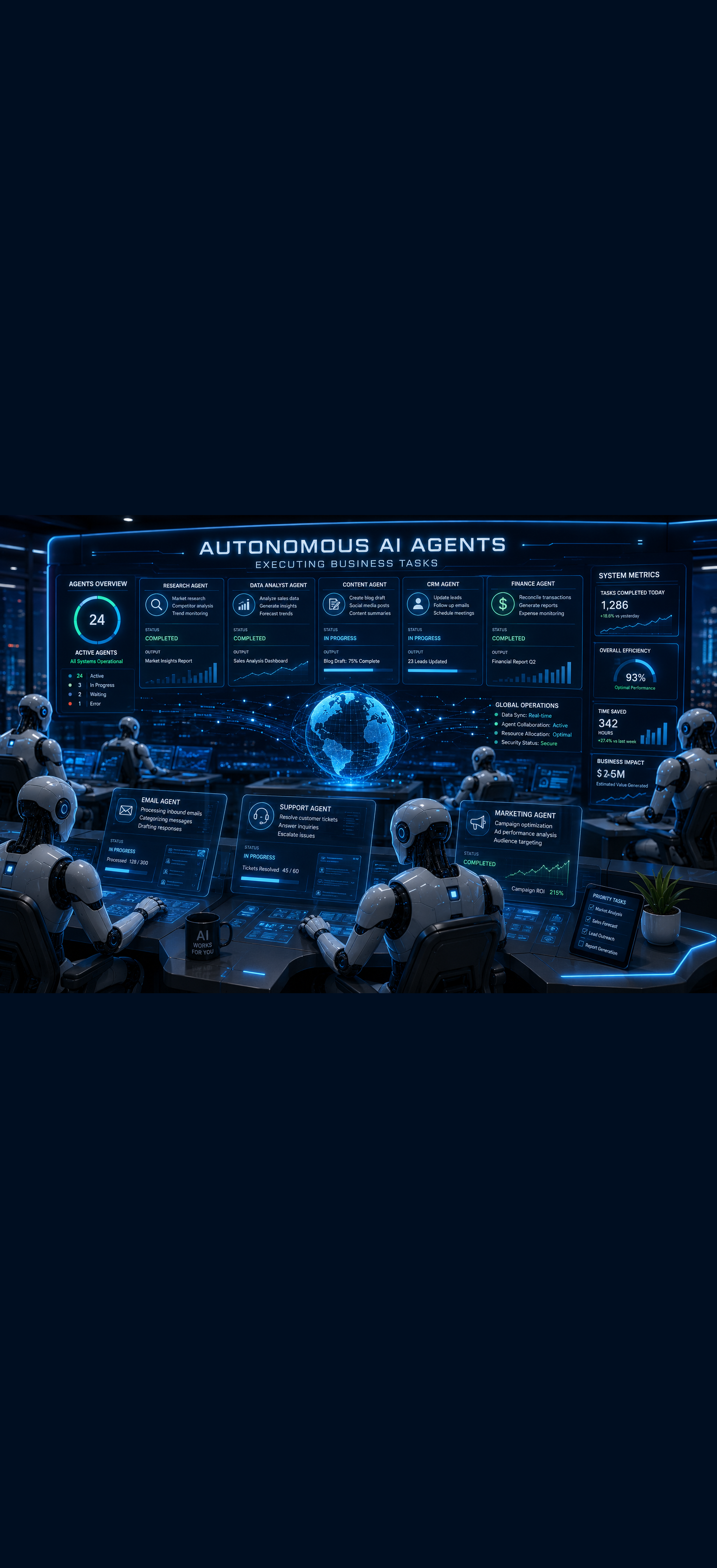
AI agents do not wait for prompts. They take goals, break them into tasks, use tools to execute those tasks, adapt when things do not go as expected, and deliver results — often without any human involvement between the initial instruction and the final output. The difference between a chatbot and an AI agent is the difference between a calculator and an employee.
This guide explains what AI agents actually are, how they are being deployed across industries right now, what this means for professionals and business owners, and how to position yourself to benefit rather than be displaced.
What AI Agents Actually Are
The term AI agent gets used loosely, so it is worth being precise about what it actually means in practice.
An AI agent is an AI system designed to pursue a goal autonomously over multiple steps. Where a standard AI tool responds to a single prompt and stops, an agent:
- Receives a high-level goal or task
- Plans the steps required to complete it
- Uses tools — web search, code execution, file management, API calls, email, databases — to execute each step
- Evaluates its own progress and adjusts when something does not work
- Continues until the goal is achieved or it encounters something requiring human input
The key capabilities that make this possible are tool use, memory, and reasoning. Modern foundation models can reason through complex multi-step problems, maintain context across long workflows, and interact with external systems through APIs. Combined, these capabilities produce systems that can genuinely work independently on meaningful tasks.
How AI Agents Are Being Deployed Right Now
AI agent deployment in 2026 spans a wide range of industries and complexity levels. Here is where the real-world adoption is happening and what it looks like in practice.
Customer Service and Support Automation
Customer service is one of the most active deployment areas for AI agents because the workflows are well-defined, the volume is high, and the tolerance for automation is well-established.
Modern AI customer service agents go far beyond the rule-based chatbots of previous years. They can understand nuanced customer queries in natural language, access customer account data through CRM integrations, execute transactions like refunds and subscription changes, escalate to human agents with full context when situations exceed their capabilities, and learn from resolution patterns over time.
Businesses deploying these agents are seeing dramatic reductions in response time, significant decreases in support ticket volume handled by human agents, and measurable improvements in customer satisfaction scores.
Research and Analysis Workflows
Knowledge work that involves gathering information from multiple sources, synthesizing it into structured analysis, and presenting findings in usable formats is being significantly automated by AI agents.
Financial analysts are deploying agents that monitor market data, aggregate news and reports, run scenario analyses, and produce morning briefings before human analysts arrive at their desks. Market research teams are using agents to survey competitive landscapes, pull product reviews, analyze sentiment, and produce structured reports that would have required weeks of manual work.
The human analyst's role shifts from information gathering to evaluation and decision-making — applying judgment to agent-produced analysis rather than producing the analysis themselves.
Software Development and Code Management
AI coding agents in 2026 can take a written specification, generate working code, run tests, identify and fix bugs, update documentation, and submit pull requests for human review. This has not eliminated software engineering jobs — demand for engineers remains high — but it has fundamentally changed what engineers spend their time doing.
The ratio of software shipped per engineer has increased dramatically, which is why organizations are accomplishing more with the same headcount rather than necessarily reducing it.
Sales and Business Development
Prospecting and lead qualification, CRM data enrichment, personalized outreach sequence management, follow-up scheduling, and pipeline reporting are all being automated by agent systems integrated with sales platforms like Salesforce, HubSpot, and LinkedIn Sales Navigator.
The sales professionals seeing the best results are those who use AI agents to handle top-of-funnel volume work, freeing their time for relationship-building and complex negotiation work that genuinely requires human presence and judgment.
Content Production Pipelines
Marketing teams are deploying AI agent workflows that take a content brief and execute the entire production pipeline: keyword research, outline generation, draft production, SEO optimization, image sourcing, metadata creation, and CMS publishing — all without human involvement at every step.
Human editors review and approve before publication, but the production work that once consumed most of a content team's time is handled by the agent workflow.
Finance and Accounting Operations
Accounts payable and receivable processing, expense categorization, reconciliation, compliance checks, and financial reporting are being handled by AI agent systems integrated with accounting platforms like QuickBooks, NetSuite, and Xero.
For small and medium-sized businesses, this means financial operations that previously required dedicated bookkeeping staff can be managed with AI agent automation and periodic human oversight.
The Architecture Behind AI Agents
Understanding how AI agents work at a structural level helps you use them more effectively and identify where they create the most value.
Single-Agent vs. Multi-Agent Systems
A single AI agent handles a task from start to finish on its own. For focused, well-defined tasks, single agents work well.
Multi-agent systems deploy specialized agents that work in coordination, with each agent handling a specific function and passing outputs to the next. An orchestrator agent might receive a high-level goal, break it into subtasks, assign those tasks to specialist agents, and compile the final output from their contributions.
Multi-agent architectures handle more complex workflows and produce higher-quality outputs for tasks requiring diverse expertise, but they are more complex to build and monitor.
Memory Systems
AI agents use different types of memory to maintain context and build knowledge over time. Working memory holds the context of the current task. External memory stores information in databases the agent can query. Long-term memory accumulates learnings across interactions that improve agent performance over time.
Tool Integration
An agent's capabilities are defined by the tools it can access. Common tools include web search and browsing, code execution environments, file reading and writing, email and calendar systems, CRM and database access, and API connections to external services.
The more relevant tools an agent can access, the more autonomously it can complete complex workflows.
What AI Agent Automation Means for Professionals
The rise of AI agents creates both challenges and significant opportunities for working professionals.
Tasks Being Automated vs. Work Being Elevated
AI agents excel at tasks that are process-driven, information-dense, repetitive at scale, and well-defined. They handle volume, consistency, and speed better than humans in these areas.
AI agents currently struggle with tasks requiring genuine emotional intelligence, complex ethical judgment, creative vision grounded in human experience, novel problem-solving in ambiguous situations, and high-stakes relationship management.
The professionals most at risk are those whose roles consist primarily of the first category. The professionals most positioned to thrive are those who develop skills to work alongside agents — defining tasks, evaluating outputs, handling exceptions, and applying judgment to agent-produced work.
The Rise of the Agent Manager
A new professional role is emerging: the agent manager or AI workflow operator. This professional designs, deploys, monitors, and optimizes AI agent workflows for business processes.
This role does not require deep machine learning expertise. It requires understanding business processes well enough to define agent tasks clearly, technical fluency to work with agent platforms, and judgment to identify when agent outputs need human review or correction.
Productivity Multipliers for Knowledge Workers
For professionals who approach AI agents as amplifiers of their own capabilities, the productivity gains are extraordinary. A consultant using an agent to handle research, data compilation, and initial draft production can deliver more client value in fewer hours than was possible through any other means.
The key mindset shift is moving from "AI is doing my work" to "AI is handling the execution layer so I can focus on the judgment and strategy layer."
Building AI Agent Workflows: Where to Start
Identify Your Best Automation Candidates
Start by listing your most time-consuming, repetitive workflows. The best candidates for AI agent automation share three characteristics: they are well-defined with clear inputs and outputs, they involve information processing rather than physical execution, and they are high-frequency enough that automation creates meaningful time savings.
Start with Existing Agent Platforms
Several platforms make AI agent deployment accessible without engineering resources:
- Zapier AI and Make for building automated workflows with AI decision-making through a visual interface
- Microsoft Copilot Studio for businesses using Microsoft 365 to build custom AI agents
- HubSpot AI Agents for sales and marketing automation integrated directly into CRM workflows
- Claude and ChatGPT with tools enabled for multi-step agentic research, analysis, and content tasks
Start with a single workflow. Implement it carefully. Measure the time savings and output quality. Then expand from there.
Design for Human-in-the-Loop Oversight
The most effective AI agent deployments in 2026 are not fully autonomous. They are designed with strategic human checkpoints where agent outputs are reviewed, approved, or corrected before proceeding.
Build your agent workflows with clear escalation paths, output review steps for high-stakes decisions, and easy correction mechanisms when agents produce errors.
The Ethical and Practical Considerations
Transparency and Accountability
When AI agents interact with customers, partners, or other stakeholders, transparency about that interaction is both an ethical responsibility and an emerging regulatory requirement. Design your agent deployments with clear disclosure practices and maintain human accountability for agent decisions that affect people significantly.
Data Privacy and Security
AI agents that access business data, customer records, and external systems create new data security considerations. Apply least-privilege access principles — agents should access only the data they genuinely need to complete their assigned tasks.
Quality Control Systems
AI agents make mistakes. They can misinterpret instructions, encounter unexpected situations, and produce outputs that require correction. Build quality control checkpoints into every agent workflow. Never deploy an agent in a customer-facing or high-stakes context without tested review mechanisms.
Staff Communication and Change Management
Introducing AI agent automation in a team environment requires honest communication about what is changing, why, and what it means for roles. Organizations that handle this transparently and focus on how automation frees people for higher-value work achieve better outcomes than those who introduce automation without context.
Conclusion: Agents Are Not the Future — They Are the Present
The conversation about AI agents often sounds like speculation about what might happen someday. The reality is that AI agents are automating meaningful business processes right now, in real organizations, producing measurable results.
The professionals and entrepreneurs who understand how AI agents work, where they create the most value, and how to build workflows around them are accumulating productivity advantages that will compound significantly over the next few years.
You do not need to build AI systems from scratch to benefit from this shift. You need to understand it clearly enough to identify the right automation opportunities in your own work, deploy available tools effectively, and position your skills on the judgment and strategy side of the human-AI collaboration.
The work is changing. The question is whether you are changing with it.
Want more insights like this? Subscribe to the AI Success Forum newsletter.