The AI-Powered Resume Strategy That Gets More Interviews
The AI-Powered Resume Strategy That Gets More Interviews
Most resumes never get read by a human. They get filtered, scored, and discarded by an applicant tracking system before a single recruiter lays eyes on them. If your interview rate is lower than you expect, your resume strategy is likely the problem, not your qualifications.
The good news is that AI tools have fundamentally changed what is possible for job seekers who know how to use them. With the right AI-powered resume strategy, you can tailor every application with precision, pass automated filters consistently, and present yourself in a way that compels hiring managers to reach out.
This guide shows you exactly how to build that strategy from the ground up.
Why Most Resumes Fail Before Anyone Reads Them
Before you can fix your resume, you need to understand why it is not working.
Most companies with more than 50 employees use an Applicant Tracking System (ATS) to manage applications. These systems scan your resume for specific keywords, formatting compatibility, and relevance signals before passing it to a human reviewer. A resume that looks polished in a PDF viewer can be completely unreadable to an ATS if the formatting is wrong.
Beyond ATS issues, most resumes fail because they are written once and sent everywhere. Generic resumes do not speak to the specific role. They do not mirror the language of the job description. They do not lead with what the employer actually cares about.
AI tools solve both problems when used correctly.
Step One: Build a Master Resume First
Before you use any AI tool, you need a strong foundation to work from. This is your master resume, a comprehensive document that includes everything: every role, every achievement, every skill, every metric, every project.
This document is not what you send to employers. It is your raw material. Think of it as your professional inventory.
Include every quantifiable result you can remember:
- Revenue generated or costs reduced
- Team sizes managed
- Projects delivered on time and under budget
- Percentage improvements in key metrics
- Tools and platforms you have worked with
The more detail you capture here, the better your AI-assisted applications will be. AI tools can only work with what you give them. Vague input produces vague output.
Step Two: Use AI to Analyze Job Descriptions Like a Recruiter
This is where your AI-powered resume strategy begins to separate you from the competition.
Take the job description you are targeting and paste it into a tool like ChatGPT, Claude, or a specialized resume tool like Jobscan or Teal. Ask it to identify:
- The top five to eight skills the employer is prioritizing
- The exact language and terminology used repeatedly
- The implied experience level and type of background they want
- Any qualifications listed as preferred versus required
This analysis takes two minutes and reveals the lens through which every application will be evaluated. Most job seekers read a job description once and start writing. You are going to study it like a document before drafting a single word.
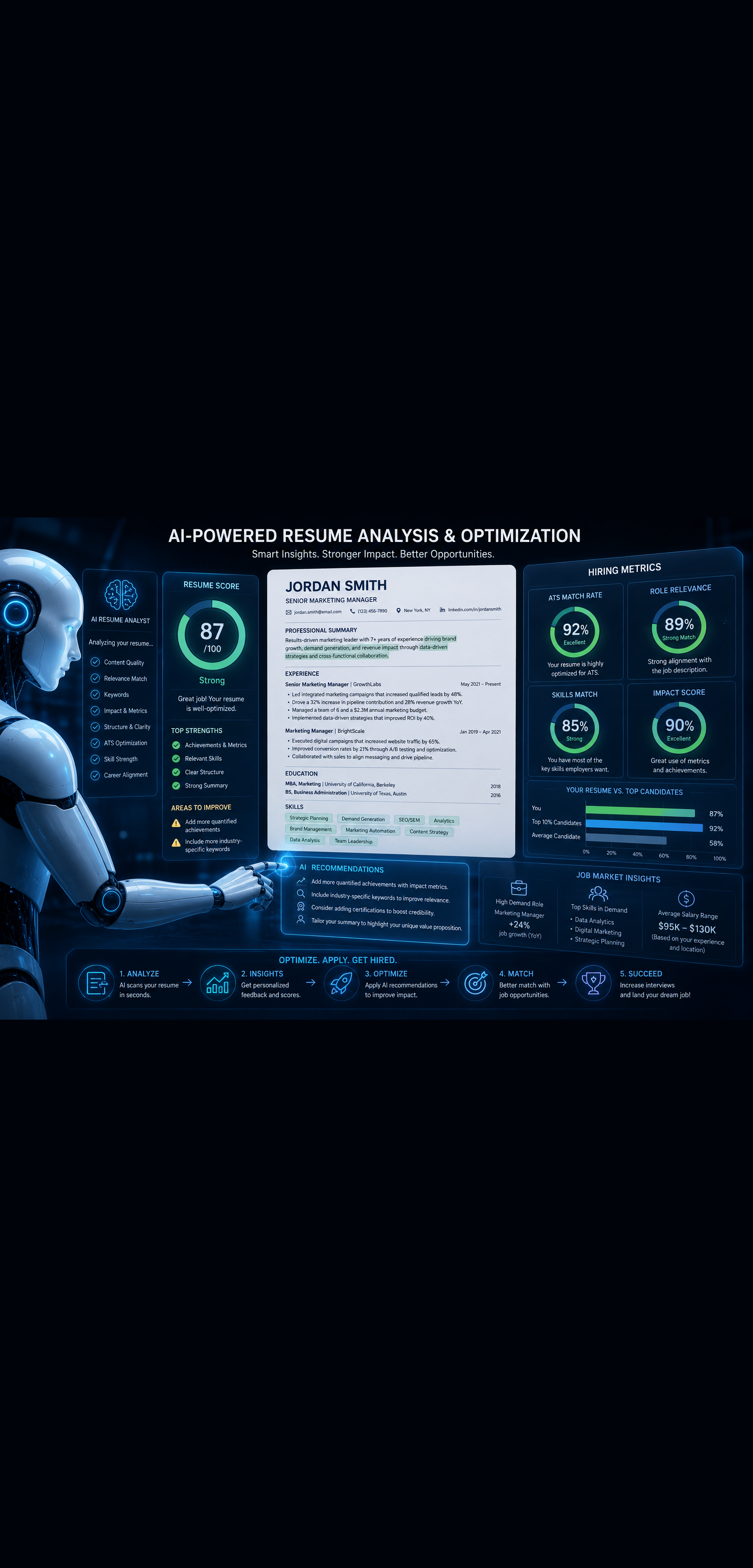
Tools like Jobscan specifically compare your resume against a job description and give you a match score with detailed recommendations. It is one of the most practical AI tools for job seekers available today and can meaningfully increase your ATS pass rate when used consistently.
Step Three: Tailor Your Resume With AI Assistance
Now take your master resume and the job description analysis and use AI to help you tailor your content for this specific role.
A prompt that works well in ChatGPT or Claude:
"Here is my master resume [paste resume]. Here is the job description [paste JD]. Rewrite my professional summary and top three to four bullet points under my most recent role to align with this position. Use the language from the job description where it accurately reflects my experience. Keep it honest and achievement-focused."
What comes back will not be perfect on the first pass. Your job is to review it critically, adjust anything that does not accurately reflect your experience, and add specificity that only you can provide.
AI handles the structural alignment and language mirroring. You handle the accuracy and authenticity. That combination is far more powerful than either approach alone.
The AI-Powered Resume Strategy for Your Professional Summary
Your professional summary is the highest-value real estate on your resume. It is the first thing a human reads after your name and title. Most people write a generic three-line paragraph that says almost nothing memorable.
Use AI to write a summary that does three things in four to five lines:
- Names your professional identity clearly
- Highlights your most relevant achievement or specialty for this role
- Signals what you bring to this specific type of organization
Here is the difference between a weak summary and a strong one:
Weak: "Experienced marketing professional with a background in digital strategy and content creation seeking a new opportunity to contribute to a growing team."
Strong: "Digital marketing strategist with 7 years driving B2B pipeline growth through SEO, paid acquisition, and content programs. Increased organic traffic 140% at a Series B SaaS company. Known for bridging creative direction and performance data to deliver campaigns that convert."
The second version is specific, achievement-anchored, and speaks directly to what a B2B marketing hiring manager cares about. AI can help you get there faster, but you need to feed it the right inputs.
Step Four: Optimize for ATS Without Keyword Stuffing
Passing an ATS is not about cramming keywords into your resume. It is about using the right language in the right context so both the system and the human reviewer find your experience credible and relevant.
Here is how to optimize intelligently:
- Mirror the job title language. If the posting says "Customer Success Manager" and your current title is "Client Relations Lead," add a parenthetical or mention the equivalent terminology in your bullet points where accurate.
- Use skills in context. Do not list "Salesforce" in a skills section and nowhere else. Mention it in a bullet point that shows how you used it.
- Avoid tables, text boxes, and graphics. Many ATS systems cannot parse these correctly. Stick to clean, single-column formatting with standard section headers.
- Save in the right format. Unless the posting specifies otherwise, submit as a .docx file. Some ATS systems parse Word documents more reliably than PDFs.
Tools like Teal and Resume Worded can run an automated ATS audit on your resume and flag formatting or keyword issues before you submit. Running this check takes five minutes and can be the difference between getting filtered out and getting a callback.
Step Five: Use AI to Write Targeted Cover Letters Fast
Cover letters are not dead. In competitive roles, a well-written cover letter that speaks directly to the company's challenges and your specific fit can be the reason you get chosen over an equally qualified candidate.
The problem is that most people either skip the cover letter or write one generic version they copy-paste everywhere. Neither approach works.
AI makes it practical to write a tailored cover letter for every application in under 15 minutes. Use this prompt structure:
"Write a cover letter for [Job Title] at [Company Name]. My background: [paste two to three relevant bullet points from your resume]. The role requires: [paste key requirements from JD]. The company's focus is [note their mission or recent news]. Keep it to three paragraphs, professional but direct, no clichés."
Review the output, inject your voice, add a specific detail about the company that shows you did your research, and cut anything that sounds generic. A cover letter that feels personal and specific is a signal that you are genuinely interested in this role, not just mass-applying.
Step Six: Track Applications and Iterate
An AI-powered resume strategy is not a one-time event. It is a system you improve over time based on real data.
Track every application you submit:
- The role and company
- The match score from your ATS tool
- Whether you received a response
- What stage you reached in the process
After 10 to 15 applications, patterns will emerge. If you are getting ATS rejections, your keyword alignment needs work. If you are getting interviews but not advancing, the resume is working but your interview preparation needs attention. If you are getting responses only from certain types of roles, that tells you something important about where your resume is strongest.
Tools like Teal's Job Tracker and Notion work well for managing this process. The goal is to treat your job search like a performance system with inputs you can measure and adjust.
Common Mistakes That Undermine an AI Resume Strategy
Even with the right tools, these mistakes will limit your results:
- Accepting AI output without editing. AI produces a starting point, not a finished product. Always review for accuracy, tone, and specificity.
- Using the same tailored resume for similar but different roles. Two roles with the same title at different companies often want very different things. Tailor each one.
- Over-optimizing for ATS at the expense of readability. If your resume passes the ATS but reads like a keyword list to a human, it will not convert to an interview.
- Ignoring your LinkedIn profile. Recruiters will check your LinkedIn immediately after seeing your resume. Make sure both are consistent and equally compelling. AI tools like LinkedIn's own writing assistant or Claude can help you optimize your profile summary and experience sections as well.
Final Thoughts
The job market in 2026 is competitive and increasingly filtered by technology. But that same technology is available to you as a job seeker, and the professionals who learn to use it strategically are winning more interviews, faster, with less wasted effort.
Your resume is not a static document. It is a living sales asset that should evolve with every application, every piece of feedback, and every shift in your target market. Build your master resume, study every job description, use AI to tailor and optimize, and track your results like a campaign.
The interviews are there. A smarter strategy is what gets you in the room.
Want more insights like this? Subscribe to the AI Success Forum newsletter.