AI Is Not Taking Your Job—Someone Using AI Might
AI Is Not Taking Your Job-Someone Using AI Might
Every few months, a new wave of headlines declares that AI is coming for your job. Lawyers, accountants, writers, analysts, designers, developers. The list grows longer with each model release and every breathless news cycle.
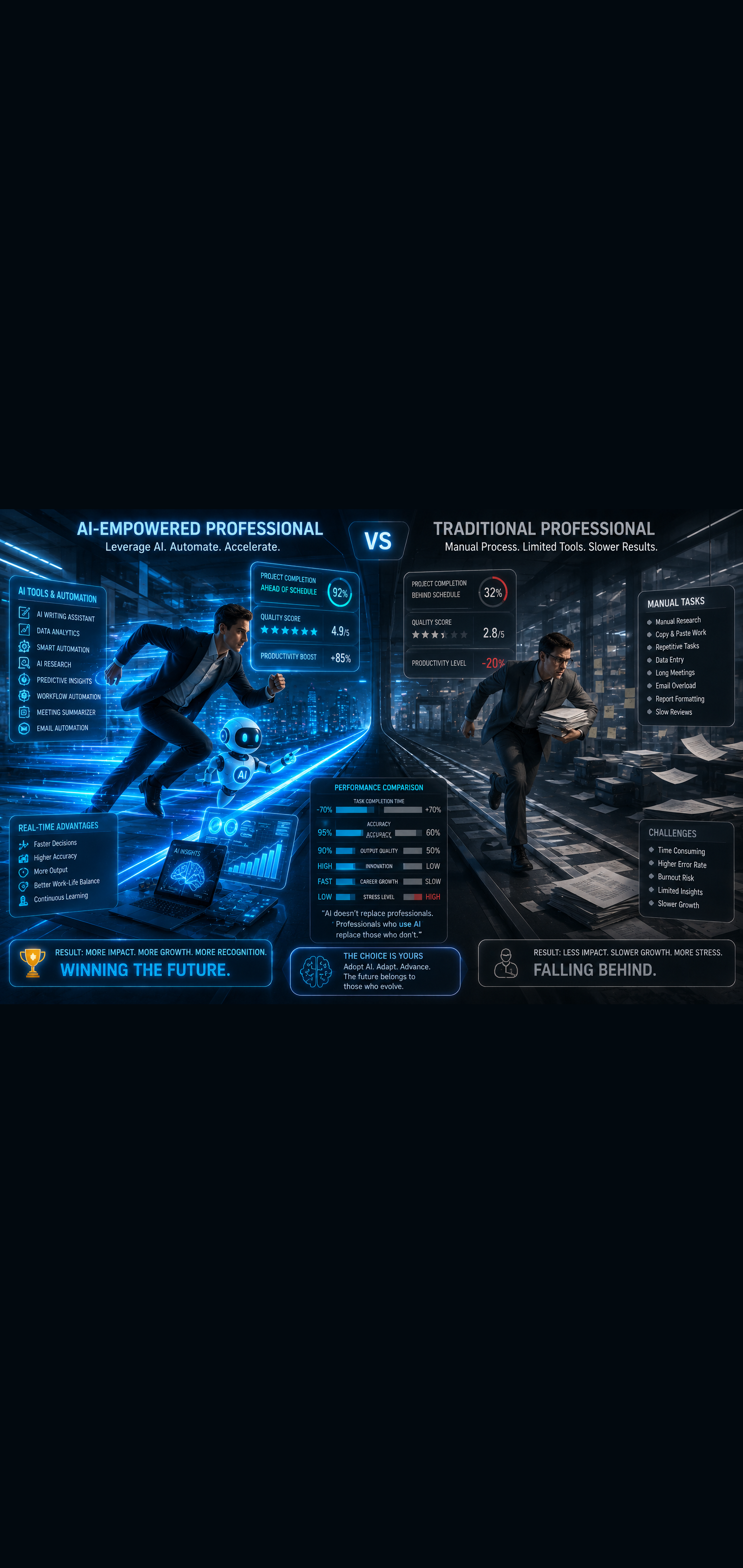
Here is the more honest framing: AI is not going to walk into your office and take your seat. But a professional who uses AI to do what you do, faster, cheaper, and at higher volume, absolutely might.
That distinction is not semantic. It changes everything about how you should be thinking about your career right now.
The Real Threat Is Not the Technology
The conversation about AI and employment has been stuck in the wrong frame for years. People debate whether AI is smart enough to replace humans, whether it truly understands language, whether it can be creative. These are interesting philosophical questions. They are largely irrelevant to your career.
The relevant question is simpler: can someone else use AI to deliver what you deliver, at a level that is good enough for the market, faster and at lower cost than you can?
In many cases, the answer is already yes. Not because AI is superior to human expertise. Because a capable professional armed with the right AI tools has a leverage advantage that compounds over time.
A copywriter using AI can produce three times the output in the same hours. A financial analyst using AI-powered research tools can cover more ground with greater consistency. A developer using an AI coding assistant can ship features faster and catch errors earlier. The output quality may not always be higher. But the speed, volume, and cost efficiency often are.
That is the competitive reality you are operating in, whether you acknowledge it or not.
Why AI Fear Is Holding Professionals Back
Fear of AI is understandable. Any technology that changes the rules of your profession is unsettling. But fear without action is the worst possible response to this shift, and it is the most common one.
Professionals who are afraid of AI tend to do one of two things. They ignore it, hoping their experience and relationships will insulate them long enough that the disruption passes. Or they dismiss it, leaning on arguments about AI's limitations rather than adapting to its capabilities.
Both responses have the same outcome. They leave you standing still while the professionals around you move forward.
The irony is that most of the people worried about AI replacing them have not spent meaningful time actually using AI tools in their work. They are afraid of something they have not tested. And the ones who have tested it, who have integrated AI into their daily workflow and seen what it actually does, are almost universally less afraid and far more focused on opportunity.
Adoption, not avoidance, is where career security lives in the AI economy.
What AI Adoption Actually Looks Like in Practice
AI adoption is not about becoming a technologist or learning to code. For most professionals, it means integrating a handful of well-chosen tools into your existing workflow in ways that meaningfully increase your output quality, speed, or both.
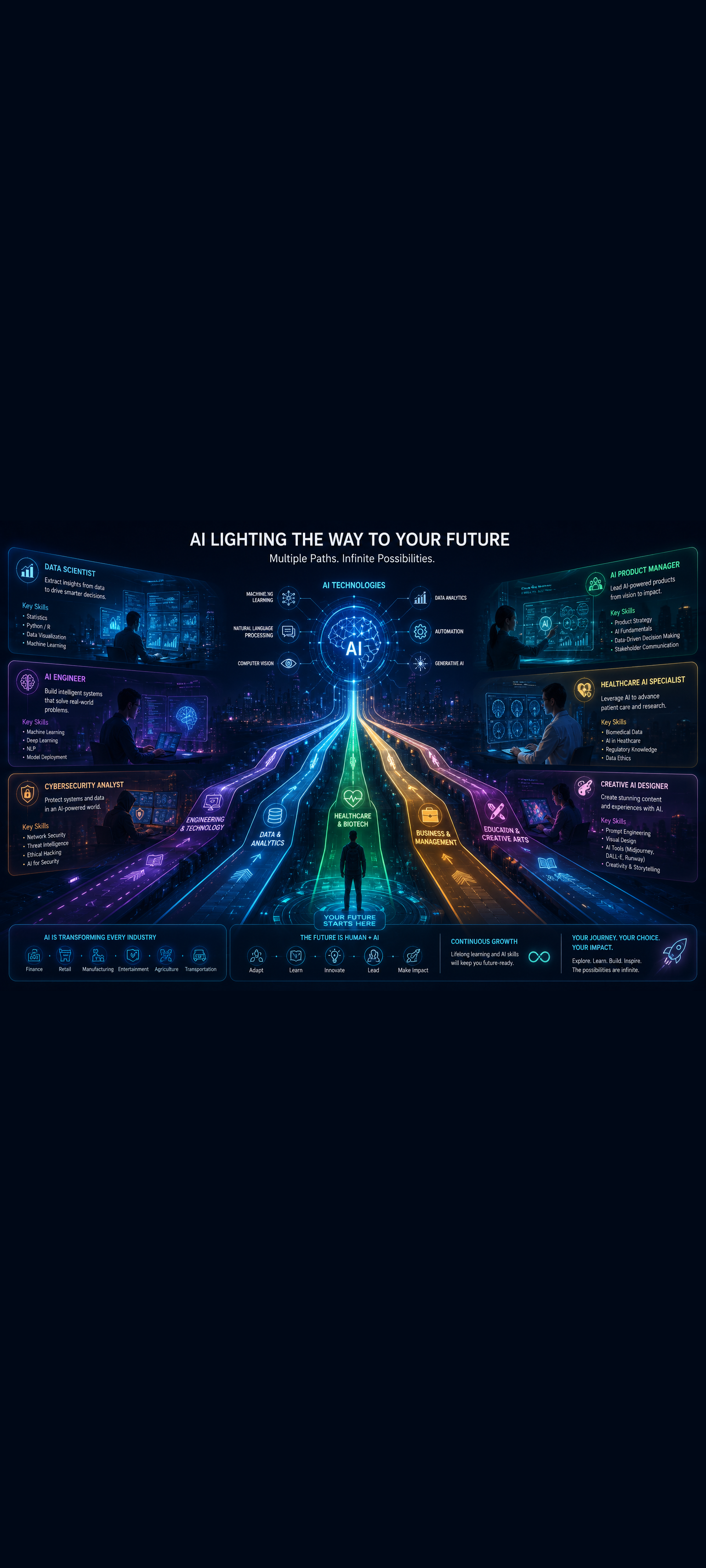
Here is what that looks like across different roles:
For writers and content creators: Using AI to generate first drafts, research angles, repurpose content across formats, and edit for clarity and tone. The human contribution shifts from execution to editorial direction, strategy, and voice.
For analysts and researchers: Using AI-powered tools to process large volumes of data, surface patterns, generate report drafts, and synthesize findings from multiple sources. The human contribution shifts to interpretation, judgment, and stakeholder communication.
For developers and engineers: Using AI coding assistants to write boilerplate, debug errors, generate documentation, and explore unfamiliar codebases. The human contribution shifts to architecture decisions, code review, and complex problem solving.
For salespeople and client-facing professionals: Using AI to research prospects, personalize outreach, prepare for meetings, and draft proposals. The human contribution shifts to relationship building, negotiation, and trust development.
For managers and leaders: Using AI to draft communications, analyze team performance data, prepare presentations, and stay current on industry developments. The human contribution shifts to vision, culture, and decision-making under ambiguity.
In every case, the professional does not disappear. Their role evolves. And the professionals who embrace that evolution are consistently outperforming those who resist it.
The Compounding Advantage of Early AI Adoption
There is a compounding dynamic to AI adoption that most people underestimate.
When you start using AI tools in your work, the initial gains are real but modest. You save some time here. You produce better output there. The advantage over non-adopters is noticeable but not dramatic.
Six months later, the gap is larger. You have learned which tools work best for which tasks. You have developed prompting skills that consistently produce high-quality outputs. You have redesigned parts of your workflow around AI capabilities. You are doing things that were not possible before, not just doing the same things faster.
Twelve months in, you are operating in a genuinely different league. Your output volume, quality, and consistency have all improved. You have built a reputation for delivering more with less. You are the person your organization turns to when they want to understand how AI can be applied to a new challenge.
The professional who started adopting AI tools a year before you is already at month twelve. That gap does not close easily. The compounding nature of skill and workflow development means that early movers hold structural advantages that late adopters spend years trying to recover.
The time to start is not when AI adoption becomes obviously necessary. It is now, while the advantage is still available.
How to Stay Competitive in an AI-Augmented Market
Staying competitive does not require a complete reinvention of your professional identity. It requires a deliberate strategy applied consistently over time. Here is where to focus.
Audit Your Current Workflow Honestly
Start by mapping out the tasks that make up your working week. Which of these are repetitive, structured, or information-heavy? These are the highest-priority targets for AI augmentation because they are where AI tools deliver the most immediate and measurable benefit.
Which tasks require genuine human judgment, relationship navigation, or creative originality? These are your core differentiators, the areas where you should be spending more of your time as AI handles more of the routine work.
The audit itself often reveals that a significant portion of your working hours are consumed by tasks that AI could handle at 80 to 90 percent of your quality, at a fraction of the time. That is not a threat. It is an opportunity to redirect your energy toward higher-value work.
Pick Two or Three Tools and Go Deep
The instinct when starting with AI is to try everything. Resist it. Surface-level familiarity with many tools produces far less value than genuine proficiency with a few.
Identify the two or three tools most relevant to your role and commit to mastering them over the next 60 to 90 days. For most knowledge workers, starting with a powerful language model like Claude or ChatGPT covers a large portion of use cases. Add one domain-specific tool after that.
Real proficiency means understanding not just what a tool can do but how to get consistently excellent outputs from it, where it tends to fail, and how to verify and improve its work. That level of fluency takes time and deliberate practice, which is exactly why most casual adopters never achieve it and why those who do hold a durable advantage.
Develop Your AI Prompting Skills
Prompting is the new literacy of the AI economy. The quality of what you get from an AI tool is directly proportional to the quality of the input you provide.
Professionals who invest in developing their prompting skills consistently report dramatically better outputs than those who use default, unstructured prompts. This is a learnable skill with a relatively short learning curve and an outsized impact on your productivity and output quality.
Study prompt engineering principles. Experiment systematically. Build a personal library of prompts that work well for your most common tasks. This library becomes a professional asset that compounds in value over time.
Position Yourself as an AI-Fluent Professional
The market is beginning to differentiate clearly between professionals who are AI-fluent and those who are not. This distinction shows up in hiring decisions, promotion considerations, consulting engagements, and client preferences.
Make your AI fluency visible. Mention it in your LinkedIn profile and resume. Reference it in job interviews and client conversations. Write about how you use AI in your work, what results it has produced, and what you have learned. Visible expertise in AI adoption is a meaningful signal to any employer or client evaluating your candidacy.
This does not mean overstating your capabilities. It means accurately representing a genuine and growing competency that sets you apart from peers who have not made the same investment.
Keep Your Human Skills Sharp
AI fluency is the multiplier. Human skills are still the foundation. The professionals who are thriving in the AI economy are not the ones who have replaced their judgment with AI outputs. They are the ones who use AI to handle the volume while they focus their human capabilities on the decisions that actually matter.
Critical thinking, creative judgment, ethical reasoning, relationship intelligence, and communication remain the core of professional value. Invest in these skills alongside your AI adoption. They are what ensure that your AI-augmented output is genuinely better, not just faster.
The Mindset Shift That Changes Everything
Underneath all of this is a mindset question. How do you relate to AI as a professional?
If you see it as a threat, you will approach it defensively. You will look for reasons it cannot do what you do. You will minimize its capabilities and overstate its limitations. And while you are doing that, the professionals around you will be figuring out how to use it.
If you see it as a tool, you will approach it pragmatically. You will test it, learn its strengths and weaknesses, and integrate it where it helps. This is the right frame, but it still underestimates the opportunity.
The most productive mindset is to see AI as a force multiplier for your existing expertise. It does not replace what you know. It amplifies how much you can do with it. The more genuine expertise you bring to the table, the more powerful your AI-augmented output becomes.
Professionals with deep domain knowledge and strong AI fluency are not competing with AI. They are operating at a level that neither AI alone nor their non-adopting peers can match.
That is not a threat to manage. It is an advantage to build.
Final Thoughts
AI is not your competition. The professionals who are learning to use it effectively are. And the gap between those who adopt early and those who wait is widening every quarter.
The path forward is not complicated. Audit your workflow. Choose your tools. Build your prompting skills. Position your AI fluency visibly. Keep developing the human capabilities that AI cannot replicate. Do all of this consistently and you will not just survive the AI economy. You will be one of the professionals others are trying to keep up with.
Start this week. Not next quarter. This week.
Want more insights like this? Subscribe to the AI Success Forum newsletter.