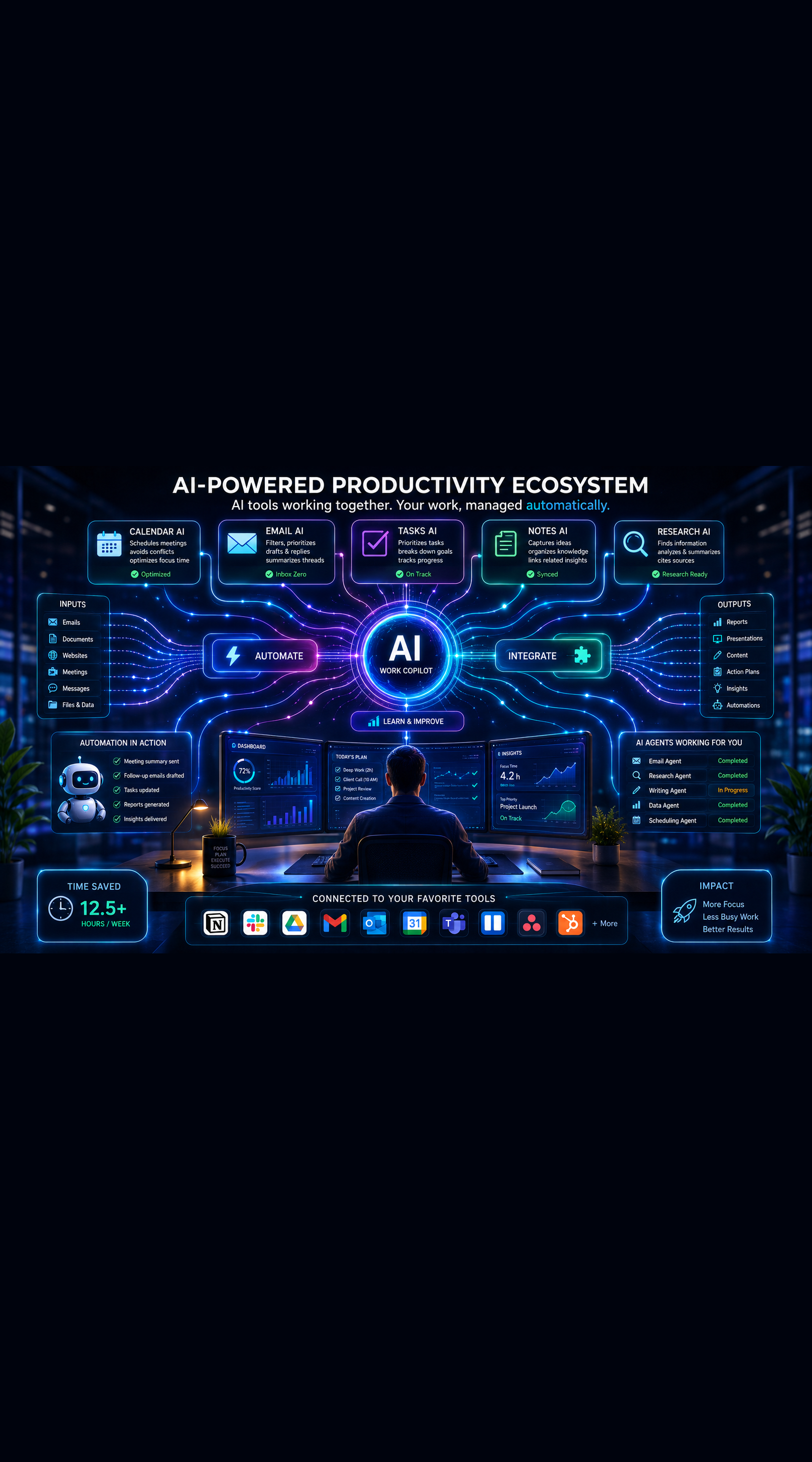
The AI-Powered Morning Routine for Peak Performance
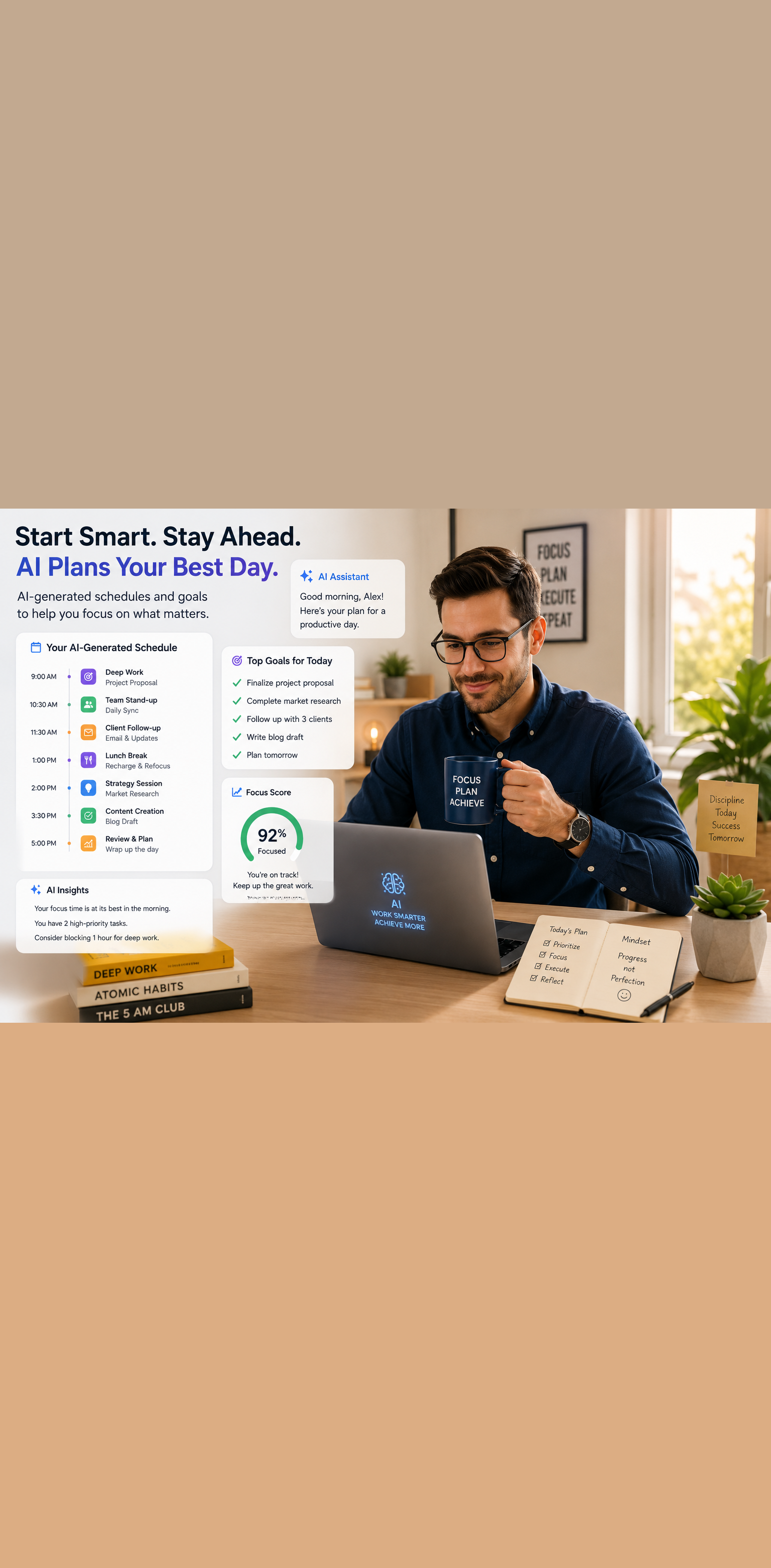
The AI-Powered Morning Routine for Peak Performance
How you start your morning determines the trajectory of your entire day. This is not motivational folklore. It is a pattern that high performers across every field have validated through decades of deliberate habit design. The first 60 to 90 minutes after waking set your cognitive tone, your emotional baseline, and your productivity momentum for everything that follows.
What AI has changed is not the importance of a strong morning routine. It has changed how precisely, how personally, and how efficiently you can design and execute one. The right combination of AI planning tools, habit tracking systems, and intelligent scheduling assistants can turn a vague intention to have a better morning into a structured, optimized routine that compounds in value every single day.
This guide shows you exactly how to build an AI-powered morning routine for peak performance, from the moment your alarm goes off to the moment you sit down for your first focused work session.
Why Most Morning Routines Fail and How AI Fixes the Problem
Most professionals have attempted a morning routine at some point. Most of those attempts lasted between one and three weeks before dissolving back into reactive, chaotic mornings driven by notifications, urgent emails, and the constant feeling of being behind before the day has even started.
The failure is almost never a motivation problem. It is a design problem. Generic morning routines borrowed from productivity books or social media are built for someone else's life, someone else's schedule, and someone else's cognitive and physical rhythms. When they do not fit your reality, they collapse under the friction of execution.
AI solves the design problem in three specific ways.
Personalization at a level that generic advice cannot achieve. AI tools can help you design a routine built around your specific goals, your actual schedule constraints, your identified energy patterns, and your realistic commitments rather than an idealized version of a morning that no one you know actually lives.
Adaptive optimization over time. A morning routine that was perfect in January may not be optimal in June as your projects, priorities, and energy patterns shift. AI tools that track your habits and performance can surface these misalignments before they cause the routine to break down entirely.
Intelligent scheduling that protects your morning. AI calendar tools can actively defend your morning routine blocks against meeting invitations, work requests, and competing commitments that would otherwise erode your protected time without you noticing until it is already gone.
Step One: Define What Peak Performance Means for You
Before designing any routine, you need clarity on what you are optimizing for. Peak performance looks different for a founder building a company, a professional managing a demanding corporate role, a creative building an audience, and a parent balancing career and family responsibilities.
Use Claude or ChatGPT to run a structured self-assessment. Prompt the tool with your specific context: your professional role, your most important current goals, your identified strengths and energy patterns, and the outcomes you most want your morning routine to support. Then ask it to help you define what a peak performance day actually looks like for you specifically.
A prompt that works well for this exercise:
"I am a [professional role] working on [key goals]. My most important work involves [type of deep work]. I tend to have [describe your energy pattern, for example high energy mornings and low energy early afternoons]. Help me define what peak performance looks like for a typical day and what my morning routine should be optimizing for."
The output gives you a personalized framework to design against rather than a generic aspiration. This step takes 20 minutes and significantly improves the quality of everything that follows.
Step Two: Map Your Energy Patterns With Data
The most common mistake in morning routine design is scheduling the wrong activities for the wrong times. Trying to do deep creative work during your natural low-energy window does not just feel hard. It produces objectively lower-quality output than the same work done during your peak cognitive window.
AI-assisted habit tracking tools can help you identify your actual energy patterns rather than the ones you assume you have.
Oura Ring combined with its AI analysis features tracks sleep quality, heart rate variability, body temperature, and activity data to generate a daily readiness score and personalized recommendations for when your body is primed for high-intensity cognitive work versus when recovery activities are more appropriate.
Whoop offers similar physiological tracking with AI-powered coaching that adapts to your biometric patterns over time and provides specific guidance on training, recovery, and performance optimization.
If wearable tracking is not your preference, Reclaim.ai and Clockwise analyze your calendar and work patterns to identify when you tend to be most productive and protect those windows automatically.
Even without dedicated tracking tools, spending one week logging your energy level on a simple one to ten scale every two hours using a tool like Notion or Apple Notes gives you enough pattern data to make meaningful decisions about when to schedule which types of activities.
Step Three: Design Your Morning Routine Blocks
With your performance goals defined and your energy patterns mapped, you are ready to design the actual structure of your morning. A high-performance AI-powered morning routine typically contains five distinct blocks, though the length and sequence of each should reflect your personal data and constraints.
Block One: Physical Activation
Your brain functions significantly better after physical movement. This is not an opinion. It is well-established neuroscience. Exercise increases blood flow to the prefrontal cortex, releases BDNF which supports neural plasticity and focus, and regulates cortisol in a way that improves stress resilience throughout the day.
Your physical activation block does not need to be an hour-long workout. Research supports that even 20 to 30 minutes of moderate intensity movement produces significant cognitive benefits. What matters is consistency and intentionality.
Use AI tools to design a physical routine matched to your current fitness level, available time, and equipment access. ChatGPT or Claude can generate a personalized weekly movement plan based on your specific inputs. Apps like Whoop and Oura can recommend optimal workout intensity based on your overnight recovery data, helping you train hard when your body is ready and scale back when it needs restoration.
Block Two: Mindset and Mental Preparation
The transition from sleep to peak cognitive performance is not instantaneous. Your brain needs time to shift from the diffuse, restorative state of sleep to the focused, analytical state required for high-value work.
Mindset preparation activities that support this transition include meditation or breathwork, journaling, reading in your field, or a structured reflection practice. The right choice depends on your personal inclination and what your data suggests about your morning cognitive state.
AI tools can enhance this block in practical ways. Headspace and Calm both use AI to personalize meditation recommendations based on your usage patterns and stated goals. For journaling, Claude or ChatGPT can serve as a structured thinking partner, helping you clarify your intentions for the day, process any concerns that are occupying mental space, and identify the single most important outcome you want to achieve before the day ends.
A simple daily journaling prompt that works consistently:
"What is the one outcome that would make today a success? What is the first concrete action that moves me toward it? What obstacle is most likely to get in the way and how will I handle it?"
Block Three: AI-Assisted Daily Planning
This is the block where AI tools provide the most direct and measurable value. Fifteen minutes of intelligent daily planning at the start of each morning produces dramatically better outcomes than reactive task management throughout the day.
Reclaim.ai automatically schedules your tasks based on priority, deadline, and available calendar space. It reschedules intelligently when plans change, protects your focus blocks against meeting creep, and learns your preferences over time.
Motion uses AI to build your daily schedule dynamically, continuously reprioritizing your task list based on deadlines, meeting commitments, and work estimates. When something new comes in, it recalculates your entire day automatically rather than requiring you to manually shuffle priorities.
For professionals who prefer a more hands-on approach, a daily planning session with Claude or ChatGPT can be equally effective. Share your task list, your meeting schedule, and your most important goal for the day, and ask the tool to help you structure your available time in a sequence that protects your peak cognitive hours for your highest-value work.
Block Four: Deep Work Sprint
The first focused work session of the day is your highest-value cognitive asset. Your willpower, decision-making capacity, and creative output are all at their peak in the early part of the day for most people. Protecting this window for your most important, most cognitively demanding work is the single highest-leverage habit in a peak performance morning routine.
What constitutes deep work varies by profession. For a writer, it is drafting. For a developer, it is architecture and complex problem solving. For a strategist, it is the analysis and thinking that requires sustained concentration. The common thread is that it is the work that produces the highest value and that suffers the most from interruption and distraction.
AI tools support this block not by being active within it but by doing work before it starts. When your planning session is complete, your tasks are prioritized, your focus block is protected on your calendar, and your most important work is clearly defined, you sit down to deep work with zero decision overhead. The friction of starting is eliminated. The work begins immediately.
Freedom and RescueTime can block distracting websites and applications automatically during your deep work window. Focusmate provides virtual coworking accountability that many professionals find dramatically improves follow-through on deep work commitments.
Block Five: Communication and Reactive Work
After your deep work sprint is complete, open communication. This is when you process email, respond to messages, handle requests, and attend to the reactive elements of your role that require attention but not your peak cognitive state.
AI tools make this block significantly more efficient. Superhuman uses AI to prioritize your inbox and surface the messages that require your attention first. SaneBox learns your email habits and automatically filters low-priority messages out of your main inbox. Gmail's AI drafting features and Claude can generate response drafts for complex emails in seconds, reducing the cognitive load of communication management.
The key principle is sequencing: deep work before email, always. The moment you open your inbox before completing your most important work, you have handed control of your attention to everyone else's priorities rather than your own.
Step Four: Use AI to Build and Protect Your Routine
Designing a strong morning routine is only half the challenge. Maintaining it against the constant pressure of competing demands is where most routines eventually break down.
Calendar Blocking and Defense
Use a tool like Reclaim.ai, Clockwise, or Google Calendar's scheduling features to block your morning routine components as recurring events that are protected against automatic meeting scheduling.
Communicate your morning blocks clearly to colleagues and clients. Most scheduling tools allow you to mark blocks as unavailable for meetings without explaining why. Use this feature consistently. Your deep work window and physical activation block should be as difficult to schedule over as a client meeting.
Habit Tracking With AI Accountability
Habitica, Streaks, and Notion with a custom habit tracker can provide the accountability and visual progress feedback that sustains consistency over time. AI-powered tools like Rosebud combine journaling and habit tracking with AI insights that surface patterns in your consistency data and help you understand what conditions support your best mornings versus what tends to derail them.
Review your habit tracking data weekly. Are there specific days when your routine consistently breaks down? Specific weeks in your monthly cycle? Specific types of commitments that reliably disrupt your mornings? This data helps you proactively protect against your most common failure modes rather than reacting to them after the fact.
Adaptive Optimization With AI Assistance
Schedule a monthly routine review using Claude or ChatGPT. Share your habit tracking data, your performance observations from the past month, and any changes in your goals or constraints. Ask the tool to help you identify what is working, what is not, and what specific adjustments would improve the routine's effectiveness for the coming month.
This practice treats your morning routine as a living system that evolves with you rather than a fixed protocol you either follow perfectly or abandon entirely.
Sample AI-Powered Morning Routine for a Busy Professional
Here is a concrete example of how these principles translate into a practical morning structure for a professional with a 6:30 AM start time and a 9:00 AM first meeting.
6:30 AM: Wake up. No phone. Drink water. Five minutes of breathwork or simple stretching to initiate the transition from sleep.
6:35 AM: Physical activation. 25-minute run, gym session, or home workout based on Oura or Whoop readiness recommendation.
7:00 AM: Shower and transition.
7:15 AM: Mindset block. Ten minutes of meditation using Headspace. Five minutes of structured journaling: today's single most important outcome, first action, and anticipated obstacle.
7:30 AM: AI-assisted planning session. Review Reclaim.ai or Motion's suggested daily schedule. Confirm deep work block. Adjust priorities if needed based on any time-sensitive developments.
7:45 AM: Deep work sprint. 60 to 75 minutes of focused work on the most important task. Freedom app blocking all distractions. Phone face down or in another room.
9:00 AM: First meeting or communication block. Email and messages processed using Superhuman or Gmail AI drafts. Responses batched and handled efficiently.
This routine is not presented as a prescription to follow exactly. It is an illustration of how the five blocks work together in practice. Your version will reflect your specific schedule, energy patterns, and priorities.
Common Mistakes That Undermine AI-Powered Morning Routines
Even with excellent tools and strong intentions, these patterns will erode the quality of your mornings over time.
Starting with your phone. The moment you check your phone before completing your mindset and planning blocks, you have handed your attention to the reactive world. Keep your phone out of reach until your planning session is complete at the earliest.
Over-engineering the routine before testing it. A ten-step morning routine that takes three hours sounds impressive and works for approximately four days before collapsing. Start with a 60-minute routine covering the essential blocks and expand gradually based on what you learn about your actual capacity and schedule.
Treating every missed morning as a failure. Travel, illness, family commitments, and unexpected demands will occasionally disrupt your routine. The goal is consistency over time, not perfection every day. Missing one morning does not break the habit. Deciding that missing one morning justifies missing the rest of the week does.
Confusing tool adoption with habit formation. Downloading five AI productivity apps does not create a peak performance morning. The tools support the habits. The habits have to be built through consistent repetition over time. Give any new routine element at least four weeks of genuine effort before evaluating whether it is working.
Final Thoughts
The AI-powered morning routine is not about optimizing every minute of your day into a joyless productivity machine. It is about using intelligent tools to design a morning that consistently sets you up for your best work, your clearest thinking, and your strongest performance on the things that matter most to you.
The professionals who invest in this design work and maintain it consistently over months and years are not just more productive. They are calmer, more focused, and more deliberate about where their energy goes. That combination has a compounding effect on career outcomes, creative output, and overall quality of life that generic morning advice simply cannot match.
Design your routine this weekend. Start with the blocks that feel most natural and most needed. Use AI tools to personalize, schedule, and protect the structure. And then show up for it every morning with the knowledge that you are building something that compounds.
Your best days do not happen by accident. They are designed.
Want more insights like this? Subscribe to the AI Success Forum newsletter.