How AI Can Help You Focus and Eliminate Distractions
How AI Can Help You Focus and Eliminate Distractions
Focus is the scarcest resource in modern professional life. Not time, not talent, not tools — focus. The ability to direct your full cognitive attention at a single meaningful task for an extended period is what separates people who produce exceptional work from those who stay perpetually busy without making real progress.
The problem is that everything in the modern digital environment is designed to compete for your attention. Notifications, social media, endless communication channels, algorithmic content feeds — all of it pulls you away from the deep, concentrated work that moves the needle. The result is a professional epidemic of shallow work: high activity, low output, constant context-switching, and an underlying frustration that your best thinking rarely gets the space it needs to happen.
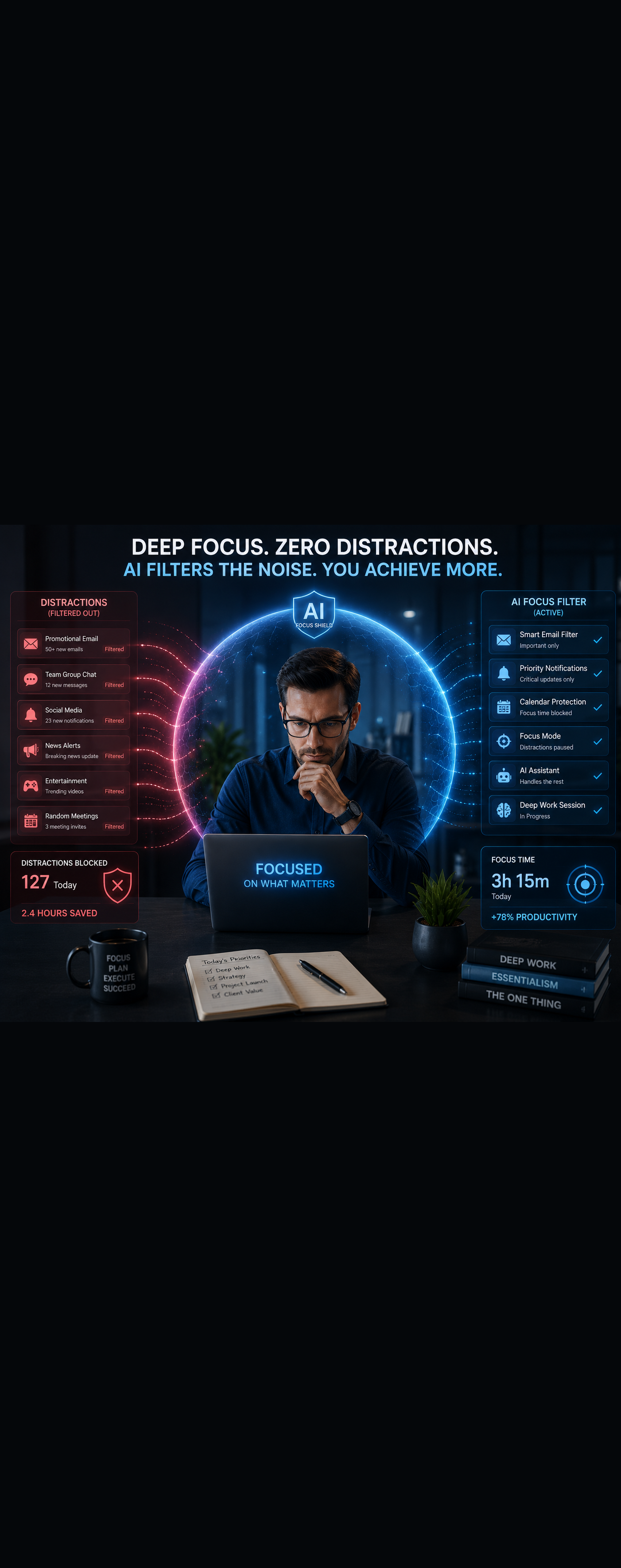
AI can help you fight back. Not just by making distracted work faster, but by helping you design an environment, schedule, and set of habits that protect your focus at its source. This guide gives you a practical system for using AI to focus better and eliminate the distractions stealing your most productive hours.
Why Distraction Is a Structural Problem, Not a Willpower Problem
Before building solutions, it is important to understand what you are actually dealing with. Most advice about focus treats distraction as a willpower failure — if you just tried harder, you would stay on task. This framing is both inaccurate and counterproductive.
Distraction is primarily a structural problem. Your devices are engineered by teams of experts to maximize engagement. Your work environment may not be designed to support deep concentration. Your schedule may be structured around constant availability rather than protected deep work blocks. Your task management system may not clearly distinguish between important work and urgent noise.
Willpower alone cannot overcome structural problems. What you need is a restructured environment and workflow — one where focus is the default rather than the exception. AI helps you build that structure faster and maintain it more consistently than manual approaches alone.
How AI Can Help You Focus: The Five Layers of an AI-Powered Focus System
An effective focus system works at five layers simultaneously: planning, environment, scheduling, task management, and recovery. AI contributes meaningfully to each one.
Layer 1: AI-Powered Daily Planning for Focused Work
Most people start their workday reactively — checking email, responding to messages, and letting incoming demands determine their priorities. This reactive start makes focused deep work nearly impossible because your attention is already fragmented before you begin.
AI-powered planning creates an intentional structure for your day before the inbox opens.
The Morning Planning Ritual
Spend 10 to 15 minutes each morning using AI to plan your focused work session before engaging with email or messages. The conversation might look like this:
"Here are my three most important projects right now: [list them]. My energy tends to be highest in the first three hours of my workday. Help me design a focused morning session that protects my best hours for deep work on my highest-priority task. I have meetings at [times]. Build the schedule around those constraints."
ChatGPT or Claude will produce a structured daily plan that front-loads your deep work, batches your shallow work, and creates realistic time blocks based on your actual constraints. This plan takes the decision-making friction out of starting your day and gives you a clear structure to follow rather than improvising reactively.
Prioritization Clarity
A major source of distraction is not external interruptions but internal ambiguity — not knowing clearly enough which task deserves your attention right now. When your priorities are unclear, your brain defaults to easy, familiar tasks rather than important, challenging ones.
Use AI to eliminate priority ambiguity before each work session:
"I have these tasks on my list today: [list all tasks]. Help me identify the single most important thing I should work on first based on impact, deadlines, and dependencies. Then rank the remaining tasks."
Clear priorities make it dramatically easier to resist distraction because you always know exactly where your attention should be.
Layer 2: AI Tools for Environmental Focus
Your physical and digital environment either supports or undermines your ability to focus. AI-powered tools at this layer help you restructure both.
Digital Environment Management
The biggest sources of digital distraction for most professionals are notification systems, browser browsing patterns, and the habitual checking of communication apps. Several AI-powered tools address these directly.
Freedom and Cold Turkey use AI-assisted pattern analysis to help you identify your most distracting digital habits and create enforced distraction blocks during your focus sessions. You can schedule recurring focus sessions where specific websites and apps are blocked at the system level — not just filtered, but genuinely inaccessible until your session ends.
The difference between an optional filter and an enforced block is enormous in practice. Willpower is not required when the distraction is structurally unavailable.
RescueTime runs in the background and uses AI to categorize how you spend your time across applications and websites. It generates weekly reports showing exactly how much of your workday went to focused productive work versus distracted activity. The data is often startling and consistently motivating for professionals who want honest feedback on where their time actually goes.
One Tab and Session Buddy for browser management help you clear the cognitive clutter of dozens of open tabs — a significant source of mental fragmentation — while preserving your research context for later retrieval.
Noise and Audio Environment
Acoustic environment has a measurable impact on concentration quality. AI-powered audio tools address this layer of your focus environment.
Brain.fm uses AI-generated music specifically engineered to support focus, relaxation, or sleep by modulating neural oscillation patterns. Unlike regular music or generic ambient sound, Brain.fm's AI compositions are designed for cognitive effect rather than entertainment. Many professionals report noticeably improved concentration quality during focused work sessions.
Krisp.ai uses AI noise cancellation to eliminate background sound during calls and recording sessions. For professionals working in open offices, cafes, or shared home environments, eliminating audio distraction during communication tasks reduces the cognitive overhead of each interaction.
Layer 3: AI-Optimized Scheduling for Deep Work
How your day is scheduled determines how much deep focused work is structurally possible. Most professional schedules are optimized for availability rather than productivity — meetings scattered throughout the day, always-on communication expectations, and no protected blocks for concentrated work.
AI helps you redesign your schedule to protect your focus at the structural level.
Identify and Protect Your Peak Hours
Every professional has periods of the day when their cognitive energy is highest and their ability to focus is strongest. For most people this is the first two to four hours of the workday, though chronotype varies. These peak hours are your most valuable productivity resource and should be protected for your most important deep work.
Ask ChatGPT: "I want to redesign my work schedule to protect my peak focus hours for deep work. My current schedule looks like this: [describe your typical day]. My most important work requires [describe the type of focused work you do]. Help me redesign this schedule to protect at least two hours of uninterrupted deep work daily while maintaining my necessary commitments."
The restructured schedule AI produces often reveals scheduling habits that are costing significant productive output — meetings scheduled during peak hours, communication checking habits that fragment concentration, and shallow work tasks filling time that should be protected.
Batch Communication and Shallow Work
Every switch between deep work and communication tasks carries a cognitive switching cost. Research on attention residue shows that even after returning to deep work after a brief interruption, your cognitive resources remain partially engaged with the previous task for 20 to 30 minutes.
The solution is time-blocking — batching all communication, meetings, and shallow work into defined windows rather than allowing them to interrupt your focus throughout the day.
Use AI to help you design an optimal batching structure for your specific role and responsibilities. A well-designed time-block schedule might protect mornings for deep work, use midday for meetings and synchronous communication, and batch email and administrative tasks into two defined windows rather than processing them continuously.
Use AI to Protect Focus from Meeting Creep
Meeting scheduling is one of the most significant structural threats to professional focus. Without explicit protection, meetings expand to fill available calendar space through a combination of others' scheduling convenience and the professional norm of availability.
Use AI to draft firm but professional calendar policies you can share with colleagues and build into your scheduling tools:
"Help me write a professional calendar policy message I can put in my scheduling tool that clearly communicates my focus hours, preferred meeting windows, and how to contact me for urgent matters outside those windows."
Protecting your calendar proactively is dramatically more effective than trying to reclaim focus time after it has been colonized.
Layer 4: AI-Enhanced Task Management for Flow
Getting into a focused flow state requires more than removing distractions. It requires approaching your work in a way that supports sustained concentration rather than fragmenting it.
Break Work into Focused Chunks
One of the most common flow-breaking habits is working from a vague, undefined task rather than a clear, bounded one. "Work on the proposal" is not a task that supports focus. "Write the executive summary section of the Q3 client proposal, approximately 400 words, drawing on the research notes in Notion" is.
Use AI to help you break vague work into specific, executable tasks before your focus session begins:
"I need to work on [project] today. Help me break this into three to four specific, clearly defined tasks I can execute in focused 45-minute sessions. Each task should have a clear deliverable I will know is complete when I finish."
Specific tasks with clear completion criteria create the conditions for flow because your brain knows exactly what it is doing and when it has succeeded.
The Focus Session Framework
Structure your deep work sessions using the Pomodoro technique or a similar timed framework. Work in focused intervals — typically 25 to 90 minutes depending on the task type and your concentration capacity — with short breaks between sessions and a longer break after every third or fourth session.
AI helps you plan and optimize these sessions:
"I have 90 minutes of focused time to work on [task]. Help me structure this session with specific goals for each 25-minute block, a brief review at the end of each block, and a clear definition of what success looks like at the end of the 90 minutes."
Timed session structures with clear intermediate goals prevent the low-level anxiety of open-ended work that often drives distraction-seeking behavior.
Process Your Open Loops Before Focusing
A major source of internal distraction is the mental presence of unprocessed open loops — tasks, commitments, and concerns that are not properly captured in a trusted system. Your brain will continue to surface these during focus sessions as a reminder not to forget them.
Before each focus session, spend five minutes doing an open loop capture with AI assistance:
"I am about to start a focused work session. Help me quickly capture and process everything on my mind that might distract me. I will list everything and you help me categorize each item as: defer to later today, add to task list, delegate, or let go."
This brief clearing process removes the internal sources of distraction before they can interrupt your focused work.
Layer 5: AI-Supported Focus Recovery
Even with excellent systems, focus degrades. Attention wanders, energy drops, and concentration quality decreases across the workday. AI helps you recover focus faster and maintain it more sustainably.
Recognize and Address Focus Drift
When you notice your concentration flagging or your attention drifting repeatedly to the same distraction, use a brief AI-assisted refocus prompt rather than continuing to struggle:
"I am working on [task] and finding it difficult to concentrate. I keep getting distracted by [specific distraction or thought]. Help me identify what might be causing this and suggest a five-minute approach to get back into focused mode."
This approach treats focus drift as information rather than failure. Often, difficulty concentrating signals that you need to clarify something about your task, address a genuine concern that your brain keeps surfacing, or take a recovery break before continuing.
Design Effective Recovery Breaks
The quality of your breaks determines how well your concentration recovers between focus sessions. Social media scrolling, email checking, and other passive digital consumption during breaks have been shown to impair rather than restore cognitive function.
Ask AI to help you build a personalized break menu — a short list of recovery activities that actually restore your concentration:
"I take 5 to 10 minute breaks between focused work sessions. Help me design a break menu of activities that are genuinely restorative for concentration rather than mentally depleting. Consider my work context [describe your work environment] and what is practically available to me."
Good recovery breaks typically involve physical movement, genuine mental rest from screen-based activity, brief exposure to natural light or outdoor environment, or a relaxing non-digital activity. AI helps you design breaks that fit your specific context and constraints.
End-of-Day Review for Tomorrow's Focus
How you end your workday significantly influences how easily you focus the next morning. An unstructured end-of-day leaves open loops that the mind continues to process during recovery time, reducing the quality of rest and making the next morning's startup harder.
Use a brief AI-assisted end-of-day review to close the mental loops of your current day:
"Here is what I worked on today: [brief summary]. Help me do a quick end-of-day review that captures any open loops, identifies the single most important task for tomorrow morning, and gives me a clean mental stop point so I can genuinely disengage from work."
This habit creates a clear boundary between work mode and recovery mode, improving both the quality of your rest and the ease of your next day's focused start.
The Best AI Focus Tools Worth Knowing
Beyond the general AI assistants like ChatGPT and Claude, several specialized tools are worth adding to your focus stack.
Reclaim.ai is an AI scheduling tool that automatically protects time for your habits, focus blocks, and high-priority tasks by analyzing your calendar and dynamically scheduling protected time around your meetings and commitments. It continuously reschedules around calendar changes so your focus blocks are always protected without manual calendar management.
Notion AI for task and project management helps you maintain clarity on priorities and next actions within your knowledge management system, reducing the ambiguity that drives distraction.
Headspace or Calm with AI personalization offer guided meditation and mindfulness sessions calibrated to your usage patterns and focus goals. Regular mindfulness practice has strong research support as a concentration-enhancing habit, and AI personalization makes the practice more effective by adapting to your needs over time.
Focusmate is a virtual co-working tool that pairs you with an accountability partner for timed focus sessions. While not strictly AI-powered, it addresses one of the most powerful human drivers of focus: social accountability. Knowing someone is watching you work creates a powerful motivational structure that many people find more effective than any digital tool.
Building Your Personal AI Focus System
The tools and strategies in this guide work best when assembled into a personalized system rather than applied randomly. Here is a practical starting framework.
Morning: 10-minute AI-assisted planning session before opening email. Set your one most important task for the day. Block your peak hours for deep work.
Focus sessions: Work in timed blocks with a clearly defined task and deliverable. Use website blockers during sessions. Take restorative breaks between sessions.
Shallow work windows: Batch email, messages, and administrative tasks into two defined daily windows. Use AI drafting to process communication faster.
Weekly: Review RescueTime data to understand actual focus patterns. Identify your biggest distraction sources. Make one structural change to address the most significant pattern.
Daily close: Five-minute end-of-day review to capture open loops and set tomorrow's first focus task.
Build this system one layer at a time. Start with daily planning and a single focus session structure. Add tools and habits as each layer becomes stable.
Conclusion: Design Your Environment for the Focus You Deserve
Willpower alone is not a focus strategy. The professionals doing their best work in 2026 are not simply trying harder to concentrate — they are building environments, systems, and habits that make focused work structurally easier and distraction structurally harder.
AI gives you more tools to design that environment than any previous generation of professionals has had access to. Planning tools that remove daily priority ambiguity. Scheduling tools that protect your best hours. Task management approaches that create the conditions for flow. Recovery systems that keep your concentration sharp across the full workday.
The work worth doing requires your full attention. Build the system that gives it the space to happen.
Want more insights like this? Subscribe to the AI Success Forum newsletter.