The AI Success Mindset: How Top Performers Think Differently

The AI Success Mindset: How Top Performers Think Differently
Every significant technology shift in history has produced two distinct groups of professionals. The first group waits, watches, and adapts only when adaptation becomes unavoidable. The second group moves early, builds fluency while the tools are still emerging, and positions themselves as leaders in the new landscape before it becomes crowded.
The difference between these groups is rarely access. It is rarely intelligence. It is rarely even work ethic. It is mindset. The specific set of mental frameworks that determines how a professional interprets change, responds to uncertainty, and decides where to invest their learning energy.
AI is producing this same split in real time, right now, across every industry and profession. And the gap between the two groups is widening every quarter.
This guide breaks down the specific mental frameworks that top AI performers use to think differently, adapt faster, and build advantages that compound over time.
Framework One: Opportunity Lens Over Threat Lens
The most fundamental mindset difference between top AI performers and everyone else is the lens through which they initially interpret AI news, AI capabilities, and AI's impact on their field.
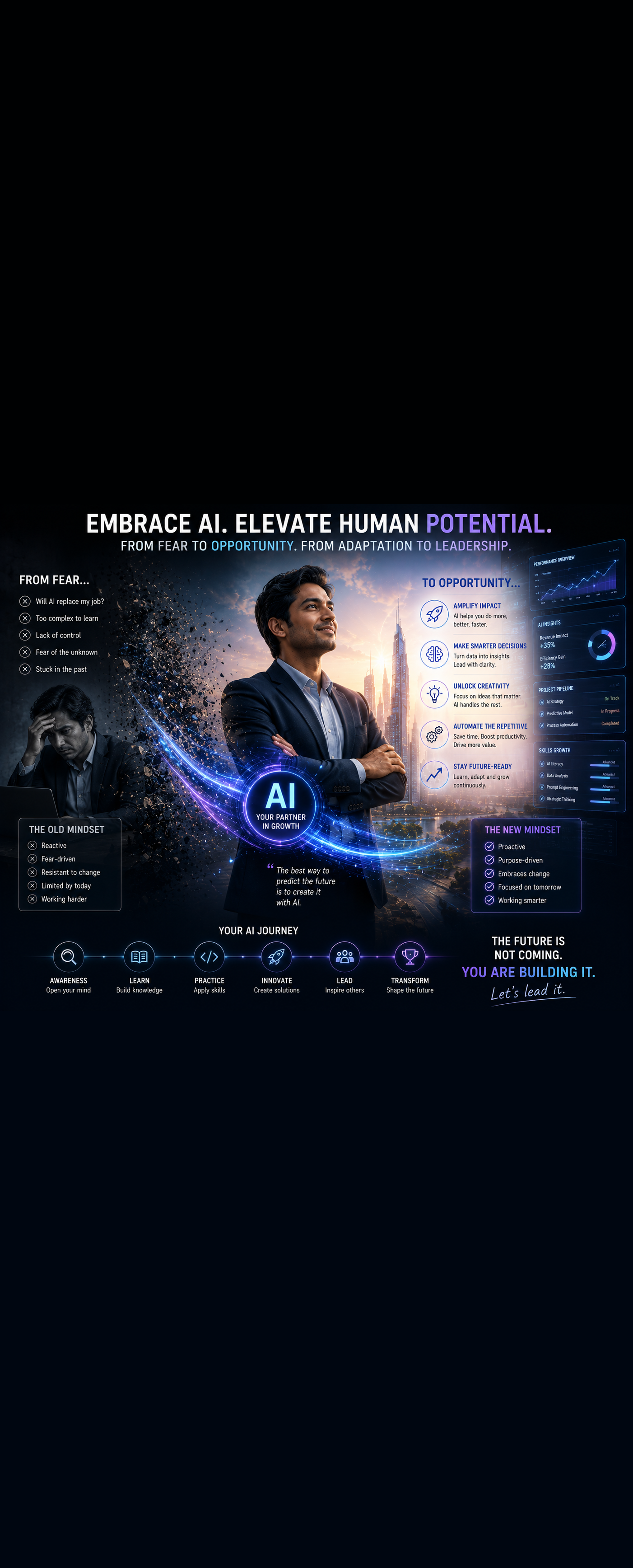
The threat lens is the default for most professionals. When a new AI capability is announced, the threat lens immediately asks: what does this mean for my job? What can AI do that I used to be needed for? How much of my value is at risk?
These are not unreasonable questions. But they lead to a fundamentally defensive posture that limits what is possible. A professional in threat mode monitors AI from a distance, looking for evidence of its limitations and finding temporary reassurance in each one. They stay reactive, responding to AI's advance rather than shaping their relationship with it.
The opportunity lens asks different questions. When a new AI capability is announced, the opportunity lens asks: how can I use this? What does this make possible for someone in my role? What competitive advantage is available to the professional who integrates this capability first?
These questions lead to an offensive posture. A professional in opportunity mode is actively experimenting, building skills, and positioning themselves ahead of peers who are still watching from a distance.
How to Shift to the Opportunity Lens
The shift is not about suppressing legitimate concerns. It is about asking both sets of questions and giving your energy primarily to the ones that lead to action.
A practical exercise: the next time you encounter news about an AI capability that creates anxiety, deliberately force yourself to articulate three specific ways that same capability could benefit you or your work. This is not optimism for its own sake. It is training your brain to see the opportunity that exists alongside every disruption.
Top performers have made this reflex automatic. The threat lens still activates. They just do not let it run the analysis.
Framework Two: Tool Thinking Over Replacement Thinking
Replacement thinking frames AI as a competitor. It asks whether AI can do what you do, produces an uncomfortable answer more often than not, and leaves professionals feeling threatened by their own tools.
Tool thinking frames AI as a capability multiplier. It asks what you can accomplish with AI that you cannot accomplish without it, and produces an empowering answer almost every time.
The difference seems semantic. The practical consequences are enormous.
A copywriter using replacement thinking looks at AI writing tools with suspicion and measures their worth by finding tasks the AI cannot handle as well as they can. A copywriter using tool thinking looks at AI writing tools and asks how to combine their creative judgment and strategic thinking with AI's execution speed to produce better results than either could achieve alone.
The first copywriter is competing with AI. The second is wielding it. The market treats these two professionals very differently.
The Craftsperson Mental Model
The most useful framing for tool thinking is the craftsperson mental model. A master carpenter does not feel threatened by a new power tool. They evaluate it on one criterion: does this make me more effective at what I do? If yes, they learn it and integrate it. If not, they move on.
Top AI performers apply the same evaluative lens. They are not trying to adopt every AI tool. They are selectively and deliberately integrating the tools that make them meaningfully more effective in their specific context, treating each one as an addition to their professional toolkit rather than a commentary on their relevance.
Framework Three: Systems Thinking Over Willpower Thinking
Most professionals approach productivity as a willpower problem. If they could just be more disciplined, more focused, and more consistent, they would achieve better results. This framing puts the burden entirely on individual effort and character, which are both finite and unreliable.
Top performers approach productivity as a systems design problem. Instead of relying on willpower to focus, they build environments where focus is the path of least resistance. Instead of trying to remember every priority, they build systems that surface the right priorities at the right moment automatically. Instead of fighting distraction through discipline, they design distraction out of their environment.
AI enables a level of systems design that was not previously accessible to individual professionals. AI scheduling tools handle task prioritization automatically. AI communication tools manage inbox volume without requiring constant manual intervention. AI workflow tools automate the repetitive processes that used to consume focused attention throughout the day.
Top performers see AI not as a productivity tool but as systems infrastructure. The question they ask is not "how can AI help me work harder?" It is "how can AI help me design a system where good work happens more naturally and consistently?"
Building Systems Instead of Relying on Discipline
The practical application of this framework starts with identifying the points in your work where you most frequently rely on willpower to do the right thing. Where do you catch yourself checking social media instead of working? Where do you avoid starting important tasks because the activation energy feels too high? Where do you consistently fall short of your own standards because the environment is not set up to support your intentions?
Each of these points is a system design problem, not a character problem. And AI tools exist to address most of them. The top performer's instinct when they notice themselves failing to do the right thing is not self-criticism. It is system design.
Framework Four: Iteration Mindset Over Perfection Mindset
Perfection mindset in the context of AI adoption looks like this: I will start using AI tools seriously once I have time to learn them properly. I will integrate AI into my workflow once I understand which tools are best. I will share my AI-assisted work once I am confident it is as good as my fully manual work.
This mindset sounds reasonable. It is actually a sophisticated form of procrastination that keeps professionals frozen in preparation mode indefinitely while the market moves around them.
The iteration mindset looks different. It starts now, imperfectly, and gets better through experimentation and feedback rather than through advance preparation. It accepts that the first attempt will be worse than the tenth and that the tenth can only be reached by completing the first through ninth.
Top AI performers are not better prepared than their peers when they start. They are simply more willing to begin in an imperfect state. They ship AI-assisted work before they feel ready, learn from the gaps in that work, and improve rapidly through iteration in a way that armchair preparation can never replicate.
The 70 Percent Rule
A practical version of the iteration mindset is the 70 percent rule: if an AI-assisted output is 70 percent of the way to where you want it to be, ship it, learn from the response, and improve on the next iteration. Waiting for 100 percent readiness means waiting forever in a domain where the tools themselves are changing faster than any individual learning curve can keep up with.
This does not mean accepting poor quality as a permanent standard. It means accepting that improvement is sequential, not preparatory, and that the market provides feedback that no amount of internal preparation can replicate.
Framework Five: Compound Thinking Over Linear Thinking
Linear thinking about AI skill development assumes that the effort you invest and the results you get are proportional throughout the process. You spend an hour learning a tool, you get an hour's worth of capability. You spend another hour, you get another hour's worth. The relationship is direct and consistent.
This model is wrong in a way that leads to significant underinvestment in early learning.
Compound thinking recognizes that skills, like financial investments, generate returns that grow non-linearly over time. The first week of learning an AI tool produces modest results. The second week produces better results, built on the foundation of the first. By the third month, you have developed a level of fluency that allows you to produce outputs that would have been impossible in week one, not because the tool changed but because your skill in using it compounded.
Top performers who understand compounding invest more heavily in the early stages of learning than the immediate returns seem to justify, because they are thinking about the 12-month return, not the 12-day return. They also start earlier, because they understand that the compounding clock only starts running when you begin.
The Portfolio Approach to AI Skills
An extension of compound thinking is approaching your AI skill development like a portfolio. You have a core holding, the one or two tools you use daily that form the foundation of your AI-augmented practice. You have growth positions, tools you are actively learning and integrating because they address important gaps in your workflow. And you have a watchlist, tools you are monitoring because they may become relevant as your needs evolve.
This portfolio framing prevents the scattered, shallow engagement with many tools that produces the illusion of AI fluency without its substance. Top performers are not impressive because they have tried 20 AI tools. They are impressive because they have mastered three or four and built their workflow around that mastery.
Framework Six: Contribution Thinking Over Consumption Thinking
The majority of professionals in the AI space are consumers. They follow AI newsletters, watch AI demonstrations, read AI use case articles, and feel informed about AI without doing the active integration work that produces real capability.
Top performers balance consumption with contribution. Contributing means producing work that demonstrates your AI fluency: writing publicly about how you use AI in your field, building tools or workflows that showcase your capability, teaching others what you have learned, or taking on projects that require you to push beyond your current AI skill level.
Contribution accelerates learning in a way that consumption cannot match. When you write publicly about your AI workflow, you are forced to understand it deeply enough to explain it clearly. When you teach someone else to use a tool, you encounter the gaps in your own understanding and fill them. When you take on a project that requires you to stretch your current AI capabilities, you learn through necessity rather than interest, which is faster and stickier.
Contribution also produces a professional dividend that consumption alone never generates. The professional who is visibly building AI fluency and sharing what they learn attracts opportunities, collaborators, and inbound interest that the silent consumer never sees.
Starting Your Contribution Practice
You do not need a large audience or a polished platform to start contributing. A LinkedIn post describing how you used an AI tool to solve a specific problem in your work is a contribution. A brief tutorial shared in a professional Slack community is a contribution. A conversation with a colleague where you share what you have learned is a contribution.
Start where you are. Contribute what you currently know. The audience and the depth of contribution grow from there.
Framework Seven: Identity Alignment Over Behavior Change
The least effective approach to AI adoption is trying to change behavior without changing identity. Behavior change sustained only by willpower and external motivation always degrades over time as competing demands erode the energy available to maintain it.
The most effective approach is identity alignment: shifting how you think about who you are in relation to AI tools, so that using them becomes consistent with your self-concept rather than in tension with it.
Most professionals who struggle with AI adoption carry a silent identity story that works against them. They see themselves as the expert who has built their career on a specific skill set, and AI tools feel like an implicit admission that those skills are less valuable than they used to be. The adoption of AI tools feels like a concession rather than an expansion.
Top performers have resolved this identity conflict in favor of a different story. They see themselves as professionals who use every available tool to deliver the best possible results for their clients, teams, and organizations. In this identity, using AI tools is not a concession. It is an expression of exactly the professional commitment that defines them.
Writing Your Professional Identity Statement
A practical exercise from executive coaching that works equally well for AI adoption: write a one-paragraph statement of your professional identity that explicitly includes your relationship to AI tools as a positive, defining characteristic.
Not "I am trying to use AI more in my work." But "I am a professional who combines deep expertise in [your field] with strategic use of AI tools to deliver outcomes that neither expertise nor technology alone could produce."
Read this statement regularly. Let it shape the choices you make about how you spend your learning time and how you present yourself professionally. Identity that is articulated becomes identity that is lived.
The Compounding Effect of Mindset
None of these frameworks produces dramatic results in isolation. Their power is in combination and in consistency over time.
A professional who applies the opportunity lens, the tool thinking framework, the iteration mindset, and the compound thinking perspective to their AI practice for 12 consecutive months will look unrecognizable compared to their starting point. Not because they followed a perfect plan. Because they consistently chose the adaptive response over the defensive one, the action over the preparation, and the iteration over the procrastination.
That compounding is available to anyone willing to apply these frameworks with genuine intention. It does not require exceptional intelligence, exceptional access, or exceptional resources. It requires a decision about how to think about what is happening in your field and a commitment to acting on that thinking every day.
Final Thoughts
The AI Success Mindset is not a fixed state you either have or do not have. It is a practice. A set of deliberate choices about how to interpret change, respond to uncertainty, and invest your energy in a professional landscape that is evolving faster than any of us fully anticipated.
Top performers are not defined by their AI skills alone. They are defined by the mindset that led them to build those skills before they felt essential, to share what they learned before they felt expert, and to keep iterating before they felt ready.
That mindset is what separates the professionals who will look back on this period as their most significant career accelerant from the ones who will look back wishing they had moved sooner.
You already know which professional you want to be. The mindset is available. The tools are available. The moment is now.
Want more insights like this? Subscribe to the AI Success Forum newsletter.