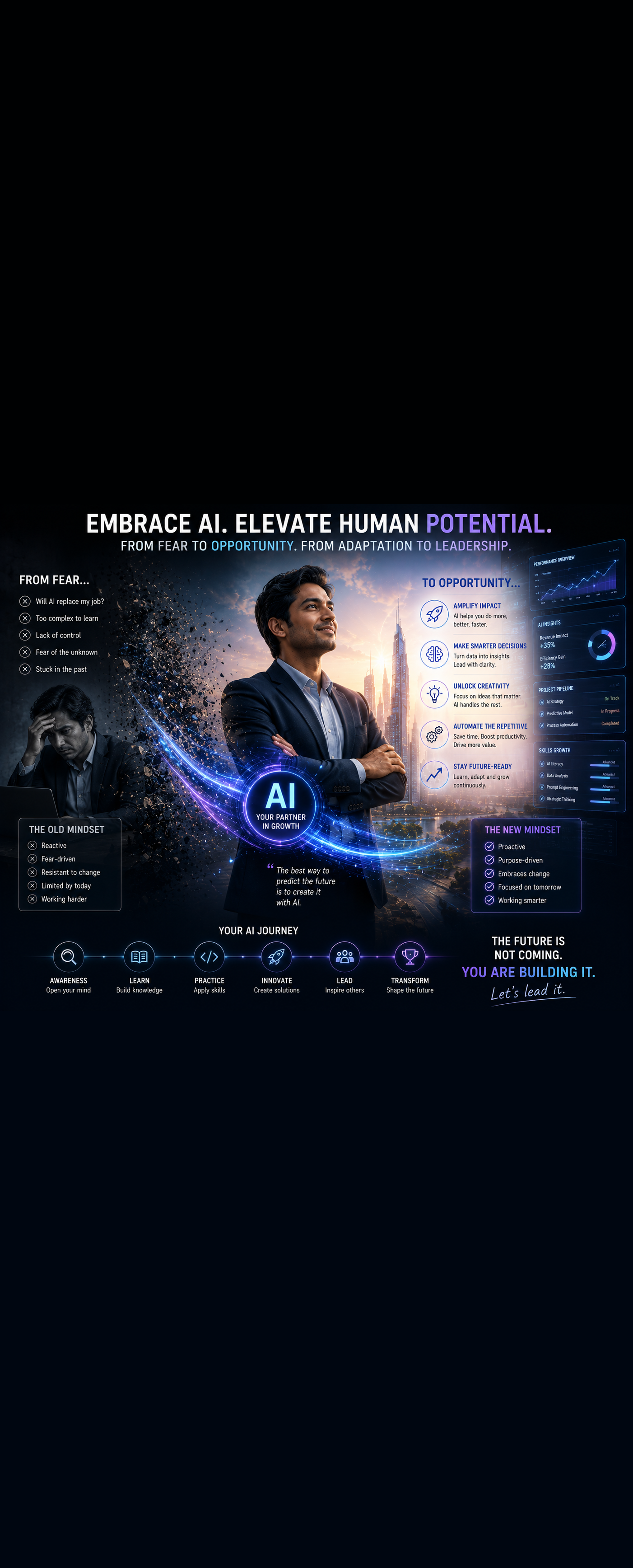
The AI Opportunity Gap: Why Early Adopters Win Big

The AI Opportunity Gap: Why Early Adopters Win Big
Every major technological shift in history has created two groups of people. Those who moved early and captured disproportionate rewards. And those who waited, watched, and eventually caught up, only to find the best opportunities already taken.
AI is that shift right now. And the gap between early adopters and everyone else is widening faster than most professionals realize.
This is not about hype. It is about understanding how opportunity windows work, why they close faster than expected, and what you can do today to make sure you are on the right side of the divide.
What the AI Opportunity Gap Actually Means
The AI opportunity gap is the growing advantage that professionals and businesses who adopt AI tools early hold over those who delay.
It is not just about knowing how to use a chatbot. It is about the compounding effect of months and years of practice, experimentation, and workflow integration that early adopters accumulate while late adopters are still deciding whether to get started.
By the time the majority catches up to where early adopters are today, those early adopters will have moved two or three levels further ahead. The gap does not close. It compounds in favor of whoever started first.
This pattern has repeated itself with every major technology wave. The internet, social media, smartphones, e-commerce. In every case, the professionals and businesses that moved early captured advantages that late movers spent years trying to close.
Why Early Adopters Win Big in the AI Era
Early adoption creates advantages across three dimensions that are genuinely difficult to replicate later.
Skill depth that cannot be faked. Someone who has been using AI tools daily for two years has developed an intuition that a newcomer simply does not have. They know which tools work for which tasks, how to craft prompts that get precise results, and where AI judgment needs to be overridden by human expertise. That depth takes time to build and cannot be shortcut.
Reputation and positioning. Early adopters become the go-to experts in their organizations and industries. When AI becomes a standard expectation, the person who was already known as the AI-savvy professional gets promoted, gets hired, and gets called first. That positioning was built during the window when most people were still skeptical.
Network and opportunity access. Early adopters connect with other early adopters. They join communities, attend events, and build relationships at the frontier of the field. Those networks open doors to opportunities that never get advertised publicly.
The AI Opportunity Gap Is Already Widening in Every Industry
This is not a future warning. The gap is opening right now, across every field.
In marketing, early adopters are producing more content, running more tests, and personalizing campaigns at a scale that teams twice their size cannot match manually. In finance, professionals using AI for research and analysis are covering more ground and making faster decisions. In education, healthcare, law, and engineering, the same pattern is emerging.
The professionals who recognized this early and started building AI literacy 12 to 24 months ago already have a measurable advantage. They are more productive, more visible, and better positioned for the opportunities that are opening up as organizations scramble to find people who actually know how to work with these tools.
The window is not closed. But it is narrowing. Every month of delay is a month of compounding advantage handed to someone else.
How Early Adoption Creates Business Advantages
For business owners and entrepreneurs, the AI opportunity gap is even more pronounced. AI tools are not just productivity boosters for businesses. They are structural advantages that change cost structures, speed, and output quality in ways that create genuine competitive moats.
A small business owner who adopts AI tools early can:
- Produce content, proposals, and communications at the speed of a much larger team
- Automate repetitive operations that used to require additional hires
- Analyze customer data and market trends with tools that previously required expensive specialists
- Test new ideas and iterate faster than competitors still working with manual processes
The businesses that integrated AI workflows early are not just slightly more efficient. In many cases they have fundamentally changed what is possible for a small team, creating advantages that competitors without AI integration will struggle to overcome without significant investment and time.
The Biggest Reasons Professionals Delay and How to Overcome Them
Understanding why people delay is important because the reasons feel legitimate in the moment, even when they are not.
"I will wait until the tools are more mature." The tools are already mature enough to create significant advantages. Waiting for perfection means handing your lead time to early adopters. Every tool iteration will bring improvements, but the compounding advantage of starting now outweighs the marginal benefit of a slightly better tool later.
"I do not have time to learn something new." AI tools reduce the time you spend on low-value tasks. The investment to learn them pays back in hours saved within weeks. The real time cost is not learning AI. It is continuing without it.
"My industry is different." Every industry professional says this. And in every industry, early adopters are already finding applications that matter. The tools are flexible enough to add value across contexts, and the professionals discovering those applications first are the ones building the biggest advantages.
"I am not technical enough." Modern AI tools require no coding or technical background. If you can type a question and read an answer, you can use the tools that are creating the biggest advantages right now.
Where to Start If You Have Not Already
The goal is not to learn every AI tool at once. That approach leads to overwhelm and shallow engagement with too many things. The goal is to go deep with a small number of high-leverage tools that are directly relevant to your work.
Start here:
- ChatGPT or Claude for writing, research, brainstorming, and daily productivity tasks
- Perplexity AI for current information and research that requires up-to-date sources
- Midjourney or DALL-E if visual content is relevant to your work
- Notion AI or similar for organizing your knowledge and streamlining documentation
Spend 20 focused minutes per day for 30 days with one tool before adding another. Build depth before breadth. The compounding advantage comes from genuine understanding, not surface-level exposure to dozens of tools.
Platforms like Coursera and Udemy offer structured AI courses that can accelerate your learning curve significantly and help you build a credible foundation faster than self-directed exploration alone.
The Cost of Waiting Is Higher Than You Think
Most professionals underestimate the cost of delay because it is invisible in the short term. You do not feel the opportunity gap today. You feel it 12 months from now when someone with less experience but more AI fluency gets the promotion, the client, or the contract that should have been yours.
The professionals who will look back with regret are not the ones who tried AI tools and decided they were not useful. They are the ones who kept meaning to start and never did.
The opportunity window in every major technology shift is real and finite. The internet made millionaires of people who moved in 1996 and left late movers scrambling to catch up by 2001. Social media built careers and businesses for people who moved in 2010 and turned into a crowded, expensive channel for newcomers by 2018.
AI is moving faster than either of those shifts. The window is open right now. The question is not whether you should step through it. The question is how quickly you can move.
Your Next Step Starts Today
You do not need a perfect plan. You need a first step taken today, followed by a second step tomorrow.
Open a free account on ChatGPT or Claude right now if you have not already. Spend 20 minutes using it for something real in your work. Notice what it can do. Ask it to help you with a task you would normally spend an hour on manually.
That first experience is the beginning of the compounding advantage that early adopters have been building for the past two years.
The AI opportunity gap is real. Which side of it you end up on is still your choice. But that choice has a timeline, and it is shorter than most people think.
Want more insights like this? Subscribe to the AI Success Forum newsletter.