The AI Freelancer's Guide to Earning More in Less Time
The AI Freelancer's Guide to Earning More in Less Time
Freelancing has always had a fundamental tension at its core. Your income is directly tied to your hours. Work more hours, earn more money. Take time off, income stops. Scale your rates and risk losing clients. The ceiling always feels closer than you want it to be.
AI has broken that equation. Not theoretically, but practically, for freelancers across writing, design, development, marketing, consulting, and virtually every other service category.
The freelancers who have integrated AI tools into their workflows are delivering projects faster, taking on more clients without burning out, raising their rates with confidence, and building income levels that their previous hourly model could never have supported.
This guide is the practical playbook for how to make that shift. Not the hype version. The version that actually works.
Why AI Is a Freelancer's Highest-Leverage Tool
Employees trade time for salary. Freelancers trade deliverables for fees. This distinction matters enormously when it comes to AI.
When a salaried employee uses AI to complete a task in two hours instead of six, the company captures most of the benefit. The employee saves some stress but earns the same salary.
When a freelancer uses AI to complete a project in two hours instead of six, they capture the entire benefit. The client pays the same project fee. The freelancer earns the same income in a third of the time, freeing the remaining four hours to take on additional work, rest, or build a new income stream.
This is why AI is a disproportionately powerful tool for freelancers compared to almost any other professional category. Every hour of time you recover through AI-assisted work is an hour you can convert directly into additional income, reduced working hours, or both.
The freelancers who understand this are not treating AI as a productivity trick. They are treating it as a business model transformation.
The Four Ways AI Increases Freelance Income
Before getting into specific tactics, it helps to understand the four distinct mechanisms through which AI increases freelance earnings.
Faster delivery: AI compresses the time required to complete a project. A task that took four hours now takes one. This means you can complete more projects in the same time or the same projects in less time.
Higher output quality: AI tools help you research more thoroughly, catch errors earlier, explore more creative directions, and produce more polished first drafts. Better output quality justifies higher rates and generates stronger client referrals.
Expanded service offering: AI allows you to offer services adjacent to your core expertise that would have taken too long to deliver manually. A copywriter can now offer SEO keyword research. A developer can now offer basic UX copy. A designer can offer written brand guidelines. Expanded services mean higher project values per client.
Reduced non-billable overhead: Administrative tasks, client communication, invoicing, project planning, and business development all consume unpaid time. AI compresses these tasks, increasing the proportion of your working hours that are billable.
Understanding which of these mechanisms is most relevant to your specific freelance practice helps you prioritize where to apply AI tools first.
AI Tools Every Freelancer Should Be Using in 2026
The AI tool landscape changes quickly, but these categories and specific tools have demonstrated staying power and practical value across freelance disciplines.
Writing and Communication
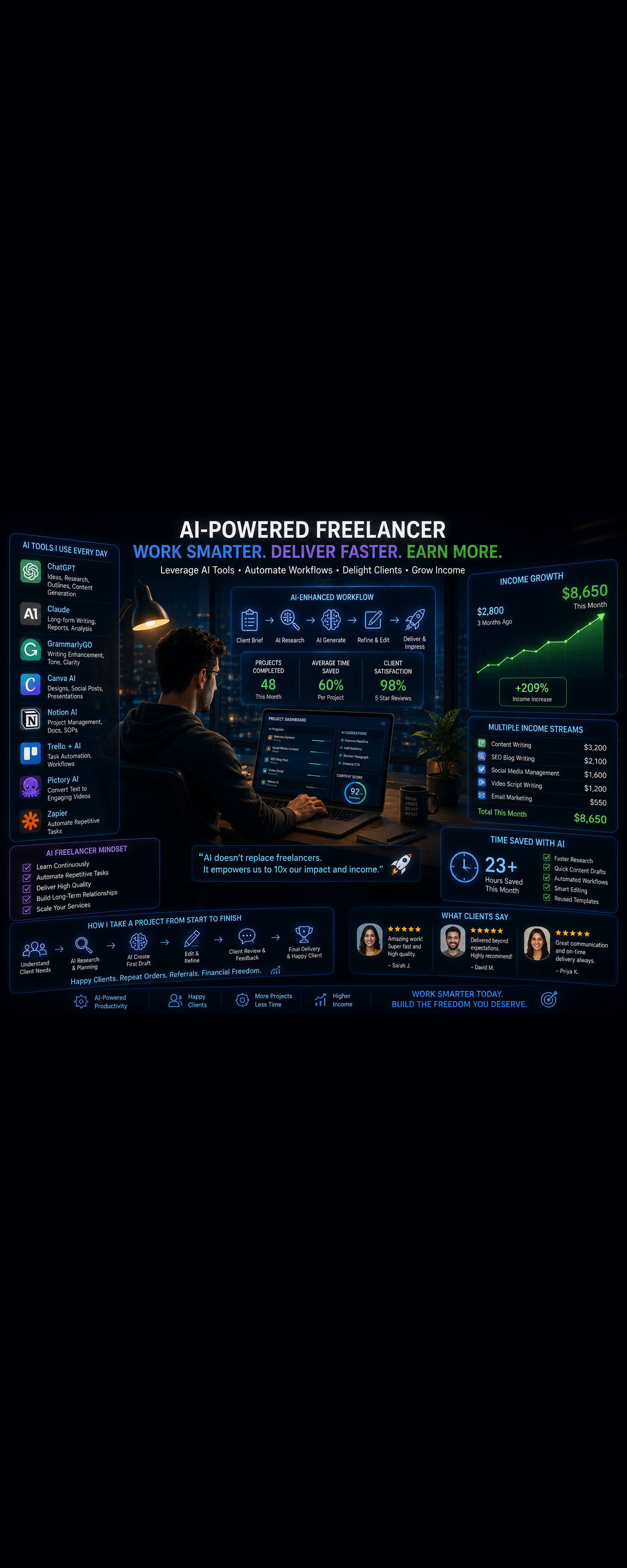
Claude and ChatGPT are the foundational tools for any freelancer who works with words. Drafting, editing, restructuring, tone adjustment, and ideation all happen faster with these tools. The key is learning to prompt them effectively and to treat their output as a starting point that your expertise elevates, not a finished product you submit to clients.
Grammarly and Hemingway Editor remain valuable for polishing and readability, even when your drafts are AI-assisted. They catch the errors that both you and AI miss under deadline pressure.
Research and Synthesis
Perplexity AI has become the go-to tool for fast, cited research. Instead of spending 30 minutes reading through search results, you can get a synthesized answer with sources in seconds, then verify and expand on the most relevant information. For freelancers in writing, consulting, strategy, and research-intensive fields, this tool alone can save hours per week.
Design and Visual Content
Midjourney, Adobe Firefly, and Canva's AI features have transformed what a solo freelancer can produce visually. Designers are using AI to explore concept directions faster and present more options to clients. Writers and marketers are using AI image tools to produce accompanying visuals that increase the perceived value of their deliverables.
Development and Technical Work
GitHub Copilot and Cursor have become standard tools for freelance developers. AI-assisted coding reduces the time spent on boilerplate, documentation, and debugging, allowing developers to focus on the architecture and problem-solving that commands premium rates. Freelancers using these tools consistently report 30 to 50 percent faster project completion times.
Project Management and Client Communication
Notion AI and ClickUp AI help freelancers manage projects, create documentation, and draft client-facing communications faster. Otter.ai transcribes and summarizes client calls automatically, eliminating the manual note-taking that pulls focus away from the conversation itself.
How to Restructure Your Pricing to Capture AI Efficiency Gains
This is the piece most freelancers get wrong. They integrate AI, deliver projects faster, and then unconsciously undercharge because they feel guilty about how quickly the work was completed.
Stop thinking about your pricing in terms of time. Start thinking about it in terms of value delivered.
Your client does not care how long it took you to write their landing page. They care whether the landing page converts. Your client does not care how many hours you spent building their automation workflow. They care whether the workflow saves them time and reduces errors. Your client does not care that you used AI to accelerate your design process. They care whether the brand assets look professional and represent them well.
Value-based pricing decouples your income from your hours entirely, which is the model that allows AI efficiency gains to translate directly into higher earnings.
How to Transition to Value-Based Pricing
Start by identifying the specific, measurable outcomes your work produces for clients. Revenue generated, time saved, costs reduced, performance metrics improved. These are the outcomes clients are actually paying for.
Research what the market pays for those outcomes, not for the hours required to produce them. A landing page that consistently converts at five percent is worth significantly more than one that converts at one percent, regardless of how long each took to write.
Set your project fees based on the value delivered and your positioning in the market, then use AI to deliver that value as efficiently as possible. The gap between your fee and your time cost is your margin, and AI widens that margin substantially.
Practical Workflow Changes That Save Hours Every Week
Beyond specific tools, the freelancers earning the most with AI have made structural changes to how they work. These workflow adjustments compound over time into significant income advantages.
Build a Prompt Library
Every time you develop a prompt that produces excellent output for a recurring task, save it. A personal prompt library is one of the most valuable assets a freelance professional can build.
Over time, your library becomes a system. New project? Pull the relevant prompts, feed in the client-specific context, and produce a strong first draft in minutes. The time invested in developing and refining each prompt pays dividends on every future project of the same type.
Organize your library by task type: research prompts, drafting prompts, editing prompts, client communication prompts, proposal prompts, and so on. Store it in Notion, a dedicated document, or a tool like PromptBase if you want to eventually monetize your best prompts.
Template Everything Repeatable
Every freelance business has repeatable elements: client onboarding, project briefs, status updates, invoices, proposals, testimonial requests, and project handovers. These tasks consume significant time every week because most freelancers recreate them from scratch or from vague memory each time.
Use AI to create polished, professional templates for every recurring communication and document in your business. Then spend five minutes personalizing each template for the specific client and context. The result is consistently professional output in a fraction of the time.
Batch Similar Tasks Together
AI tools are most efficient when you use them for similar tasks in sequence. Batching means doing all your drafting in one session, all your research in another, and all your editing in a third, rather than switching between task types throughout the day.
This approach works synergistically with AI because you maintain context and prompting momentum within a single task type. You also reduce the cognitive switching cost that fragments focus and reduces output quality.
Automate Client Communication Workflows
Proposal follow-ups, project milestone updates, invoice reminders, and feedback request emails are all tasks that can be templated and semi-automated. Tools like HoneyBook and Dubsado allow freelancers to build automated client workflows that trigger the right communication at the right moment without manual effort.
Combined with AI-drafted templates, these platforms can handle a significant portion of your client communication overhead automatically, freeing your attention for the billable work and high-value relationship interactions that actually move your business forward.
How to Take on More Clients Without Burning Out
Increased capacity is one of the most significant benefits AI delivers to freelancers. But adding clients without adding systems is a reliable path to burnout. Here is how to scale responsibly.
Define Your Capacity Ceiling Before You Need It
Before you are overwhelmed is the right time to define how many active clients or projects you can manage at any one time. AI changes this number upward, but it is not unlimited.
Know your ceiling. When you reach it, either raise your rates to reduce volume while maintaining income, or build documented systems that would allow you to bring on a subcontractor or assistant without compromising quality.
Qualify Clients More Rigorously
With AI increasing your capacity, the temptation is to say yes to every client opportunity. Resist it. Not every client is worth taking on, even when you have the capacity.
Use a structured client qualification process to filter for clients who have clear projects, realistic timelines, appropriate budgets, and communication styles that work well with how you operate. A single difficult client can consume three times the time and energy of an equally valued straightforward client.
AI can help you build and refine your qualification framework. Use it to draft discovery call questions, create a scoring rubric for evaluating new opportunities, and develop a polite but clear decline template for clients who do not meet your criteria.
Build a Trusted Referral Network
As AI increases your output capacity, you will inevitably encounter more work than you can handle even at your new ceiling. Build relationships with two or three other freelancers in adjacent or complementary disciplines who you can refer overflow work to and who will reciprocate.
This network keeps you from turning down good client relationships entirely when you are at capacity. It also creates a reciprocal referral system that generates inbound work without any marketing effort on your part.
Raising Your Rates as an AI-Fluent Freelancer
Your AI fluency is a genuine differentiator that justifies higher rates. Most clients do not care specifically that you use AI. What they care about is faster turnaround, higher quality, and more consistent reliability. All of which AI helps you deliver.
Here is how to position and execute a rate increase as an AI-fluent freelancer.
Lead With Outcomes and Speed
When positioning your rates to new clients or raising them with existing ones, lead with the outcomes you deliver and the speed at which you deliver them. A web copywriter who can deliver a complete five-page website copy package in five business days rather than three weeks is offering a meaningfully different service, and the market will pay for that difference.
Frame your faster delivery as a competitive advantage for the client, not as a cost-saving measure for yourself. They get their project faster, launch sooner, and see results earlier. That is the value proposition.
Raise Rates With Existing Clients Strategically
A rate increase with a long-term client is most successful when framed around an expanded capability or value proposition rather than a simple price increase. If your AI-assisted workflow now includes additional deliverables, faster turnaround, or improved output quality, you have a genuine case for a higher rate that the client can evaluate based on what they receive.
Give existing clients appropriate notice, typically 60 to 90 days, and communicate the rate increase as a reflection of your evolving service rather than an arbitrary cost adjustment.
Position Yourself in the Premium Tier
The AI tools that compress your production time cost a few hundred dollars per month. The income gap between a freelancer positioned in the commodity tier and one positioned in the premium tier can be tens of thousands of dollars per year.
Invest in your positioning: your portfolio, your case studies, your LinkedIn presence, your written voice, and the professional quality of every client touchpoint. AI makes the execution of premium quality faster. Your positioning strategy determines whether clients perceive you as worth premium rates.
Building Passive Income Streams Alongside Your Freelance Practice
One of the most powerful long-term moves an AI-fluent freelancer can make is building income streams that do not require active delivery time. The efficiency gains from AI create the margin to build these streams without sacrificing client work.
Digital Products From Your Expertise
The knowledge and systems you have developed as a freelancer have genuine market value to others at earlier stages of the same journey. Templates, prompt libraries, workflow guides, mini-courses, and resource packs built around your specific expertise can generate recurring passive income through platforms like Gumroad, Teachable, or Payhip.
AI dramatically accelerates the creation of these products. A template pack that might have taken a weekend to create can now be produced in a few hours. A mini-course that might have required weeks of scripting and recording can be outlined and scripted in a fraction of that time.
Affiliate Income From the Tools You Use
Every AI tool you use and recommend to clients or peers has the potential to generate affiliate commissions. Most of the major AI tools and platforms run affiliate programs with recurring commissions, meaning a single referral can generate monthly income for as long as that customer remains subscribed.
A freelancer who actively uses and publicly talks about tools like Claude, Jasper, Surfer SEO, or Notion AI can build a meaningful passive income stream simply by sharing genuine recommendations with their audience through a newsletter, blog, or LinkedIn presence.
Final Thoughts
The freelancers thriving in 2026 are not the ones working the most hours. They are the ones who have built the most efficient, highest-value practices by combining genuine expertise with strategic AI integration.
The shift is not complicated, but it requires intention. You have to choose to restructure your pricing around value rather than time. You have to invest in learning the tools that matter most for your discipline. You have to build the systems and templates that make AI efficiency compound over time rather than remaining a one-off productivity boost.
Every change described in this guide is available to you starting today. Pick the one that will have the most immediate impact on your practice and implement it this week.
Your income ceiling just got a lot higher. The only question is how fast you want to reach it.
Want more insights like this? Subscribe to the AI Success Forum newsletter.