How to Launch an AI SaaS Business Without Technical Skills
How to Launch an AI SaaS Business Without Technical Skills
Three years ago, building a software product meant hiring developers, spending months in technical planning, and burning through a significant amount of capital before a single customer could use your product. For most non-technical entrepreneurs, that barrier made the SaaS business model feel permanently out of reach.
That barrier no longer exists.
No-code development platforms combined with accessible AI APIs have made it genuinely possible for entrepreneurs without a line of coding experience to build, launch, and grow an AI-powered SaaS business. Not a prototype. Not a rough demo. A real product with paying customers.
This guide walks you through exactly how to do it, from validating your idea to building your product to acquiring your first subscribers.
Why AI SaaS Is the Best Business Model for Non-Technical Founders
Before getting into the how, it is worth understanding why AI SaaS is worth pursuing in the first place.
Software businesses have economics that almost no other business model can match. You build the product once and sell it repeatedly. Each new customer adds to your monthly recurring revenue without requiring a proportional increase in your costs. As your customer base grows, your business becomes increasingly valuable, both as an ongoing income source and as an acquisition target.
AI has made SaaS even more accessible because the hard technical work, training models, building intelligence into software, and processing complex inputs, is handled by foundation models from companies like Anthropic, OpenAI, and Google. You are building on top of capabilities that took billions of dollars and years of research to create. Your job is to identify a specific use case, wrap a useful interface around that capability, and get it in front of the right customers.
The non-technical founder's advantage is often underestimated. Deep understanding of a specific industry, a professional network in a target market, and the ability to communicate with customers clearly are often more valuable in the early stages of a SaaS business than the ability to write code.
Step One: Find a Problem Worth Solving
Every successful SaaS business starts with a problem that real people are experiencing and willing to pay to solve. This sounds obvious but it is where the majority of failed product ideas fall apart. They are built around what the founder thinks would be cool rather than what the market is actually paying for.
The most reliable way to find a problem worth solving is to look at your own professional experience and the communities you are part of. What tasks do professionals in your field find tedious, error-prone, or time-consuming? What workarounds are people using because no adequate solution exists? What are people complaining about in the forums, Slack groups, and LinkedIn discussions in your industry?
Signals That Indicate a Fundable Problem
Not every problem is worth building a product around. Look for problems that have these characteristics.
The problem is recurring. A one-time problem does not justify a subscription product. You want a pain point that people experience regularly, whether daily, weekly, or monthly.
People are already paying for an imperfect solution. If professionals in your target market are cobbling together a solution using spreadsheets, manual processes, or a combination of tools not designed for the job, that is a strong signal of unmet demand.
The problem has a clear AI-leverage angle. AI excels at specific types of tasks: generating text, summarizing documents, classifying information, answering questions, extracting data, and identifying patterns. The best micro-SaaS ideas use AI to do one of these things better, faster, or more accessibly than current alternatives.
Validating Before You Build
The most expensive mistake in product development is building something nobody wants. Validate your idea before investing time in building.
Talk to ten to fifteen potential users. Not to pitch them your idea, but to understand their problem. Ask how they currently handle the task, what they dislike about their current approach, and what they would be willing to pay for a better solution.
If you can pre-sell your product or get letters of intent before building it, you have strong validation. If potential users are enthusiastic in conversation but unwilling to commit even a nominal amount, reconsider whether the problem is painful enough to drive paying customers.
Step Two: Design Your Product Around a Single Core Value
Non-technical founders building their first SaaS product consistently make the same mistake. They try to build too much.
A focused product that does one thing exceptionally well almost always beats a feature-rich product that does many things adequately. Your first version should have the minimum functionality required to solve the core problem for your target user. Nothing more.
This is called a Minimum Viable Product, and the discipline of building a true MVP rather than a polished, feature-complete product is what allows non-technical founders to launch in weeks instead of years.
Define your product's core value in one sentence. What does it do, for whom, and what specific outcome does it produce? If you cannot articulate this clearly, your product scope is probably too broad.
Examples of focused AI SaaS value propositions:
- An AI tool that generates first-draft performance reviews for managers based on employee data and notes
- A platform that automatically converts meeting transcripts into structured action items and follow-up emails
- An AI assistant that helps e-commerce sellers write optimized product listings from a simple description and photo
- A tool that generates personalized cold email sequences for sales teams based on prospect research
Each of these is narrow, specific, and built around a clear AI capability applied to a defined workflow problem.
Step Three: Choose Your No-Code Building Stack
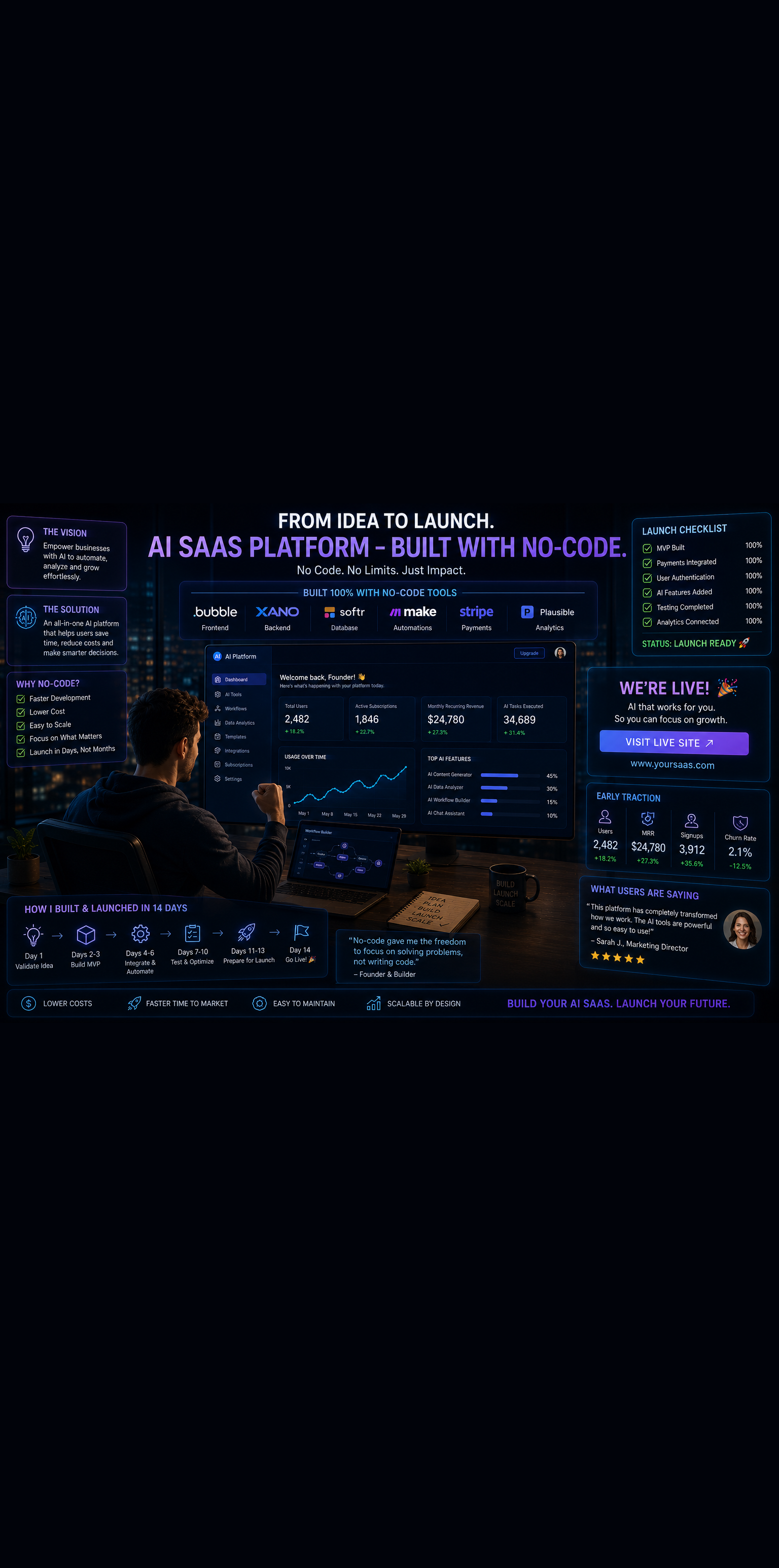
The right combination of no-code tools depends on your product type, your technical comfort level, and your budget. Here are the platforms that give non-technical AI SaaS founders the most capability with the least friction.
For Building the Product Interface
Bubble is the most powerful no-code application builder available and the platform most serious no-code SaaS founders use. It allows you to build complex, multi-page web applications with user authentication, database functionality, and API integrations without writing code. The learning curve is steeper than some alternatives but the capability ceiling is correspondingly higher.
Glide and Softr are faster to get started with and work particularly well for simpler tools built on top of spreadsheet or database data. If your product is relatively straightforward, these platforms can get you to a working product faster than Bubble.
Webflow combined with Memberstack or Outseta works well if your product involves a content-heavy interface or if you want more control over the visual design of your application.
For AI Functionality
OpenAI API and Anthropic API are the two most widely used foundations for AI-powered SaaS products. Both offer powerful language model capabilities that you can call through API connections in your no-code platform.
You do not need to understand how these models work at a deep technical level. You need to understand how to structure prompts that produce reliable, high-quality outputs for your specific use case, and how to connect the API to your interface so users can interact with it without seeing the underlying mechanics.
Make and Zapier are essential tools for connecting different parts of your product stack. When a user submits information in your interface, Make or Zapier can trigger an API call to your AI model, process the response, and return the output to the user, all without a single line of custom code.
For User Authentication and Payments
Clerk and Auth0 handle user authentication cleanly and integrate well with major no-code platforms.
Stripe is the standard for payment processing in SaaS. It handles subscriptions, one-time payments, free trials, and billing management, and it integrates with most no-code platforms either directly or through Zapier and Make.
Step Four: Build Your MVP in Stages
With your tool stack chosen and your product scope defined, build in a deliberate sequence that gets you to a testable product as fast as possible.
Stage One: The Manual MVP
Before building any technology at all, test your core value proposition manually. If your product is supposed to generate performance reviews from employee notes, offer the service manually to five paying customers first. You do all the work by hand using AI tools. They pay a nominal fee. You learn whether your output actually solves their problem before investing in building a product.
This approach, sometimes called a Wizard of Oz MVP, validates real willingness to pay with zero development time. The insights you gain from these early manual engagements will make your eventual product significantly better.
Stage Two: The Functional Prototype
Build the minimum interface required to deliver your core value to a user without manual intervention on your part. This is not a polished product. It is a functional one.
Focus exclusively on the core user flow: the user inputs their information, the AI processes it, and the user receives their output. Everything else, polish, additional features, optimization, secondary use cases, comes later.
Use Bubble or your chosen platform to build this flow. Connect it to your AI API through Make or Zapier. Test it exhaustively yourself before showing it to anyone else.
Stage Three: The Launchable Product
Add the elements required for a paying customer to use your product independently: user authentication, payment processing, a basic onboarding experience, and error handling for the most common failure modes.
This is still not a feature-complete product. It is a product that solves the core problem reliably enough that a real customer would pay for it and continue using it. That is the standard to meet before launch. Nothing more.
Step Five: Price Your Product for Growth
Pricing is one of the most consequential decisions you will make and one that most non-technical founders undervalue their product on.
Start With a Simple Tier Structure
For an early-stage AI SaaS product, a two or three tier pricing structure is sufficient. A basic tier at a low entry price point that gives users enough functionality to experience the core value, and a professional or business tier at a higher price point that removes usage limits and adds advanced features.
Common price points for micro-SaaS products in the $29 to $99 per month range tend to hit the sweet spot between accessible enough to reduce signup friction and high enough to generate meaningful recurring revenue with a modest customer base.
Consider Usage-Based Elements
Many AI SaaS products include a usage-based component, such as a monthly limit on the number of documents processed, reports generated, or API calls made. This structure allows you to offer a low entry price while capturing more revenue from heavy users, and it protects you from scenarios where a small number of users consume a disproportionate share of your AI API costs.
Offer an Annual Plan From Day One
An annual plan priced at two months free, effectively ten times the monthly rate, improves your cash flow, reduces churn, and signals confidence in your product's staying power. Many SaaS buyers prefer annual billing for budgeting reasons, and offering it from launch costs you nothing while capturing a segment of buyers you would otherwise miss.
Step Six: Launch and Acquire Your First Customers
Building the product is only half the challenge. Getting your first ten to fifty paying customers is where most early-stage SaaS businesses stall.
Start With Your Personal Network
Your first customers are almost always people who already know and trust you. Reach out directly and personally to everyone in your professional network who fits your target user profile. Offer early access at a discounted rate in exchange for detailed feedback. These early customers are not just revenue. They are your product development partners.
Launch on Product Hunt
Product Hunt is the most established platform for SaaS product launches and remains an effective channel for reaching early adopter audiences. A well-executed Product Hunt launch can generate hundreds of signups in a single day and provide social proof that supports ongoing customer acquisition.
Prepare your launch materials carefully: a clear product description, screenshots showing real outputs, a compelling tagline, and responses to anticipated questions. Launch on a Tuesday, Wednesday, or Thursday for maximum visibility.
Leverage Niche Communities
Every target market has communities where potential users gather online. Reddit communities, Facebook groups, Slack workspaces, LinkedIn groups, and industry forums are all places where you can share your product with people who have the exact problem you solve.
Do not lead with a sales pitch. Lead with value. Share a useful piece of content related to the problem you solve, participate in existing discussions, and mention your product where it is genuinely relevant and helpful. Community-based customer acquisition builds the kind of authentic word-of-mouth that paid advertising cannot replicate.
Build an Organic Content Strategy
The SaaS products with the lowest customer acquisition costs over time are almost always the ones with strong organic content strategies. Blog posts, YouTube tutorials, LinkedIn content, and SEO-optimized comparison pages that rank for terms your ideal customer searches for generate a continuous stream of qualified leads without ongoing advertising spend.
Use AI tools to accelerate your content creation. Research and outline with Perplexity, draft with Claude or ChatGPT, optimize with Surfer SEO, and publish consistently enough to build authority in your niche over six to twelve months.
Managing Your AI API Costs as You Scale
One challenge that catches many first-time AI SaaS founders off guard is the relationship between customer growth and AI API costs. As your user base grows, your API usage grows proportionally, and without careful management, your cost structure can erode your margins significantly.
Build your pricing with your API costs in mind from the start. Understand the cost per user action at your current API pricing, build in a margin that remains healthy as volume scales, and monitor your cost per customer closely as you grow.
Implement usage limits at every pricing tier that prevent any single user from consuming a disproportionate share of your API budget. Cache outputs where appropriate to avoid redundant API calls for identical inputs. And stay informed about API pricing changes from your provider, as these can materially impact your economics.
From Solo Product to Scalable Business
The journey from solo founder with a no-code product to a scalable SaaS business follows a predictable pattern for those who execute it well.
The first milestone is your first ten paying customers. This validates that real people will pay for your product and gives you the feedback loop to make it significantly better.
The second milestone is your first hundred customers. At this stage, you have enough revenue to invest in marketing, enough user feedback to prioritize your product roadmap intelligently, and enough social proof to accelerate acquisition.
Beyond a hundred customers, the business development challenges shift toward retention, expansion revenue, and building the distribution channels that can take your product to thousands of users without requiring proportional growth in your own effort.
Each stage of this journey is achievable without technical skills. What it requires is customer focus, product discipline, and the willingness to learn from real user behavior rather than assumptions.
Final Thoughts
The democratization of software development is one of the most significant economic shifts of the past decade. For the first time in history, a non-technical entrepreneur with a genuine understanding of a specific market problem can build a software product that solves it and build a sustainable, scalable business around that product.
The tools are available. The AI capabilities are accessible. The market for well-designed, problem-specific software has never been larger.
What the market cannot provide for you is the decision to start. That part is entirely yours.
Identify your problem. Validate your idea. Build your MVP. Launch it.
The SaaS business you have been thinking about building is more achievable than you think.
Want more insights like this? Subscribe to the AI Success Forum newsletter.