The 1% Rule: Small Daily AI Habits That Create Massive Results
How to Learn Faster Than 90% of People Using AI
The way people learn has not changed much in decades. You read a book, watch a video, take notes, and hope something sticks. But the top 10% of learners today are doing something fundamentally different. They are using AI as a personal learning engine, and the results are staggering.
If you want to learn faster than 90% of people, you do not need more willpower or a better memory. You need a smarter system. This guide breaks down exactly how to build that system using AI tools that are available to you right now.
Why Most People Learn Slowly (And How AI Fixes It)
Traditional learning is passive. You consume information, but you rarely engage with it deeply enough to retain it. Research in cognitive science consistently shows that passive consumption leads to shallow encoding, which means you forget most of what you read or watch within 48 hours.
The three biggest learning killers are:
- No personalization - generic content that does not match your current knowledge level
- No active recall - reading without testing yourself builds false confidence
- No feedback loop - you do not know what you are missing until it is too late
AI solves all three. It adapts to your level, forces active engagement, and gives you instant feedback. That is not a small upgrade. That is a complete reinvention of how learning works.
Step 1: Use AI to Pre-Learn Before You Study
Most people dive straight into a textbook or course without any context. This is like trying to assemble furniture without looking at the picture on the box first.
Before you start any new topic, spend five minutes asking an AI tool like ChatGPT or Claude to give you a simple overview. Ask it to explain the big picture, the key concepts you will encounter, and why the topic matters in the real world.
This pre-learning step primes your brain. When you encounter new information during the actual study session, your brain already has a framework to attach it to. Retention improves significantly because you are filling in gaps rather than building from zero.
Try this prompt: "Explain the key concepts of [topic] in simple terms, and tell me what I should focus on as a beginner."
Step 2: Replace Passive Reading With Active AI Dialogue
Reading is one of the least effective ways to learn if you are doing it passively. The fix is to turn every reading session into a conversation.
As you work through an article, chapter, or course module, pause regularly and paste key sections into an AI chat. Ask it to:
- Summarize the main point in one sentence
- Give you a real-world example you can relate to
- Ask you a question to test your understanding
- Explain any part you found confusing in simpler terms
This turns consumption into active engagement. Your brain processes information more deeply when it has to retrieve, respond, and apply rather than just absorb.
Tools like Perplexity AI are especially useful here because they can pull in current examples and references alongside their explanations, making abstract concepts feel immediately relevant.
Step 3: Test Yourself With AI-Generated Quizzes
Active recall is one of the most well-researched learning techniques in cognitive science. Simply put, trying to remember information is far more effective than re-reading it.
After each study session, ask your AI tool to quiz you on what you just covered. Give it the topic or paste in your notes, and prompt it with: "Create five questions that test my understanding of this material. Include one application question."
Then answer the questions without looking at your notes. Ask the AI to evaluate your answers and explain where your thinking was incomplete or off-track.
This single habit will put you ahead of the majority of learners who review their notes passively and assume they understood the material because it felt familiar.
Step 4: Build a Personal Knowledge Base With AI Summaries
One of the biggest problems with learning is that insights get scattered across browser tabs, notebooks, and half-finished courses. You learned something valuable six months ago but cannot remember where you put it.
AI solves this by helping you compress and organize what you learn in real time.
After each learning session, spend three minutes asking your AI tool to generate a structured summary of what you covered. Include key takeaways, definitions, and one action you can apply. Save these summaries in a simple tool like Notion or Obsidian.
Over time, this builds a personal knowledge base that you actually created and understand, not a folder of saved articles you will never re-read. When you need to revisit a topic, you have a clear, concise reference written in language that made sense to you.
Step 5: Use AI to Connect New Knowledge to What You Already Know
Isolated facts are easy to forget. Knowledge that connects to something you already understand sticks for much longer.
This is called elaborative interrogation, and AI makes it effortless. After learning something new, ask your AI assistant: "How does this connect to what I already know about [related topic]?" or "Can you give me an analogy that ties this to everyday life?"
The goal is to build a web of connected understanding rather than a list of memorized facts. When information is linked to prior knowledge and personal experience, retrieval becomes much easier and faster.
This technique is particularly powerful for professionals learning new AI tools or technical skills, where abstract concepts need to be grounded in practical, familiar contexts before they click.
Step 6: Apply What You Learn Immediately With AI Assistance
Knowledge without application fades fast. The most effective learners close the gap between learning and doing as quickly as possible.
After studying a new concept or skill, use AI to help you apply it the same day. If you learned about prompt engineering, ask your AI tool to help you write three real prompts for your actual work. If you studied a new marketing framework, ask it to help you apply that framework to your current project.
Platforms like Coursera and Udemy offer project-based AI courses that are built around this principle. Pairing structured courses with real-time AI assistance means you are practicing application from day one, not after you finish the course.
The faster you apply what you learn, the faster it becomes a durable skill rather than a fleeting memory.
The Compound Effect of AI-Powered Learning
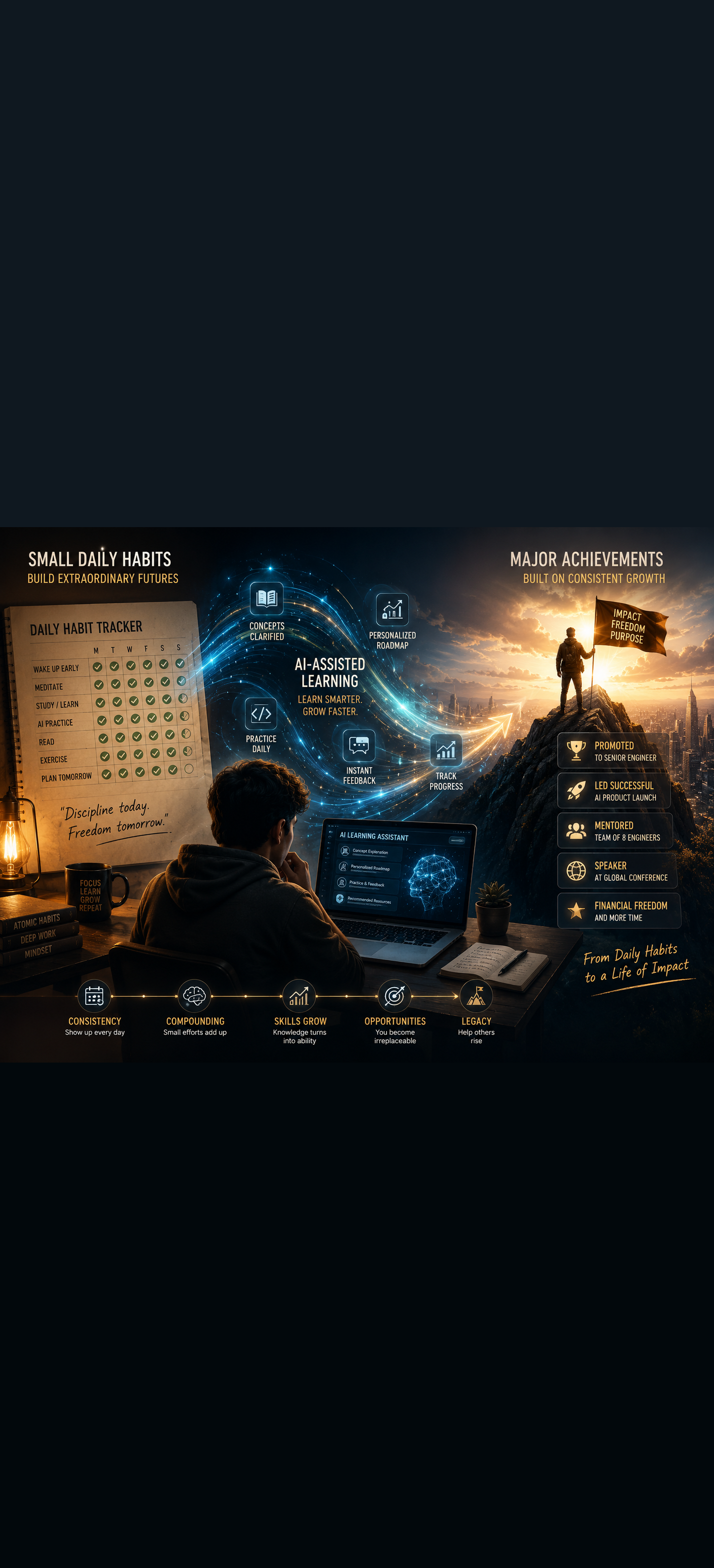
None of these steps are complicated. Each one takes minutes, not hours. But done consistently, they create a compounding advantage that separates fast learners from average ones.
Consider the math. If you retain just 30% more from each study session by using active recall and AI dialogue, and you study four times per week, your effective learning output doubles within a few months. You are not studying more. You are learning more from the same time investment.
That is the real power of using AI as a learning engine. It does not just save you time. It multiplies the value of every hour you invest in your own growth.
The top 10% of learners are not smarter than you. They have a better system. Now you have one too.
Start With One Step Today
Do not try to overhaul your entire learning approach at once. Pick one step from this guide and apply it in your very next study session.
Start with the AI quiz habit or the pre-learning overview. See how it feels. Notice how much more engaged you are compared to passive reading. Then add another step the following week.
Within 30 days, you will have built a learning system that most people never develop in a lifetime. And with AI tools becoming more capable every month, the advantage of using them intentionally will only grow.
Faster learning is not a talent. It is a practice. And you can start that practice today.
Want more insights like this? Subscribe to the AI Success Forum newsletter.