How to Use AI for Lead Generation and Client Acquisition
How to Use AI for Lead Generation and Client Acquisition
Finding clients is the part of running a business that most professionals find hardest, least enjoyable, and most inconsistent. The feast-and-famine cycle that plagues freelancers, consultants, and small business owners almost always traces back to an underdeveloped system for generating leads and converting them into paying clients.
AI has fundamentally changed what is possible in this area. Not by replacing the human relationship at the heart of every sale, but by compressing the time and effort required to identify the right prospects, reach them with the right message, and move them through a process that builds trust and generates decisions.
This guide covers exactly how to use AI for lead generation and client acquisition, from finding qualified prospects to closing them with less friction and better results.
Why Most Lead Generation Fails Without a System
Before getting into the AI tools and methods, it is worth understanding why most lead generation efforts underperform. The problem is almost never a lack of effort. It is a lack of system.
Inconsistent outreach produces inconsistent results. When you send ten cold emails one week and zero the next, you are not doing lead generation. You are doing occasional lead generation, which is a fundamentally different and far less effective activity.
AI solves the consistency problem by automating the parts of lead generation that do not require your personal judgment, leaving you to focus on the high-value human interactions that actually close business.
The goal is not to replace human connection in the sales process. The goal is to ensure that human connection happens at the right moment, with the right people, at a volume that creates a predictable pipeline.
Step One: Define Your Ideal Client Profile With AI Assistance
Every effective lead generation system starts with a precise understanding of who you are trying to reach. Most professionals have a vague sense of their target client. AI helps you sharpen that into something specific and actionable.
Use a tool like Claude or ChatGPT to build a detailed Ideal Client Profile by working through a structured set of questions about your best existing clients or your target market. Include:
- Industry, company size, and geography
- The specific problem they are experiencing that your service solves
- The trigger events that make them ready to buy, such as a new hire, a funding round, a regulatory change, or a seasonal pattern
- The language they use to describe their problem and the outcomes they want
- Where they spend their time online and which professional communities they belong to
The more specific your Ideal Client Profile, the more precisely you can target your outreach, the more relevant your messaging, and the higher your conversion rates at every stage of the process.
A prompt that works well for this exercise:
"I run a [type of business] that helps [target client] solve [specific problem]. Based on this, help me build a detailed Ideal Client Profile including firmographic characteristics, behavioral signals that indicate buying readiness, common objections, and the language my ideal clients use to describe their challenges."
Step Two: Use AI to Build Targeted Prospect Lists
Once you know exactly who you are looking for, AI tools can dramatically accelerate the process of finding them.
LinkedIn and Sales Navigator
LinkedIn remains the most powerful platform for B2B lead generation. Sales Navigator's advanced search filters allow you to identify prospects by industry, company size, job title, geography, seniority level, and recent activity signals like job changes and company growth.
AI tools layer on top of LinkedIn to make prospecting even more efficient. Tools like Apollo.io, Clay, and Hunter.io can pull contact data, enrich it with additional information, and help you build segmented lists of qualified prospects at a scale that manual research cannot match.
Apollo.io in particular has become a go-to platform for AI-assisted prospecting. It combines a large contact database with AI-powered filtering, email finding, and engagement tracking. You can define your Ideal Client Profile within the platform and generate a targeted list of hundreds of qualified prospects in minutes.
AI-Powered Research for Personalization
Raw prospect lists convert poorly because outreach built on them is generic. The professionals seeing the strongest results are combining list-building tools with AI research to add personalization signals to each prospect before reaching out.
Use AI to research each prospect's recent activity, including LinkedIn posts, company news, published content, and professional milestones, and identify a genuine, specific reason to reach out that goes beyond "I noticed you work in [industry]."
This does not have to be done manually for every contact. Tools like Clay can automate this enrichment process at scale, pulling data from multiple sources and using AI to generate personalized context for each prospect.
Step Three: Write High-Converting Outreach With AI
The quality of your outreach message is the single biggest variable in your response rate. Most cold outreach fails because it is self-focused, generic, and reads like a template even when it is not meant to.
AI tools help you write outreach that is relevant, specific, and oriented around the prospect's perspective rather than your own.
Cold Email That Actually Gets Responses
The structure of a high-converting cold email is well established. A subject line that creates curiosity without being clickbait. An opening line that demonstrates you know something specific about this person or company. A clear statement of the problem you solve. A brief, credible reason why you are worth a conversation. A low-friction call to action.
Use Claude or ChatGPT to draft multiple variations of this structure for each prospect segment, testing different angles and problem framings. Then review, refine, and personalize before sending.
A prompt that produces useful output:
"Write three variations of a cold email to a [job title] at a [company type]. My service helps them [specific outcome]. The opening line should reference [specific personalization signal]. Keep each email under 120 words. The call to action should ask for a 15-minute conversation, not a purchase."
LinkedIn Connection Requests and Messages
LinkedIn outreach converts best when the connection request message is brief, specific, and gives the recipient a clear reason to accept. After connection, the follow-up message should lead with value, not a pitch.
Use AI to draft connection request templates for each prospect segment and a follow-up message sequence that shares genuinely useful content or insight before making any ask. A three to four message sequence over two to three weeks, leading with value and ending with a soft invitation to connect, consistently outperforms single-message pitching.
Personalization at Scale
The tension in outreach is always between personalization and volume. Highly personalized outreach converts better but takes longer. Generic outreach is faster but converts poorly.
AI resolves this tension by making meaningful personalization achievable at scale. Tools like Lavender analyze your draft emails and score them for conversion likelihood, suggesting specific improvements. Smartwriter.ai generates personalized first lines for cold emails using publicly available information about each prospect, allowing you to combine AI-generated personalization with template-based efficiency.
Step Four: Automate Your Follow-Up Sequences
Most deals are not closed on the first contact. Research consistently shows that the majority of sales conversions happen between the fifth and twelfth touchpoint. Yet most professionals give up after one or two follow-ups because manual follow-up is tedious and easy to deprioritize when other work demands attention.
Automated follow-up sequences remove the human friction from this process. You define the sequence once, and the system executes it consistently for every prospect who enters your pipeline.
Email Sequences
Platforms like Instantly.ai, Lemlist, and Mailshake allow you to build multi-step email sequences with defined intervals and conditional logic. If a prospect opens your email but does not respond, the next message in the sequence goes out after a defined number of days. If they click a link, a different message triggers. If they reply, the sequence pauses and routes the conversation to you for personal follow-up.
AI tools within these platforms can generate sequence drafts, optimize sending times based on open rate data, and suggest subject line variations that improve deliverability and engagement.
LinkedIn Sequences
For LinkedIn outreach, tools like Expandi and Dripify automate the connection request, follow-up message, and engagement sequence within LinkedIn's guidelines. These tools allow you to run structured, multi-touch outreach campaigns at scale without manually managing each interaction.
The Follow-Up Rule That Changes Everything
The single most important mindset shift in follow-up strategy is this: follow-up is not pestering. It is service. Most non-responses are not rejections. They are consequences of a busy inbox and competing priorities.
A professional, value-oriented follow-up sequence that persists through five to eight touchpoints over three to four weeks will consistently outperform a one-touch strategy that assumes silence means no. AI makes this level of follow-up systematic rather than heroic.
Step Five: Use AI to Qualify Leads Faster
Not every lead deserves the same level of your time and attention. Spending an hour on a discovery call with a prospect who was never going to buy is one of the most common time drains in client acquisition.
AI tools help you qualify leads faster and more accurately before they reach your calendar.
AI-Powered Lead Scoring
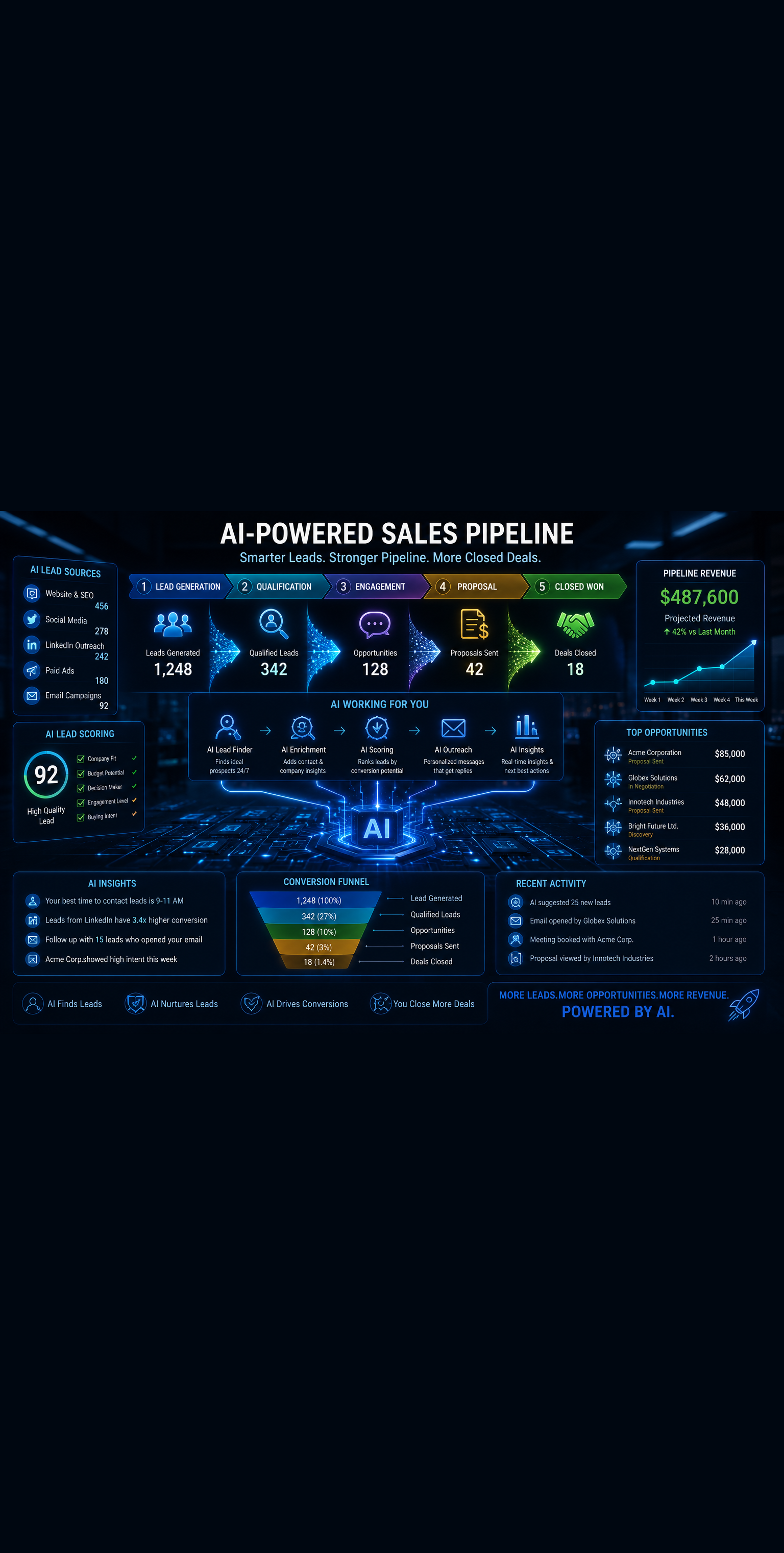
CRM platforms including HubSpot, Salesforce, and Pipedrive use AI to score leads based on engagement signals, demographic fit, and behavioral data. A prospect who has visited your pricing page three times, downloaded a resource, and opened four of your emails is a fundamentally different opportunity than someone who clicked through once from a social post.
AI lead scoring surfaces the highest-priority prospects automatically, allowing you to focus your personal attention where it will have the highest conversion impact.
Chatbots for Initial Qualification
An AI chatbot on your website or landing page can handle initial lead qualification 24 hours a day, asking the right questions to determine budget, timeline, authority, and fit before routing qualified prospects to your booking calendar.
This means the discovery calls on your calendar are already pre-qualified. The prospect has confirmed they have the budget, the timeline, and the decision-making authority before you invest your time in a conversation.
Tools like Drift, Intercom, and Tidio all support AI-powered lead qualification chatbots that integrate directly with your CRM and booking system.
Step Six: Create Content That Generates Inbound Leads
The most scalable form of lead generation is inbound. Content that attracts qualified prospects to you rather than requiring you to find them manually. AI tools make inbound content creation faster and more strategic than it has ever been.
AI-Assisted Blog and SEO Content
Every piece of content that ranks on Google for a search term your ideal client uses is a lead generation asset working around the clock. AI tools accelerate every stage of the content creation process, from keyword research and topic ideation to drafting, optimizing, and formatting.
Use tools like Surfer SEO or Clearscope to identify the specific terms your ideal clients are searching for and the content structure that ranks for those terms. Use Claude or ChatGPT to help you draft content faster, then edit with your genuine expertise and voice.
A blog with twenty well-optimized articles targeting high-intent search terms in your niche can generate a consistent stream of qualified inbound leads every month without any additional effort after the initial publication.
LinkedIn Thought Leadership
For B2B service providers, LinkedIn is the highest-leverage content platform available. Consistent, valuable content published on LinkedIn builds visibility with exactly the professional audience most likely to need your services.
AI tools help you generate content ideas, draft posts, and maintain a consistent publishing schedule without spending hours on content creation every week. The human contribution is your genuine perspective, your real experience, and the authentic voice that makes LinkedIn content actually build trust rather than just generate impressions.
A simple system: use AI to draft three to five LinkedIn post ideas based on a topic you know well, write and publish the strongest one each week, and engage authentically with the comments and conversations that follow.
Lead Magnets and AI-Generated Resources
A well-designed lead magnet, whether a guide, checklist, template, or mini-course, can convert anonymous website visitors into named, opted-in leads. AI tools make it practical to create high-quality lead magnets in a fraction of the time it used to require.
Identify the most common question or challenge your ideal client faces at the start of their buying journey. Create a focused resource that addresses it directly and delivers genuine value. Use AI to accelerate the writing and formatting, then gate it behind an email capture form.
Every person who downloads your lead magnet has self-identified as someone with the problem you solve. That is a warm lead, not a cold prospect.
Step Seven: Use AI to Prepare for and Follow Up After Sales Conversations
The lead generation process does not end when a prospect books a call. The quality of your preparation and follow-up around that conversation significantly impacts your close rate.
Pre-Call Research Automation
Before every discovery call, use AI to research the prospect's company, recent news, LinkedIn activity, and relevant industry context. A tool like Perplexity AI can aggregate this information quickly, giving you a comprehensive briefing in minutes.
Walking into a discovery call with specific knowledge about the prospect's business, their recent challenges, and their competitive environment signals a level of preparation that immediately differentiates you from the majority of service providers they will speak with.
AI-Generated Proposals
After a positive discovery call, the speed and quality of your proposal significantly impacts conversion rates. Prospects who receive a thoughtful, specific proposal within 24 hours of a conversation are far more likely to move forward than those who wait a week.
Use AI to generate a structured proposal draft based on the notes from your discovery call. Claude and ChatGPT both handle this well when given detailed input about the prospect's situation, stated goals, and the solution you are recommending. Review, personalize, and finalize within hours rather than days.
Post-Call Follow-Up Sequences
After every discovery call, regardless of outcome, trigger a defined follow-up sequence. For prospects who are interested but not yet decided, a sequence that provides relevant case studies, addresses common objections, and maintains visibility over the following weeks converts a meaningful percentage of maybes into yeses.
For prospects who said no, a low-touch sequence that keeps you visible and provides occasional value positions you perfectly for when their situation changes.
Building a Lead Generation System That Runs Consistently
The difference between professionals who struggle with client acquisition and those who have a full pipeline is almost always a matter of system versus effort.
Effort-based lead generation is exhausting and inconsistent. You generate leads when you have time, when motivation is high, and when other work is slow. System-based lead generation runs continuously because it is largely automated.
Build your system in layers. Start with one outbound channel, whether that is cold email, LinkedIn outreach, or a combination, and automate the parts that do not require your judgment. Add an inbound channel, typically content-based, that generates leads while you focus on delivery. Layer on lead scoring and qualification automation to ensure your time goes to the highest-value opportunities.
Review and optimize your system monthly. What is your lead volume? Where are they coming from? What is your response rate on outreach? What is your close rate on discovery calls? These numbers tell you exactly where to focus your improvement efforts.
Final Thoughts
AI has transformed lead generation and client acquisition from one of the most labor-intensive parts of running a business into one of the most systematizable. The professionals and businesses building strong pipelines in 2026 are not working harder than their competitors. They are working smarter, using AI to handle the volume and consistency while they focus on the human judgment and relationship-building that actually closes business.
The system described in this guide is not theoretical. Every component is being used by real businesses generating real revenue right now.
Start with one piece. Build your Ideal Client Profile. Set up a targeted prospect list. Draft your first outreach sequence. Launch it this week.
A full pipeline starts with the first message you send.
Want more insights like this? Subscribe to the AI Success Forum newsletter.