How to Stay Relevant in the Age of Artificial Intelligence

How to Stay Relevant in the Age of Artificial Intelligence
The age of artificial intelligence is not coming. It is already here. Every week, another tool automates a task that once required a human. Every month, another industry quietly shifts how it hires, promotes, and operates.
If you have ever wondered whether your job, your skills, or your value in the marketplace will survive this shift, you are not alone. But here is the truth: AI does not make humans irrelevant. It raises the bar for what relevant looks like.
This article gives you a clear, practical roadmap to stay relevant in the age of artificial intelligence, no matter what field you are in.
Why Staying Relevant in the Age of Artificial Intelligence Requires a New Mindset
Most people treat AI like a storm they need to wait out. That is the wrong approach.
The professionals who will thrive over the next decade are not the ones who ignore AI or fear it. They are the ones who understand it well enough to work alongside it, direct it, and add something it cannot replicate.
That starts with a mindset shift:
- Stop thinking of your job as a set of tasks. Start thinking of it as a set of outcomes.
- AI can handle tasks. Humans deliver judgment, context, relationships, and accountability.
- Your goal is not to compete with AI. It is to become more valuable because of it.
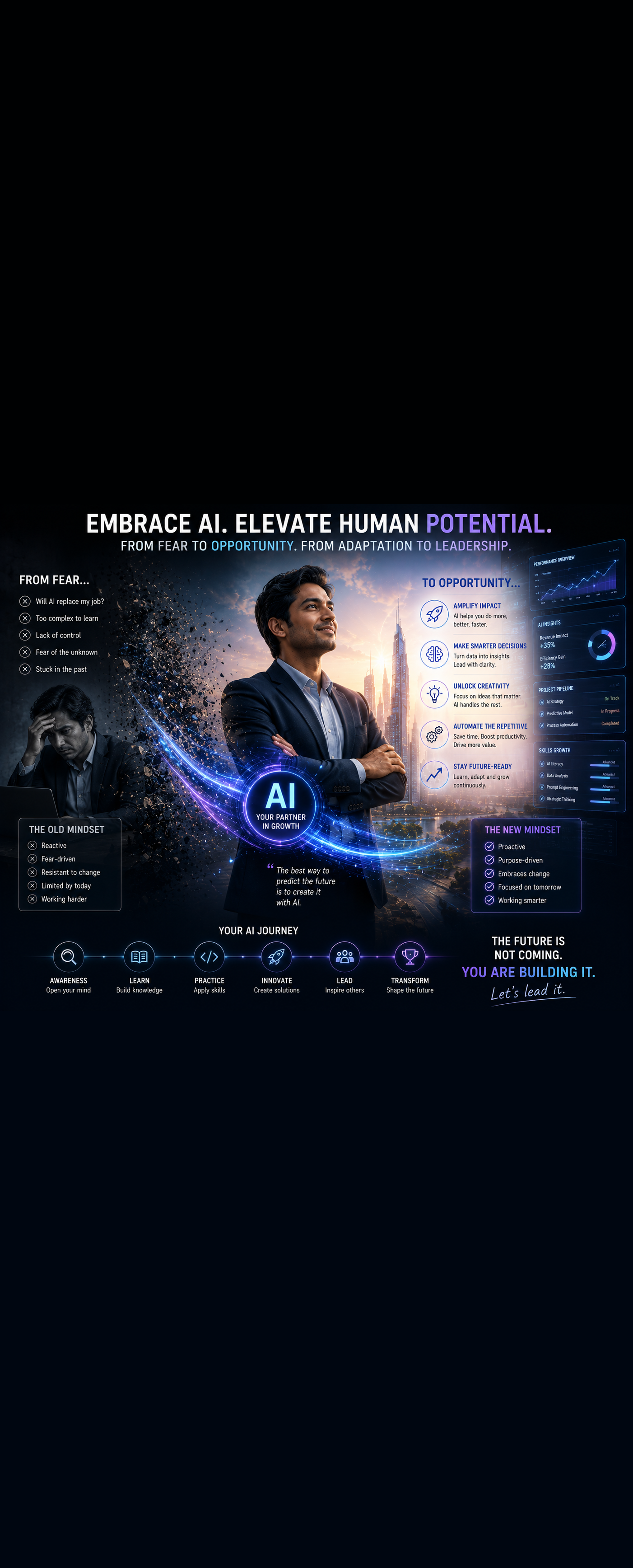
This reframe changes everything. Instead of asking "Will AI replace me?", you start asking "How do I use AI to become irreplaceable?"
Understand What AI Can and Cannot Do
Before you can position yourself effectively, you need an honest picture of AI's strengths and limitations.
What AI does well:
- Processing large volumes of data quickly
- Automating repetitive, rule-based tasks
- Generating first drafts, summaries, and code
- Pattern recognition at scale
Where AI still falls short:
- Nuanced human judgment in ambiguous situations
- Deep emotional intelligence and empathy
- Building trust and managing relationships
- Creative thinking that draws on lived experience
- Ethical reasoning in complex real-world contexts
The gap between what AI can do and what humans do best is exactly where you want to operate. Study that gap and build your career around it.
Build Skills That Compound Over Time
Not all skills are created equal when it comes to AI-proofing your career. Some skills will depreciate fast. Others will become more valuable precisely because AI handles the lower-level work.
Focus on High-Leverage Human Skills
These are skills that AI amplifies rather than replaces:
- Critical thinking: The ability to evaluate AI outputs, spot errors, and make decisions from incomplete information
- Communication: Translating complex ideas for different audiences, managing conflict, persuading stakeholders
- Leadership: Inspiring teams, navigating organizational dynamics, making calls under pressure
- Creativity: Generating genuinely novel ideas, not just remixing existing ones
- Domain expertise: Deep knowledge in a specific field that lets you guide and verify AI outputs
Learn How to Use AI Tools Effectively
Here is where many professionals make a mistake. They avoid AI tools out of pride or fear, and they fall behind. Learning to use tools like ChatGPT, Claude, Midjourney, or industry-specific AI platforms is no longer optional.
Platforms like Coursera, Udemy, and LinkedIn Learning now offer practical AI literacy courses that you can complete in a weekend. If you want to go deeper, prompt engineering guides and AI productivity courses can help you build workflows that multiply your output without sacrificing quality.
The professional who knows their industry and knows how to use AI tools is significantly more valuable than one who only knows one or the other.
Stay Relevant in the Age of Artificial Intelligence Through Continuous Learning
The half-life of skills is shrinking. What made you hireable five years ago may not be enough five years from now.
The solution is not to learn everything. It is to build the habit of learning consistently.
Create a Personal Learning System
A few practical approaches that work:
- Set aside 30 minutes each morning for reading, a course, or skill practice
- Follow thought leaders in your field on LinkedIn and X
- Subscribe to newsletters that summarize AI developments in plain language
- Join professional communities where peers share tools and strategies
Staying informed does not require hours a day. It requires intentionality. A small daily investment adds up to a significant edge over time.
Pursue Certifications That Signal Credibility
Credentials still matter, especially when they are backed by respected institutions. Google, Microsoft, IBM, and dozens of universities now offer AI and data literacy certifications that are recognized by employers.
Adding relevant certifications to your profile signals that you are not just talking about adapting. You are doing it.
Cultivate a Strong Professional Network
In an era where AI can generate content, analyze data, and write code, human relationships become a more important differentiator, not less.
Opportunities still flow through people. Referrals, collaborations, mentorships, and inside information about industry shifts all move through networks. If you are invisible in your professional community, AI disruption will hit you harder because you have no buffer.
How to Build Your Network Intentionally
- Show up consistently on LinkedIn with thoughtful posts and comments
- Attend industry conferences, even virtual ones
- Offer value before asking for anything
- Reconnect with past colleagues and mentors regularly
Being known, trusted, and liked in your field is a competitive advantage that no AI model can replicate for you.
Develop a Personal Brand That Showcases Your Unique Value
In the age of AI, personal branding is not vanity. It is strategy.
When your expertise is visible, people seek you out. When you are invisible, you compete on price against everyone else. Building a personal brand means making your knowledge, perspective, and results easy to find and trust.
Practical Ways to Build Your Brand
- Write short articles or posts sharing lessons from your work
- Record short videos explaining concepts in your field
- Contribute to relevant online communities and forums
- Build a simple portfolio site or optimize your LinkedIn profile to reflect your current skills and focus
You do not need a massive following. You need the right people to know who you are and what you stand for. Even a small, engaged audience can open doors that cold applications never will.
Embrace Change as a Career Asset
One of the most underrated traits in today's job market is adaptability. Companies are navigating AI integration, workforce shifts, and market uncertainty all at once. People who can move through change without falling apart are genuinely rare and genuinely valuable.
Adaptability is not a personality trait you either have or do not. It is a skill you practice.
Start by reframing how you talk about change. Instead of "this is hard," try "this is new, and I can figure it out." Instead of waiting for certainty, practice making good decisions with incomplete information.
The professionals who will look back at this era as a career-defining opportunity are the ones who leaned in while others pulled back.
Take Ownership of Your Career Trajectory
No employer, no government, and no algorithm is responsible for keeping your career relevant. That responsibility sits with you.
This is not a harsh reality. It is actually empowering. It means you have more control than you think.
Here is a simple quarterly review you can do on your own:
- What skills did I build this quarter?
- What tools have I learned to use?
- Who did I connect with or learn from?
- What results did I produce that I can point to?
- What do I need to focus on next?
This kind of intentional self-management separates professionals who drift from those who grow. AI will accelerate the gap between the two groups. Make sure you are on the right side of it.
Conclusion: Your Relevance Is a Choice
The age of artificial intelligence is the most significant career shift most of us will experience in our lifetimes. That is not a reason to panic. It is a reason to move with purpose.
Stay curious. Build skills that compound. Use AI as a multiplier rather than a threat. Invest in relationships and your personal brand. Take responsibility for your own growth.
Relevance is not something that happens to you. It is something you build, day by day, decision by decision.
The best time to start was yesterday. The second-best time is right now.
Want more insights like this? Subscribe to the AI Success Forum newsletter.