Complete AI Learning Roadmap for 2026
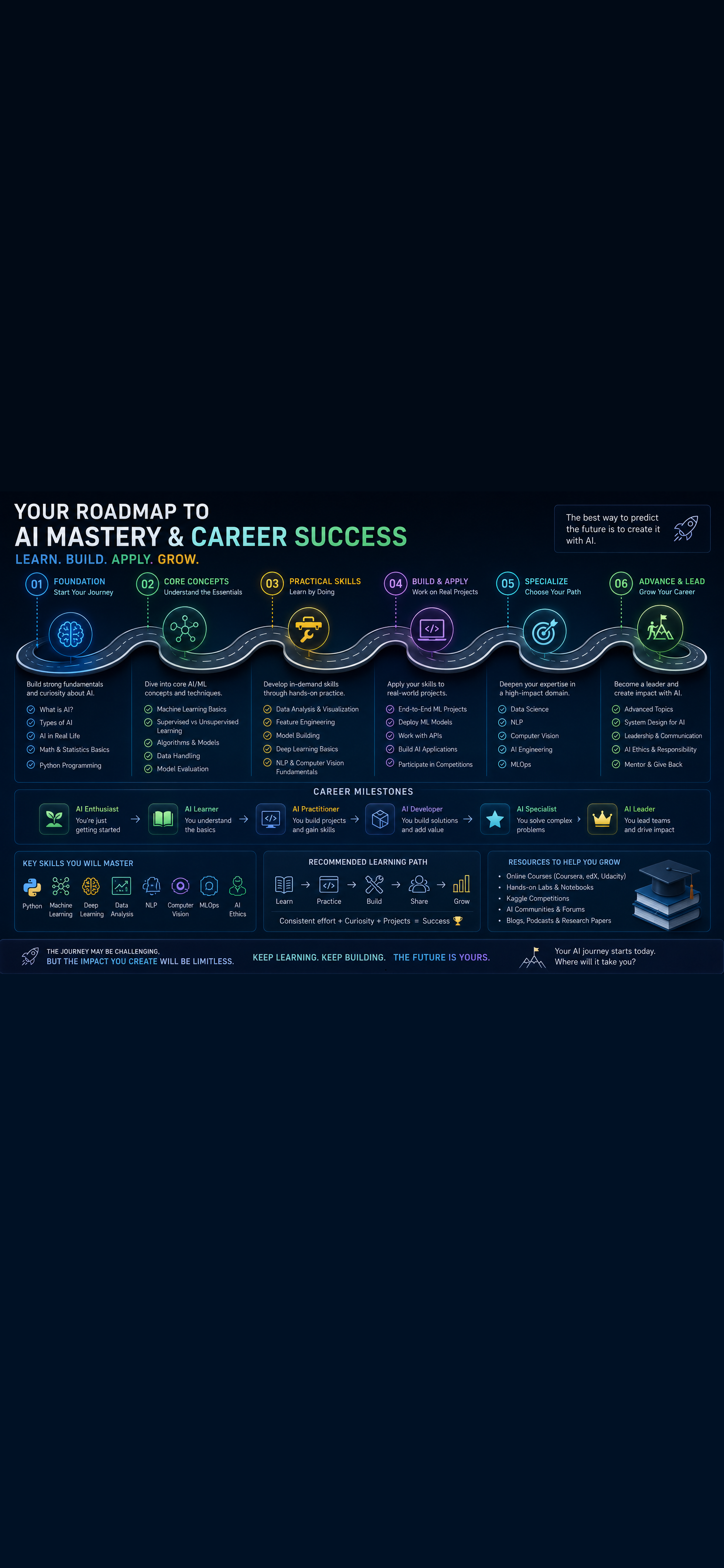
Complete AI Learning Roadmap for 2026
The number one reason people fail to build real AI skills is not lack of resources. It is lack of direction. In 2026, there is more AI learning content available than any one person could consume in a lifetime. The problem is not access. It is knowing what to learn, in what order, and for what purpose.
A roadmap solves that. Not a vague list of topics to eventually explore, but a structured, sequential path that takes you from where you are right now to where you want to be, with clear milestones and practical applications at every stage.
This is that roadmap. Whether you are starting from zero or looking to advance beyond your current level, this guide gives you a clear, actionable path for building meaningful AI competency in 2026.
How to Use This Roadmap
Before diving into the stages, a few principles that will make this roadmap work for you rather than overwhelm you.
Move sequentially. Each stage builds on the one before it. Jumping to advanced topics without foundational literacy is one of the most common reasons AI learners get frustrated and quit.
Apply before advancing. Do not move to the next stage until you have used the skills from the current one on a real task. Application is what converts learning into lasting competency.
Adjust the timeline to your life. The time estimates in this roadmap assume consistent effort of 20 to 30 minutes daily. If you can do more, you will move faster. If life is busier, give yourself more time. The path matters more than the pace.
Measure outcomes, not hours. Progress is not defined by how many videos you have watched. It is defined by what you can now do that you could not do before.
Stage 1: AI Foundations (Weeks 1 to 4)
What You Are Building
Before touching any AI tool in depth, you need a functional mental model of what AI actually is, how it works at a conceptual level, and what it can and cannot do. This foundation prevents the confusion and misplaced expectations that derail most beginners.
What to Learn
Start with the core concepts every AI practitioner understands regardless of their role or technical level:
- What artificial intelligence, machine learning, and deep learning mean and how they relate to each other
- How large language models work at a non-technical level
- What training data is and why it matters
- The difference between generative AI, predictive AI, and analytical AI
- Basic responsible AI principles including bias, fairness, and transparency
Recommended Resources
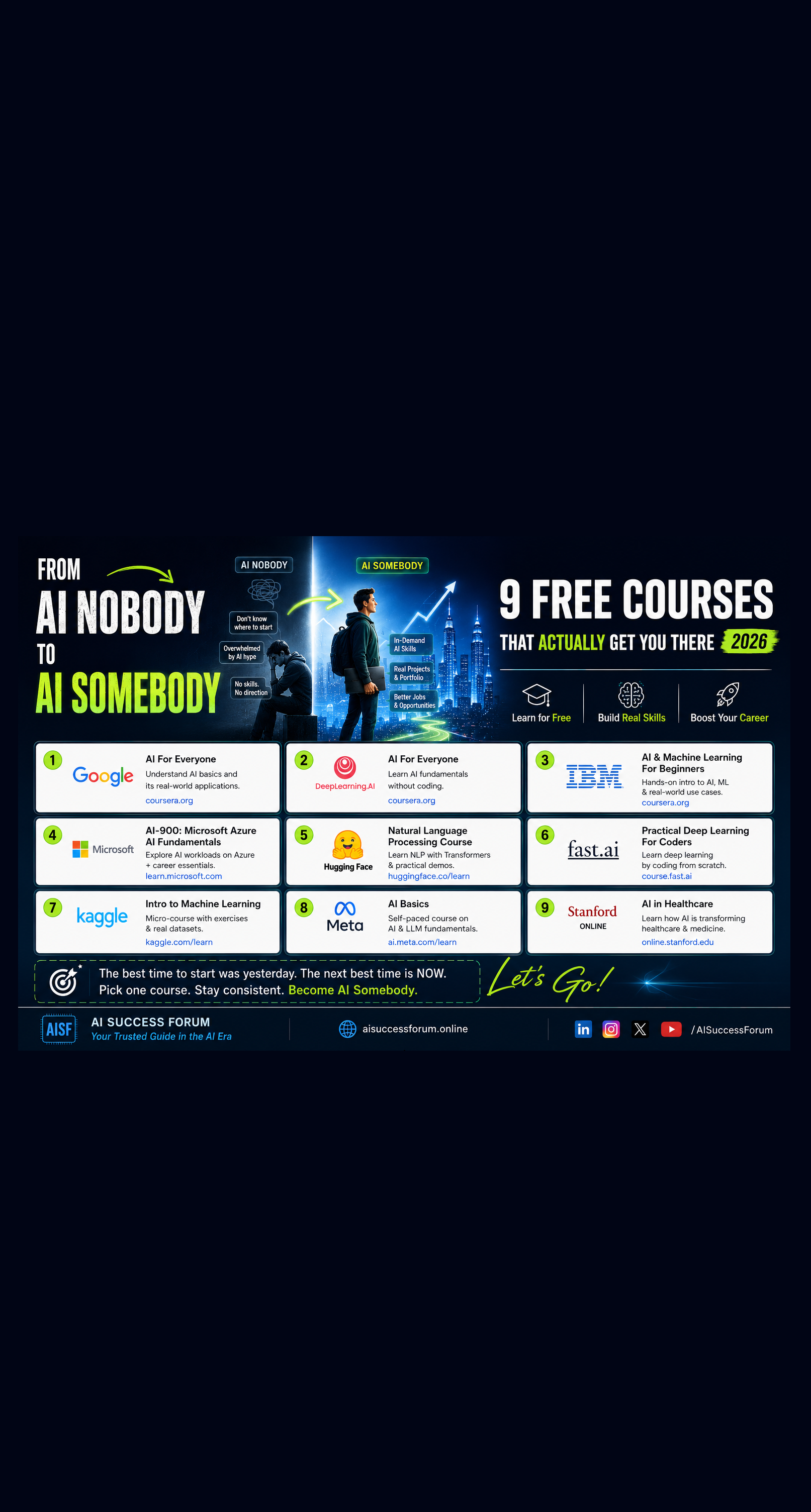
AI For Everyone by Andrew Ng on Coursera is the gold standard for non-technical AI foundations. It covers exactly the conceptual territory you need without requiring any technical background.
Elements of AI from the University of Helsinki is a free, interactive course that goes slightly deeper on how AI systems are built. It complements Andrew Ng's course well and takes most learners four to six hours to complete.
Milestone Check
You are ready to move to Stage 2 when you can explain in plain language what a large language model is, give three real-world examples of AI applications in your industry, and articulate one genuine limitation of current AI systems.
Stage 2: Practical AI Tool Fluency (Weeks 5 to 8)
What You Are Building
Conceptual understanding without hands-on experience is not useful in the real world. Stage 2 is about getting your hands on the tools that are transforming professional work and building genuine comfort with them.
What to Learn
- Using ChatGPT and Claude for real professional tasks including writing, research, summarization, and problem solving
- Core prompt engineering principles: clarity, context, role assignment, and output formatting
- How to evaluate AI outputs critically rather than accepting everything at face value
- Practical workflows for integrating AI into your existing daily work
The Practice Protocol
During this stage, commit to using at least one AI tool every single day on a real task. Not a practice exercise. A real email, a real document, a real problem from your actual work.
After each session, ask yourself two questions. What did the AI do well that I should replicate? What did I need to correct or adjust, and why? This reflection habit accelerates skill development faster than any course alone.
Recommended Resources
Prompt Engineering for ChatGPT from Vanderbilt University on Coursera provides the most structured and rigorous approach to prompt engineering available for non-technical learners.
Top-rated ChatGPT practical courses on Udemy are excellent for seeing prompt techniques applied to specific professional contexts. Look for courses updated within the last three months to ensure current content.
Milestone Check
You are ready for Stage 3 when you can reliably use AI to complete three or more specific tasks in your professional role with noticeably better output quality than you produced manually, and when you can write a prompt that consistently gets you close to the result you need on the first or second attempt.
Stage 3: Role-Specific AI Skills (Weeks 9 to 16)
What You Are Building
General AI fluency is valuable. Role-specific AI expertise is where career differentiation happens. Stage 3 is about going deep in the AI applications most relevant to your specific professional context.
What to Learn by Role
For data analysts and BI professionals: SQL generation and optimization with AI assistance, Power BI AI features including smart narratives and anomaly detection, Python for data analysis with AI-assisted coding, and using AI to translate data insights into executive narratives. The PL-300 Microsoft Power BI certification is the recommended formal credential for this path.
For marketing and content professionals: AI-powered content strategy and ideation, brand-consistent prompt frameworks, AI tools for visual content creation, SEO and content optimization workflows using AI, and scaling content production without sacrificing quality.
For business analysts and operations professionals: Process documentation and optimization using AI, AI-assisted report and presentation creation, workflow automation through AI-integrated tools, and using AI for competitive research and market analysis.
For managers and team leaders: Using AI for meeting summaries and action item tracking, AI-assisted communication and stakeholder management, building team AI literacy and adoption frameworks, and responsible AI governance at the organizational level.
For developers and technical professionals: AI-assisted coding with tools like GitHub Copilot, using AI for code review and debugging, prompt engineering for technical outputs, and integrating AI APIs into existing applications.
Recommended Resources
Microsoft Learn for role-specific paths within the Microsoft ecosystem. The AI-900 certification is the recommended foundational credential regardless of role, with PL-300 or AI-102 as the natural next step for analysts and technical professionals respectively.
Google Advanced Data Analytics Certificate on Coursera for data-focused professionals wanting a comprehensive credential with strong market recognition.
LinkedIn Learning for management and leadership-focused AI applications integrated directly with your professional profile.
Udemy for role-specific tool courses that are updated frequently and directly applicable to specific workflows.
Milestone Check
You are ready for Stage 4 when you have earned at least one formal credential relevant to your role, can point to three specific examples of AI improving your work output quality or speed, and have become the person colleagues come to with AI questions.
Stage 4: Advanced Capabilities and Specialization (Months 5 to 8)
What You Are Building
By Stage 4, you have functional AI fluency and role-specific skills. Now you are building the advanced capabilities that position you for leadership, higher compensation, and the ability to shape how AI is used within your organization rather than just adopting what others decide.
What to Learn
Advanced prompt engineering and prompt chaining: Complex workflows that string multiple AI interactions together, structured output formats for systematic data extraction, building reusable prompt libraries for teams, and techniques like chain-of-thought and few-shot prompting for sophisticated use cases.
AI workflow automation: Connecting AI tools to existing business systems through platforms like Zapier, Make, and Microsoft Power Automate. Building automated pipelines that reduce manual work at scale.
Machine learning literacy for non-technical professionals: Understanding how predictive models work well enough to evaluate their outputs critically, communicate with data science teams effectively, and identify when machine learning is the right approach to a business problem.
AI ethics and governance: Understanding bias in AI systems, privacy considerations in AI tool adoption, regulatory frameworks affecting AI use in your industry, and how to build responsible AI practices within teams and organizations.
Recommended Resources
DeepLearning.AI short courses for advanced prompt engineering and specific AI capability deep dives. Many are free or very low cost and delivered in focused formats that fit busy professional schedules.
Machine Learning for Business Analysts on Coursera for building the conceptual ML literacy that supports senior and leadership roles.
Microsoft AI-102 certification path for technical professionals ready to move into AI solution design and implementation.
Milestone Check
You are ready for Stage 5 when you have built at least one AI-powered workflow that saves measurable time for yourself or your team, can evaluate an AI system's outputs critically and identify its limitations in a specific business context, and are actively contributing to AI adoption conversations in your organization.
Stage 5: AI Leadership and Continuous Evolution (Month 9 and Beyond)
What You Are Building
The final stage is not a destination. It is a mode of operating. By this point you have real AI competency. Stage 5 is about translating that competency into leadership, organizational influence, and a sustainable habit of continuous learning in a field that never stops evolving.
What to Focus On
Build and share: Create content, guides, or frameworks that help your colleagues and professional network use AI more effectively. Teaching is the most powerful learning reinforcement available, and public sharing builds professional visibility that pays career dividends.
Lead AI initiatives: Volunteer to lead or contribute to AI adoption projects within your organization. The professionals who shape how their organizations use AI in 2026 are building career capital that will compound for years.
Stay current systematically: Build a weekly habit of consuming one piece of AI news or research relevant to your field. Newsletters, industry publications, and AI-focused communities keep you current without requiring hours of research.
Pursue advanced credentials selectively: Not every certification adds value. Choose advanced credentials based on what your specific career goals require. The Microsoft AI-102, Google Professional Machine Learning Engineer, and DeepLearning.AI specializations are strong options for professionals in technical or leadership roles.
Mentor others: Find one person earlier in their AI learning journey and help them move forward. Mentorship solidifies your own expertise, builds your professional network, and contributes to the broader goal of AI literacy in your industry.
Your 90-Day Quick Start Plan
If the full roadmap feels overwhelming, here is a simplified 90-day plan that gets you moving immediately and builds the foundation for everything that follows.
Days 1 to 10: Complete AI For Everyone on Coursera. Use ChatGPT or Claude daily for one real work task. Document what works and what does not.
Days 11 to 30: Complete a practical prompt engineering course on Udemy or Coursera. Build a personal prompt library of ten prompts tailored to your most common work tasks.
Days 31 to 60: Begin the AI-900 Microsoft Azure AI Fundamentals learning path on Microsoft Learn. Apply role-specific AI techniques to three real projects. Schedule your AI-900 exam.
Days 61 to 90: Pass the AI-900 exam. Identify your role-specific Stage 3 learning path. Begin your first role-specific course. Start contributing to one AI learning community online.
By day 90 you will have a formal credential, a practical prompt library, a daily AI habit, and a clear direction for the next phase of your learning journey. That is a fundamentally different professional position than where you started.
Common Mistakes That Slow Down AI Learners
Even with a clear roadmap, certain patterns consistently derail progress. Knowing them in advance is half the battle.
Skipping foundations to chase advanced topics. Advanced AI applications built on shaky foundations produce inconsistent results and create frustration. The stages in this roadmap are sequenced deliberately. Respect the sequence.
Learning without applying. Watching hours of AI content without using tools on real work is a slow path to nowhere. Every stage of this roadmap requires application, not just consumption.
Chasing every new tool. A new AI tool launches every week. Chasing novelty instead of depth is one of the most common traps for AI learners. Go deep on a core set of tools before expanding.
Measuring progress by certificates instead of capabilities. Certificates matter for career signaling but they are not the actual goal. The goal is being able to do things you could not do before. Keep that as your primary measure of progress.
Learning alone. Community accelerates learning dramatically. Finding even one peer who is also building AI skills creates accountability, shared discovery, and the kind of honest conversation that solo learning rarely produces.
Conclusion: The Roadmap Is Ready. Now It Is Your Turn.
Everything in this guide exists to solve one problem. Getting you from wherever you are right now to where you want to be with AI skills, as efficiently and effectively as possible.
The roadmap is clear. The resources are available. Most of the best ones are free or low cost. The only remaining variable is you.
The professionals who will look back on 2026 as the year that changed their careers are not the ones who found the perfect learning plan. They are the ones who started an imperfect one and kept going. They built the habit, accumulated the skills, earned the credentials, and showed up consistently in a field where most people are still waiting to feel ready.
You do not need to complete the entire roadmap before your life improves. Every stage delivers real value. Every skill you build compounds with the ones that follow. Every day you invest in learning creates a version of your professional self that is more capable, more confident, and more relevant than the day before.
Start at Stage 1 today if you are new to AI. Start at the stage that honestly reflects where you are if you have some exposure already. Set a 90-day goal. Block out 25 minutes tomorrow morning. Open one resource from this guide and begin.
The roadmap is ready. The only question is whether you are.
Choose your starting stage, bookmark one resource from this guide, and schedule your first learning session for tomorrow. Your AI learning journey starts with that single committed action.
Want more insights like this? Subscribe to the AI Success Forum newsletter.