Best AI Courses for Students Looking to Future-Proof Their Careers

Best AI Courses for Students Looking to Future-Proof Their Careers
The students entering the workforce over the next few years are walking into something no previous generation has faced. A job market being actively reshaped by artificial intelligence in real time, across virtually every industry, at a pace that is only accelerating.
That reality cuts two ways. For students who arrive with AI skills, it represents one of the most significant career advantages available. For those who arrive without them, it represents a genuine and growing gap that will only widen over time.
The good news is that students have something working professionals do not. Time and flexibility to build a serious AI foundation before the pressure of a full-time career makes consistent learning harder. This guide covers the best AI courses for students in 2026, how to choose the right ones, and how to build a skill set that makes you genuinely attractive to employers from day one.
Why AI Skills Matter More for Students Than Anyone Else
Working professionals need AI skills to stay relevant. Students need them to get started.
Employers across industries are increasingly screening for AI literacy at the entry level. Marketing teams want graduates who can use AI tools for content and campaign work. Finance firms want analysts who can work with AI-assisted data tools. Consulting practices want associates who understand how to apply AI to client problems. Healthcare organizations want practitioners who understand AI-assisted diagnostics and administration.
This is not a future scenario. It is the hiring reality students are graduating into right now.
A student who arrives at their first interview with demonstrated AI competency, a couple of recognized certifications, and a portfolio of AI-assisted projects stands in a fundamentally different position from a peer with the same degree and no AI skills. The degree is the baseline. AI skills are what differentiate.
Building those skills now, before you enter the workforce, is one of the highest-return investments you can make in your early career.
What AI Skills Should Students Actually Build?
Before choosing courses, it helps to be intentional about what kind of AI skills create real career value.
The most employable combination for most students is:
- Foundational AI literacy – understanding what AI is, how it works conceptually, and what it can and cannot do
- Practical tool fluency – the ability to use AI tools productively in professional contexts
- Prompt engineering – the skill of communicating with AI models effectively to produce reliable, high-quality outputs
- Field-specific AI application – understanding how AI is being used in your specific intended career field
This combination signals to employers that you are not just aware of AI but genuinely capable of contributing to AI-assisted work from day one.
Best AI Courses for Students in 2026
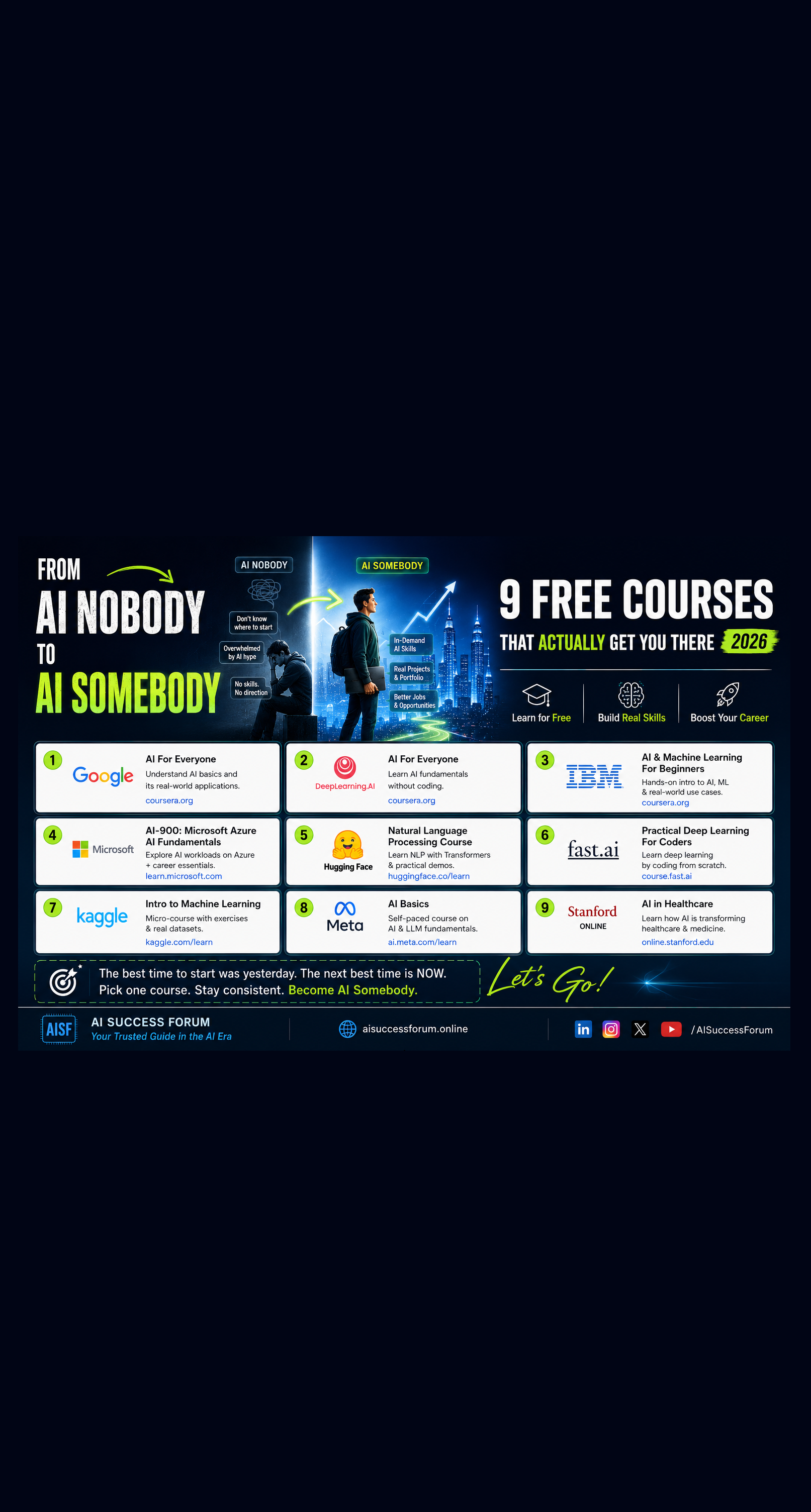
1. AI For Everyone by Andrew Ng (Coursera)
This is the single best starting point for students regardless of major or career direction. Andrew Ng, one of the most respected voices in AI education globally, designed this course specifically for non-technical learners who want to understand AI without writing any code.
The course covers how AI and machine learning work at a conceptual level, how to identify AI opportunities in different professional contexts, and how to navigate the ethical and organizational dimensions of AI adoption. It takes most students four to six hours to complete and produces a Coursera certificate that carries genuine weight.
For students who have never studied AI before, this course provides the mental model everything else builds on. It is free to audit and widely recognized by employers who see it on resumes and LinkedIn profiles.
Best for: All students, regardless of major, as a foundational starting point.
Platform: Coursera Cost: Free to audit, certificate with subscription
2. Google AI Essentials (Coursera)
Google built this course specifically to address the AI literacy gap in the professional workforce, and it translates perfectly to students preparing to enter that workforce. The curriculum focuses on practical, responsible use of AI tools in workplace settings, prompt writing, evaluating AI outputs critically, and understanding AI limitations.
The Google name on the certificate carries significant weight with employers, particularly in technology, marketing, and business roles. For students applying to competitive entry-level positions, a Google AI Essentials certificate on a LinkedIn profile signals genuine AI competency in a way that is immediately credible.
Google also maintains hiring program partnerships through several Coursera certificates, which means completing this course opens doors beyond just skill development.
Best for: Students targeting careers in technology, marketing, business, and any role in Google-ecosystem organizations.
Platform: Coursera Cost: Included with Coursera subscription
3. Elements of AI (University of Helsinki)
This completely free course from the University of Helsinki is one of the most widely completed AI introductions in the world, with millions of learners across more than 170 countries. It strikes a rare balance between conceptual depth and genuine accessibility.
Students who complete Elements of AI develop a real understanding of how AI systems are built and why they work the way they do. Topics include machine learning, neural networks, natural language processing, and the societal implications of AI, all taught without requiring any mathematical or programming background.
For students in non-technical programs who want to demonstrate serious AI engagement without spending money, this is an outstanding option. The certificate of completion is recognized in academic and professional contexts internationally.
Best for: Students in any field who want conceptual depth without cost, particularly those in humanities, social sciences, business, or design.
Platform: elementsofai.com Cost: Completely free
4. Prompt Engineering for ChatGPT by Vanderbilt University (Coursera)
Prompt engineering is emerging as one of the most transferable and valuable AI skills available to students in any field. This course from Vanderbilt University goes significantly deeper than most beginner content, covering the principles behind why certain prompts work better than others, advanced techniques like chain-of-thought prompting and role assignment, and how to build structured workflows using AI tools.
For students who already have basic familiarity with ChatGPT or other AI tools and want to use them with genuine skill, this course is the most rigorous available at a non-technical level. A Vanderbilt University certificate also adds academic credibility that reinforces the credential on a student resume.
Best for: Students who already use AI tools casually and want to develop expert-level prompting skills that apply across any profession.
Platform: Coursera Cost: Free to audit, certificate with subscription
5. Microsoft Azure AI Fundamentals AI-900 (Microsoft Learn)
The AI-900 certification is the entry-level Microsoft AI credential, and it is appearing more frequently in entry-level job descriptions across industries that operate within Microsoft-ecosystem environments. For students, the combination of a free learning path and a globally recognized vendor certification makes this one of the highest-value investments of time available.
The AI-900 exam covers AI concepts, machine learning basics, Azure AI services, and responsible AI principles. No programming background is required. The free preparation path on Microsoft Learn is thorough, well-structured, and prepares students completely for the exam.
For students targeting corporate, enterprise, or government roles where Microsoft tools are standard, this certification is a direct differentiator in hiring.
Best for: Students targeting roles in enterprise organizations, government, finance, healthcare, or any field where Microsoft tools are standard.
Platform: Microsoft Learn Cost: Free learning path, exam fee approximately $165
6. IBM AI Foundations for Everyone Specialization (Coursera)
IBM's professional certificate in AI foundations is one of the most comprehensive entry-level AI credentials available on Coursera. The specialization covers AI concepts, machine learning fundamentals, deep learning basics, and the ethics and applications of AI across industries.
IBM certificates carry significant weight in enterprise hiring pipelines, particularly in consulting, technology, and financial services. For students targeting careers in these sectors, the IBM name on a certificate creates visibility in exactly the right places.
The specialization takes most students six to eight weeks to complete at a reasonable pace and produces a portfolio of completed projects that can be referenced in interviews.
Best for: Students targeting enterprise technology, consulting, financial services, or any career where IBM's industry relationships create hiring advantages.
Platform: Coursera Cost: Included with Coursera subscription, free audit available
7. Generative AI for Everyone by DeepLearning.AI (Coursera)
DeepLearning.AI has built one of the most trusted AI education brands in the world, and this course reflects that reputation. Generative AI for Everyone is designed for professionals and students without technical backgrounds who want deep, practical understanding of generative AI tools including ChatGPT, image generation models, and AI writing assistants.
The curriculum covers how large language models work, how to use them effectively in professional contexts, how to evaluate their outputs critically, and how to identify high-value applications of generative AI in specific career fields. The combination of conceptual depth and practical guidance makes it one of the best all-around AI courses available for students.
Best for: Students who want a rigorous, well-respected credential from one of the most recognized names in AI education.
Platform: Coursera Cost: Free to audit, certificate with subscription
8. Career-Specific AI Courses on Udemy
Beyond foundational and credentialing courses, students benefit enormously from at least one course that shows them how AI is being applied specifically in their intended career field. Udemy hosts an extensive catalog of field-specific AI courses covering areas including:
- AI for marketing and content creation
- AI tools for finance and accounting students
- AI-assisted research and writing for humanities students
- AI in healthcare administration and clinical decision support
- AI for educators and instructional designers
- AI-powered coding and software development
These courses are regularly updated by practitioners actively working in those fields, which means the content reflects current industry reality rather than academic projections. For students, the ability to walk into an interview and reference specific AI applications in their target industry is a significant differentiator.
Best for: Students in any field who want to complement foundational credentials with role-specific AI knowledge.
Platform: Udemy Cost: Typically $12 to $20 during frequent sales
How to Build Your Student AI Learning Path
Rather than taking courses randomly, a sequenced approach produces significantly better outcomes.
Months 1 to 2: Build your foundation with AI For Everyone or Elements of AI. Get your conceptual baseline solid before moving to tools.
Months 2 to 3: Develop practical tool fluency with the Google AI Essentials course and daily use of ChatGPT or Claude on real academic tasks. Writing, research, summarization, and problem solving are all legitimate practice ground.
Months 3 to 4: Pursue your first formal credential. AI-900 from Microsoft or the IBM AI Foundations Specialization are both strong choices that employers recognize.
Months 4 to 6: Go deep on your field-specific application. Choose a Udemy course in your intended career area and pair it with the Vanderbilt prompt engineering course for advanced practical skills.
Ongoing: Build a portfolio. Document every AI project, workflow, and application you develop. A portfolio of practical AI work is more convincing to most employers than any certificate alone.
Building an AI Portfolio That Employers Notice
Certificates tell employers you have studied AI. A portfolio shows them you can use it. For students, building a practical AI portfolio alongside formal credentials creates a combination that is genuinely compelling in interviews.
Every time you use AI to complete a meaningful project, document it. What was the task? What tools did you use? What prompts produced the best results? What was the outcome? A simple document or portfolio site tracking these projects over months becomes a powerful interview asset.
Strong portfolio projects for students include AI-assisted research papers with documented methodology, AI-powered data analysis projects from coursework, content or marketing campaigns built with AI tools, AI workflow designs for a hypothetical business problem in your intended field, and prompt libraries developed for specific academic or professional use cases.
None of these require anything beyond the skills you are building through the courses on this list. They simply require the habit of applying and documenting.
Making the Most of Free Resources
Cost should not be a barrier to building strong AI skills as a student. Between Microsoft Learn, Elements of AI, Coursera free audits, and DeepLearning.AI short courses, there is enough free high-quality AI content available to build serious foundational competency without spending a dollar.
Coursera also offers financial aid for certificates, making the credentialing layer accessible to students who cannot afford the subscription cost. The application process is straightforward and approval rates for students are high.
Prioritize earning credentials on the certifications that cost money, such as the AI-900 exam, because the formal credential is where the career value concentrates. Use free resources to build the underlying knowledge, then invest in the exam that produces the verifiable, employer-recognized outcome.
Conclusion: The Students Who Start Now Win Later
The career landscape students are entering in 2026 rewards AI competency in ways that compound over time. The student who arrives with a foundation of AI skills, a couple of recognized credentials, and a portfolio of practical applications does not just get a better first job. They build on a foundation that grows in value with every year of professional experience.
You have something that working professionals scrambling to learn AI do not. Time, flexibility, and the ability to build deliberately without the pressure of an existing job demanding your attention.
Use that advantage. Choose one course from this guide and start this week. Apply what you learn to your actual coursework and projects. Build the habit of using AI as a thinking partner and productivity tool in everything you do academically.
By the time you graduate, the gap between you and peers who waited will be visible. Not just to employers, but to you.
Pick one course from this list today, create a free account on the platform, and complete your first lesson before the end of the week. Your future career is being built right now, one session at a time.
Want more insights like this? Subscribe to the AI Success Forum newsletter.