Best AI Courses for Data Analysts
Best AI Courses for Data Analysts in 2026
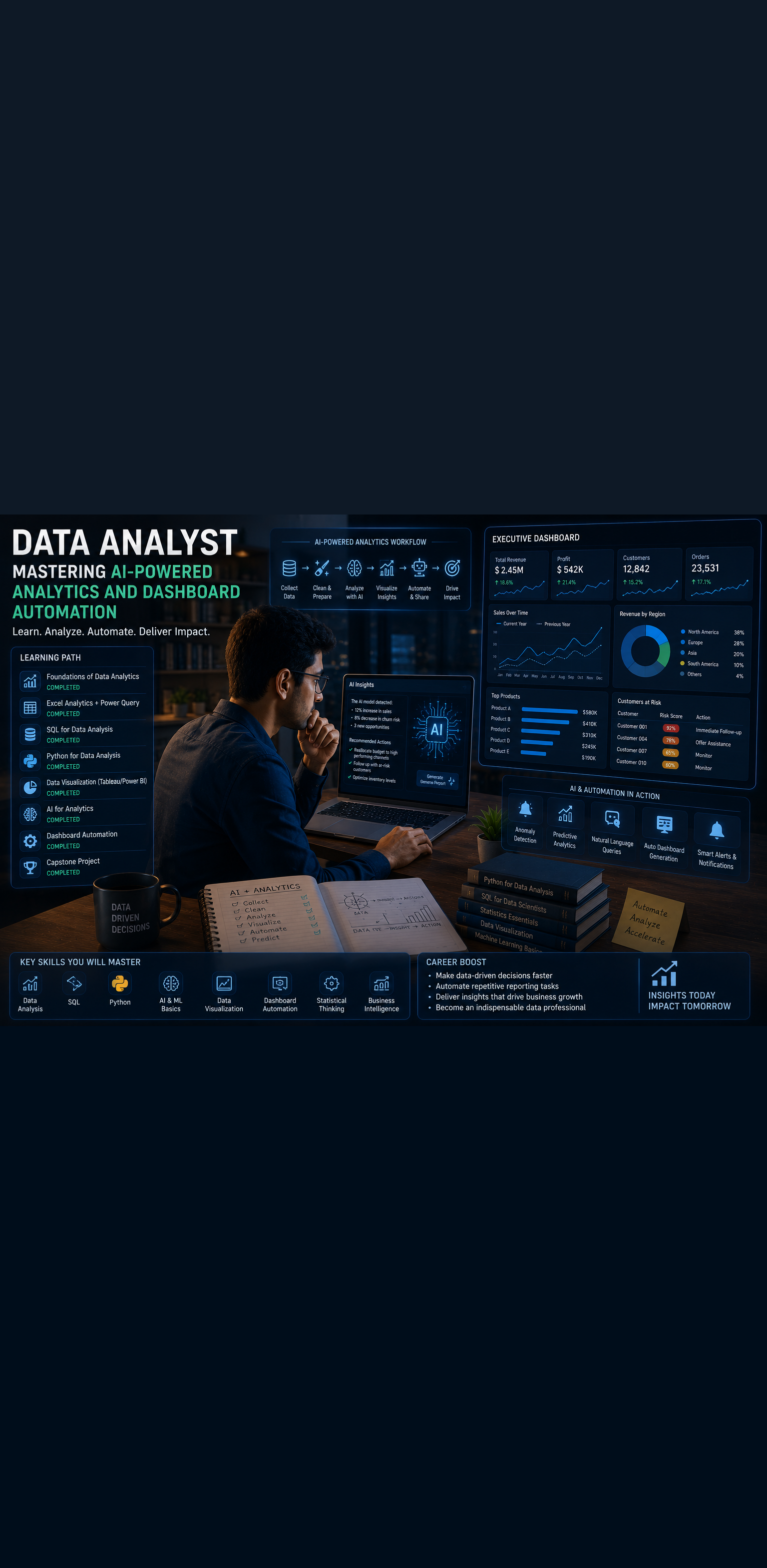
Data analysis has always been about turning raw numbers into meaningful decisions. But the introduction of AI into the analyst's toolkit has fundamentally changed what is possible, how fast it can be done, and what level of insight is now expected from professionals in the field.
In 2026, data analysts who understand how to combine traditional analytical skills with AI tools are producing work that would have taken entire teams just a few years ago. They are writing SQL faster, building dashboards more efficiently, identifying patterns at scale, and communicating insights more clearly than ever before.
If you are a data analyst looking to stay relevant, advance your career, or simply do your best work, this guide covers the best AI courses available right now that are specifically valuable for your role.
Why Data Analysts Need AI-Specific Training
Most data analysts already have strong foundations in SQL, Excel, Python, or BI tools like Tableau and Power BI. The question is not whether to replace those skills with AI. It is how to layer AI on top of them to multiply their value.
AI is changing data analysis in four critical ways:
- Speed – tasks that took hours now take minutes with AI-assisted code generation and automation
- Accessibility – non-technical stakeholders can now query data using natural language, changing what analysts are expected to deliver
- Depth – AI tools help analysts identify patterns and anomalies that manual analysis would miss
- Communication – generative AI helps translate complex findings into clear narratives for executive audiences
Courses designed for general audiences will not address these specific shifts. Data analysts need training that meets them where they are and shows them how AI integrates with the tools and workflows they already use every day.
Best AI Courses for Data Analysts in 2026
1. IBM Data Analyst Professional Certificate (Coursera)
This is one of the most comprehensive professional certificates available for data analysts who want to integrate AI into their skill set. The program covers data analysis fundamentals alongside modern AI tools, Python for data science, SQL, data visualization, and the use of AI-assisted tools within real analytical workflows.
IBM has updated this certificate significantly in recent years to reflect the growing role of AI in analytics. The capstone project requires you to apply skills to a real-world data problem, which means you graduate with portfolio-ready work rather than just a certificate.
What analysts get: A complete professional credential that covers both traditional and AI-enhanced analytical skills with a project portfolio included.
Best for: Analysts looking to formalize their credentials and build a comprehensive, modern skill set recognized by employers.
Platform: Coursera Cost: Included with Coursera subscription, free audit available
2. AI for Data Analysis with ChatGPT and Python (Udemy)
This category of practical, tool-focused courses on Udemy is where many working analysts are finding the most immediate value. The best courses in this space focus on using ChatGPT and other AI tools to accelerate Python scripting for data tasks, generate and debug SQL queries, automate exploratory data analysis, and build faster reporting workflows.
What makes these courses particularly valuable for analysts is the focus on real analytical tasks rather than theoretical AI concepts. You are not learning about AI in the abstract. You are learning how to use it to clean a messy dataset faster, generate a visualization in seconds, or build a Python function without writing every line from scratch.
What analysts get: Immediately applicable techniques for using AI to accelerate the daily tasks that make up most of an analyst's workload.
Best for: Working analysts who want practical efficiency gains they can apply to real projects within days of starting the course.
Platform: Udemy Cost: Typically $15 to $20 during sales
3. Google Advanced Data Analytics Certificate (Coursera)
Google's Advanced Data Analytics Certificate has become one of the most employer-recognized credentials in the field. The program covers statistical analysis, Python, regression modeling, machine learning basics, and data storytelling, all framed around real-world business scenarios.
The AI components are integrated throughout rather than bolted on as an afterthought, which reflects how AI actually functions in modern analytics workflows. Google's direct hiring partnerships also mean this certificate carries real weight in job applications and promotions.
What analysts get: An advanced, employer-recognized credential with strong coverage of both statistical rigor and modern AI-assisted analytical methods.
Best for: Mid-level analysts aiming for senior roles or analysts in organizations that value Google certifications in hiring decisions.
Platform: Coursera Cost: Included with Coursera subscription
4. Microsoft Power BI and AI Insights (Microsoft Learn and LinkedIn Learning)
Power BI has become one of the dominant business intelligence platforms globally, and Microsoft has deeply integrated AI capabilities into it. Understanding how to use AI-powered features like smart narratives, anomaly detection, key influencers, and natural language Q&A transforms what an analyst can deliver to stakeholders.
Microsoft Learn offers free structured learning paths covering Power BI AI features, while LinkedIn Learning provides more polished video instruction. Both paths lead to the PL-300 Power BI Data Analyst certification, which is increasingly requested by employers in analytics job listings.
What analysts get: Practical mastery of AI features within the tool most organizations already use for business intelligence.
Best for: Analysts working in Microsoft-ecosystem organizations or those looking to add a widely recognized BI certification to their profile.
Platform: Microsoft Learn, LinkedIn Learning Cost: Microsoft Learn is free, LinkedIn Learning requires subscription, certification exam fee applies
5. SQL for Data Analysis with AI Assistance (Udemy)
SQL remains the backbone of data analysis across virtually every industry. The emerging skill that separates strong analysts from great ones in 2026 is the ability to use AI tools to write, optimize, and troubleshoot SQL at speed.
The best courses in this category on Udemy teach analysts how to use ChatGPT and other AI tools to generate complex SQL queries from plain English descriptions, debug queries that are producing unexpected results, optimize slow-running code, and build stored procedures and functions more efficiently than manual coding allows.
For analysts who already know SQL basics, these courses produce immediate and measurable gains in output speed and query complexity. For those still building SQL foundations, combining traditional SQL instruction with AI assistance from the start accelerates the learning curve significantly.
What analysts get: The ability to use AI as a SQL co-pilot, dramatically increasing the complexity and speed of their database work.
Best for: Analysts at all SQL skill levels who want to leverage AI to work faster and tackle more complex data problems.
Platform: Udemy Cost: Typically $15 to $20 during sales
6. Machine Learning for Business Analysts (Coursera)
As AI becomes more embedded in business operations, analysts are increasingly expected to understand not just how to use AI tools but how the underlying models work well enough to interpret their outputs critically.
This category of courses bridges the gap between pure data analysis and machine learning. You will not become a data scientist, but you will understand how predictive models are built, how to evaluate model performance, how to communicate model outputs to non-technical stakeholders, and how to identify when a machine learning approach is appropriate versus when traditional analysis is more suitable.
What analysts get: The conceptual foundation to work confidently alongside data scientists and machine learning engineers, and to bring ML thinking into analytical projects.
Best for: Senior analysts or those in organizations where collaboration with data science teams is becoming part of the role.
Platform: Coursera Cost: Free to audit, certificate with subscription
7. Data Storytelling with AI Tools (Udemy and LinkedIn Learning)
Collecting and analyzing data is only half the job. Communicating findings in a way that drives decisions is where analysts create the most visible value for their organizations. AI has transformed this part of the role significantly.
The best data storytelling courses now cover how to use AI to generate executive-ready narrative summaries from data outputs, build interactive dashboard copy, translate statistical findings into business language, and create presentation-ready visualizations from raw analysis. These skills are increasingly what separates analysts who get promoted from those who stay in technical execution roles.
What analysts get: The ability to use AI to close the communication gap between data insights and business decision-making.
Best for: Analysts who produce strong technical work but want to increase their organizational influence and visibility.
Platform: Udemy, LinkedIn Learning Cost: Udemy $15 to $20, LinkedIn Learning with subscription
How to Build Your AI Learning Path as a Data Analyst
With so many strong options available, the smartest approach is building a sequential learning path rather than jumping between courses randomly.
A practical three-stage progression for data analysts in 2026:
Stage 1: AI-Assisted Core Skills (Months 1 to 2) Start with a course that integrates AI directly into the analytical tools you already use. SQL with AI assistance or Power BI AI features are strong starting points because the gains show up immediately in your current work.
Stage 2: Formal Credential (Months 2 to 4) Layer a recognized certificate on top of your practical skills. The IBM Data Analyst Professional Certificate or Google Advanced Data Analytics Certificate add credibility that supports career advancement conversations.
Stage 3: Advanced Integration (Months 4 to 6) Once your foundations are solid, move into machine learning concepts and data storytelling. These skills position you for senior analyst and analytics lead roles where strategic AI judgment matters as much as technical execution.
Making the Most of Every Course You Take
Course completion is just the beginning. The analysts who get the most out of AI training share a few consistent habits.
They apply every new technique to a real dataset the same week they learn it. Theoretical knowledge fades quickly without application. Real data, even imperfect data from your current role, is always better than the clean sample datasets provided in courses.
They build a personal library of AI prompts tailored to their specific analytical use cases. A prompt that reliably generates clean SQL for their most common query types or summarizes a data output in executive language is a reusable asset worth keeping.
They share what they learn with colleagues. Becoming the AI resource in your analytics team is not just generous. It cements your own understanding, raises your profile, and creates organizational leverage that shows up in performance reviews.
The Competitive Landscape for Data Analysts in 2026
The data analyst job market in 2026 is bifurcating. Analysts with strong AI skills are in high demand and commanding significant salary premiums. Analysts working with the same tools and methods they used three years ago are facing increasing pressure from automation and from colleagues who have upskilled.
This is not a prediction. It is an observation of what is already happening in hiring data across industries. AI literacy is no longer a bonus qualification on a job description. It is becoming a baseline expectation for analysts at every level.
The courses in this guide represent a direct investment in staying on the right side of that divide. Most of them cost less than a professional book, and the career return on that investment is measurable in months, not years.
Conclusion: Your Analytical Edge Starts With the Right Course
The strongest data analysts in 2026 are not the ones who know the most about statistics or have the most years of experience. They are the ones who have figured out how to combine deep domain expertise with AI tools that multiply their analytical capacity.
That combination is learnable. It takes weeks, not years, to build enough AI fluency to produce meaningfully better work as an analyst. The courses in this guide give you clear, structured paths to get there regardless of where you are starting from.
Choose one course that matches your most pressing gap right now. Commit to finishing it. Apply what you learn to a real analytical problem within your current role. Then choose the next one.
The analysts who invest in AI skills today are building career capital that will compound throughout the rest of their professional lives. The best time to start that compounding is right now.
Pick one course from this list today and schedule your first learning session within the next 48 hours. Your analytical career in 2026 and beyond starts with that decision.
Want more insights like this? Subscribe to the AI Success Forum newsletter.