Best AI Certifications Worth Taking in 2026
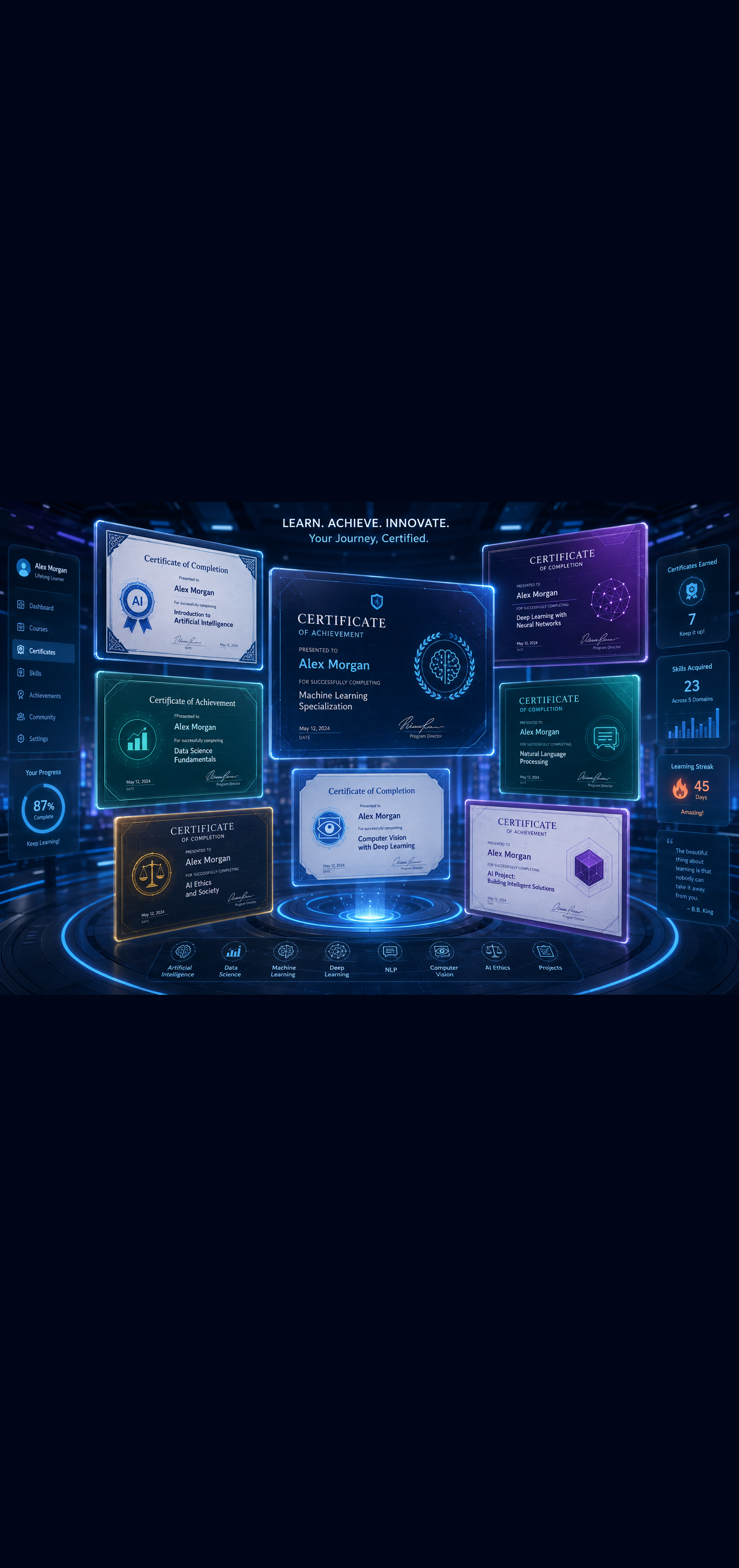
Best AI Certifications Worth Taking in 2026
The AI job market is no longer just for data scientists with PhDs. In 2026, professionals across every industry are adding AI certifications to their resumes and seeing real results in their salaries, job offers, and freelance rates.
But not every certification is worth your time or money. Some are respected by hiring managers. Others are little more than digital badges collecting dust on your LinkedIn profile.
This guide breaks down the best AI certifications worth taking in 2026, who each one is best for, and what kind of career outcomes you can realistically expect.
Why AI Certifications Still Matter in 2026
With so much free content available online, you might wonder if formal certification is even necessary. The honest answer is: it depends on your goal.
If you want to learn AI for personal productivity, a free course might be enough. But if you want to signal credibility to an employer, land a higher-paying role, or move into AI consulting, a recognized certification changes the conversation.
Hiring managers across tech, finance, healthcare, and marketing are now filtering candidates by AI competency. A verified credential from a trusted institution helps you clear that filter faster than a self-taught claim ever will.
Beyond hiring, certifications force structured learning. They push you through the concepts you might skip if left to your own devices, like model evaluation, responsible AI, and deployment fundamentals.
What to Look for in a Quality AI Certification
Before spending money, evaluate any certification on these factors:
- Issuing organization: Is it from Google, IBM, Microsoft, or an accredited university? Or is it from a no-name platform with no industry recognition?
- Curriculum depth: Does it cover practical applications, not just theory?
- Industry recognition: Are employers and LinkedIn recruiters actually responding to it?
- Time investment: Is the time-to-completion realistic for a working professional?
- Cost vs. return: Will this certification realistically help you earn more than it costs?
Keep these in mind as you review the options below.
Best AI Certifications Worth Taking in 2026
1. Google Professional Machine Learning Engineer
This is one of the most respected AI certifications available for working professionals. Offered by Google Cloud, it validates your ability to design, build, and deploy ML models in production environments.
It is not a beginner credential. You need hands-on experience with TensorFlow, Google Cloud Platform, and ML workflow best practices. Expect to spend 6 to 12 months preparing if you are coming from a general software background.
Best for: Software engineers, data analysts, and cloud professionals looking to specialize in ML.
Outcome: Average salaries for certified ML Engineers on Google Cloud range from $120,000 to $160,000 in the US market.
2. IBM AI Engineering Professional Certificate (Coursera)
IBM's AI Engineering certificate on Coursera is one of the most comprehensive entry-to-mid-level programs available today. It covers machine learning, deep learning, neural networks, and deployment using Python and popular frameworks like Keras and PyTorch.
The program is self-paced and takes roughly 4 to 6 months at a part-time commitment. It is also affordable compared to university alternatives, making it ideal for career switchers who need structured learning without a massive financial risk.
IBM is a globally recognized brand, and this certification appears consistently in job postings for AI and data roles.
Best for: Career changers, recent graduates, and analysts moving into AI roles.
3. Microsoft Azure AI Engineer Associate (AI-102)
If your organization or target employers run on Microsoft infrastructure, the Azure AI Engineer Associate certification is highly strategic. It demonstrates proficiency in building AI solutions using Azure Cognitive Services, Azure Machine Learning, and related tools.
The AI-102 exam is challenging but well-documented. Microsoft provides official study paths, practice exams, and learning sandboxes. Many professionals complete preparation in 8 to 12 weeks with consistent daily study.
Best for: IT professionals, solution architects, and developers working in Microsoft-heavy environments.
Outcome: Azure AI certifications frequently appear in enterprise job listings with salaries above $110,000.
4. DeepLearning.AI Specializations (Coursera)
Andrew Ng's DeepLearning.AI specializations remain some of the most academically rigorous and practically useful programs available online. The flagship Deep Learning Specialization covers neural networks, optimization, structuring ML projects, CNNs, and sequence models across five courses.
There are also targeted specializations in NLP, MLOps, and the increasingly popular AI for Everyone course, which is ideal for non-technical leaders who need AI fluency without the math-heavy curriculum.
These are not single certificates. They are multi-course programs that build real skills, not just a badge.
Best for: Anyone serious about understanding AI from the ground up, from beginners to experienced developers.
5. Stanford University Machine Learning Specialization
Stanford's Machine Learning Specialization, also on Coursera and co-taught by Andrew Ng, was updated in 2022 and remains highly relevant in 2026. It covers supervised learning, advanced learning algorithms, and unsupervised learning with a clean Python-first curriculum.
The Stanford name carries enormous weight with hiring managers and gives this specialization a prestige advantage over many alternatives. If you are building a profile in competitive markets like finance or big tech, this credential stands out.
Best for: Professionals who want academic credibility without enrolling in a full degree program.
6. AWS Certified Machine Learning Specialty
Amazon Web Services dominates cloud infrastructure globally, and their ML Specialty certification is a serious credential for professionals who want to work with ML at scale. It covers data engineering, exploratory data analysis, modeling, and ML implementation on AWS services.
This exam has a reputation for being difficult. Most candidates recommend 3 to 6 months of hands-on AWS experience before attempting it. However, passing it places you in a relatively small, highly compensated group of certified professionals.
Best for: Cloud engineers, solutions architects, and data engineers already working in the AWS ecosystem.
7. Certified AI Professional (CAIP) by USAII
The USAII Certified AI Professional credential is gaining traction as a vendor-neutral option for business and technology leaders. Unlike cloud-specific certifications, the CAIP focuses on AI strategy, governance, ethics, and implementation across organizational contexts.
This makes it especially valuable for consultants, project managers, and executives who need AI credibility without going deep into coding or model building.
Best for: Business leaders, consultants, and non-technical professionals who manage or evaluate AI initiatives.
How to Choose the Right AI Certification for Your Goals
With so many options, the decision comes down to three questions:
Where are you starting from? If you have no technical background, start with IBM's Coursera certificate or DeepLearning.AI's AI for Everyone. If you have a software background, aim for Google, AWS, or Azure credentials directly.
What role do you want? ML Engineer roles favor Google and AWS certifications. Azure is stronger for enterprise IT paths. Business-facing roles respond better to CAIP or non-technical specializations.
What is your timeline? Some certifications can be earned in 8 weeks. Others require 6 to 12 months of dedicated preparation. Be honest about how much time you can realistically commit each week.
A practical approach is to stack credentials over time. Start with an accessible specialization like DeepLearning.AI to build foundations, then pursue a cloud vendor certification once you have hands-on experience.
What These Certifications Can Do for Your Income
AI-credentialed professionals are commanding premium salaries in 2026 across every major market. Here is what the data looks like:
- Entry-level AI roles with a recognized certification: $70,000 to $95,000
- Mid-level ML Engineers with vendor certifications: $110,000 to $145,000
- Senior AI Architects and Specialists: $150,000 and above
- AI consultants and freelancers: $100 to $300 per hour depending on specialization
Even professionals in non-technical roles who earn an AI fluency credential are reporting meaningful salary increases when they move into AI-adjacent positions or advocate for AI adoption within their organizations.
Certifications are not a guarantee, but they are a credible signal that shortens the path from where you are to where you want to be.
Final Thoughts
The best AI certification for you is the one that aligns with your current skill level, your target role, and the employers or clients you want to attract. There is no single answer that fits everyone.
What is certain is this: AI competency is becoming a baseline expectation across professional industries, and those who invest in verifiable credentials now will hold a significant advantage over those who wait.
Pick one certification from this list. Build a realistic study schedule. And take the first step this week, not next month.
Your future opportunities are shaped by what you learn today.
Want more insights like this? Subscribe to the AI Success Forum newsletter.