AI Is Not Taking Your Job—Someone Using AI Might
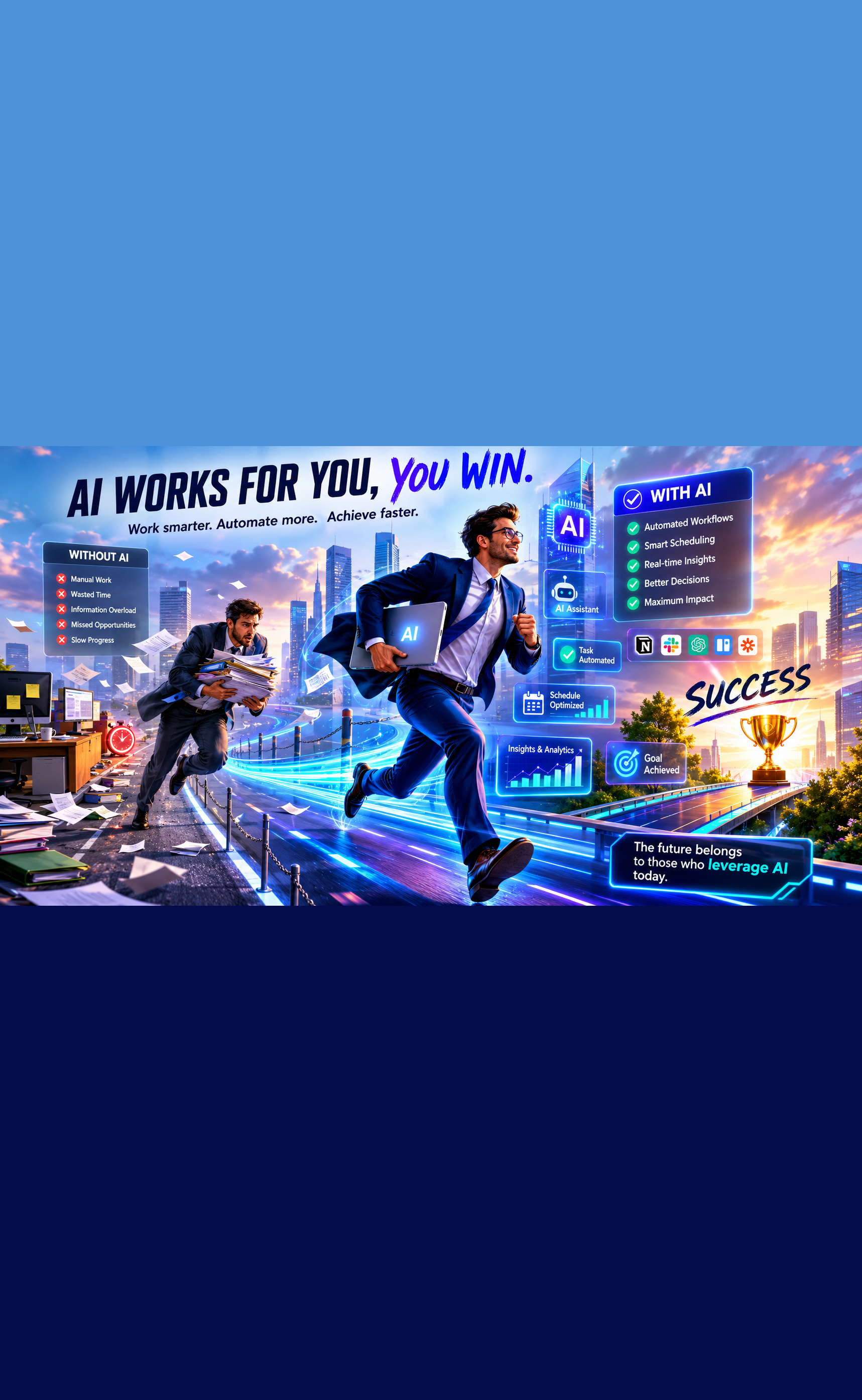
AI Is Not Taking Your Job—Someone Using AI Might
Let us start with the uncomfortable truth that most AI think pieces dance around.
AI is not going to send you a termination letter. It does not sit in job interviews. It does not build relationships with your clients or show up to lead your team through a difficult quarter. AI, at least in its current form, does not replace people.
But the professional sitting in the next office, the freelancer bidding on the same contract, the consultant pitching the same client, the applicant competing for the same role, that person using AI to do in two hours what used to take you two days? They are a very real competitive threat. And they are not waiting for your permission to get ahead.
This is not a reason to panic. It is a reason to move.
The Fear Is Real but the Framing Is Wrong
Almost every professional has felt it at some point in the last two years. That quiet, uncomfortable question that surfaces when you read about another AI capability breakthrough or watch a colleague demonstrate something you did not know was possible.
Am I falling behind?
The fear is valid. The framing almost everyone applies to it is not.
Most people frame AI anxiety as a question about whether AI will eventually be smart enough to replace them. They look for evidence that AI cannot write as well as they can, cannot reason as well as they can, cannot build relationships the way they can. And when they find that evidence, they exhale and move on, reassured for another few weeks.
This is entirely the wrong question. The right question is not whether AI is as good as you. It is whether someone using AI is better positioned than you in the market right now. And increasingly, in more contexts than most professionals want to acknowledge, the answer is yes.
A writer using AI is not producing prose that is more soulful than yours. They are producing three times the volume in the same hours, at a quality level that meets the market threshold. A developer using AI is not building more elegant architecture. They are shipping features faster and spending less time on boilerplate. A marketer using AI is not crafting more insightful strategy. They are executing that strategy across more channels with more consistency than a non-AI-assisted competitor can sustain.
The advantage is not in the quality ceiling. It is in the execution speed, the output volume, and the energy freed up for the human judgment that actually differentiates top performers.
The Professionals Who Are Actually Worried Should Be Energized Instead
Here is the paradox of AI anxiety: the professionals who are most worried about AI are often the ones with the most to gain from adopting it.
A junior analyst worried about AI taking their role has every reason to become the most AI-fluent analyst in their organization. Because the AI-fluent analyst is not the one who gets replaced. They are the one who gets promoted to manage the AI-assisted workflow that replaces their less adaptable peers.
A freelance writer worried about AI commoditizing their work has every reason to become the writer who uses AI to produce better-researched, more strategically structured content at twice the speed. Because that writer is not competing in the commodity market. They have moved up a tier.
A consultant worried about clients using AI to bypass their expertise has every reason to become the consultant who uses AI to deliver research, modeling, and recommendations faster and at higher quality than any team that is not using the same tools. Because that consultant is not being bypassed. They are the one clients call first.
The fear, redirected from avoidance into action, is one of the most powerful motivators available. The professionals who have made this shift are not the ones lying awake wondering whether AI will take their job. They are the ones building skills that make that question irrelevant.
What Adaptation Actually Looks Like
Adapting to AI does not mean learning to code. It does not mean becoming a data scientist or a machine learning engineer. For most professionals, it means something much more accessible: developing genuine fluency with the AI tools most relevant to your work and integrating them into your daily practice in a way that makes your output meaningfully better.
Genuine fluency is the key phrase. There is a significant difference between having used ChatGPT a few times and knowing how to prompt it effectively for your specific use cases, understand where it tends to fail, verify its outputs appropriately, and build it into your workflow in a way that consistently saves time and improves quality.
Most professionals are at the first level. They have experimented with AI tools, found the results inconsistent, and settled into a pattern of occasional use that produces occasional benefits. Top performers are at the second level. They have invested the time to understand their tools deeply enough that AI assistance is a reliable, consistent part of how they deliver their best work.
The gap between these two levels is not talent. It is not access. It is intention and time investment. Any professional willing to spend 30 focused minutes per day for four to six weeks learning and practicing with the right tools can make this shift. The barrier is lower than it feels from the outside.
The Compounding Cost of Waiting
The most underappreciated aspect of the current AI moment is the compounding nature of early adoption advantages.
The professional who started seriously integrating AI tools into their workflow 12 months ago is not just 12 months ahead of someone starting today. They have had 12 months to develop prompting skills, to identify which tools work best for their specific use cases, to build workflows that integrate AI seamlessly into their delivery process, and to build a professional reputation as someone who delivers better results faster.
Catching up to that person is not a matter of 12 months of effort. The compounding means the gap is wider than the time difference suggests, and it keeps widening as the early adopter continues building on their foundation while the late adopter is still in the learning and experimentation phase.
This is not meant to create despair. It is meant to create urgency. Because the same compounding dynamic works in your favor the moment you start. The professional who begins seriously building AI fluency today will be significantly ahead of the one who starts six months from now. And dramatically ahead of the one who waits until it feels unavoidable.
The best time to start was a year ago. The second-best time is right now, today, before another week passes.
The Mindset That Changes Everything
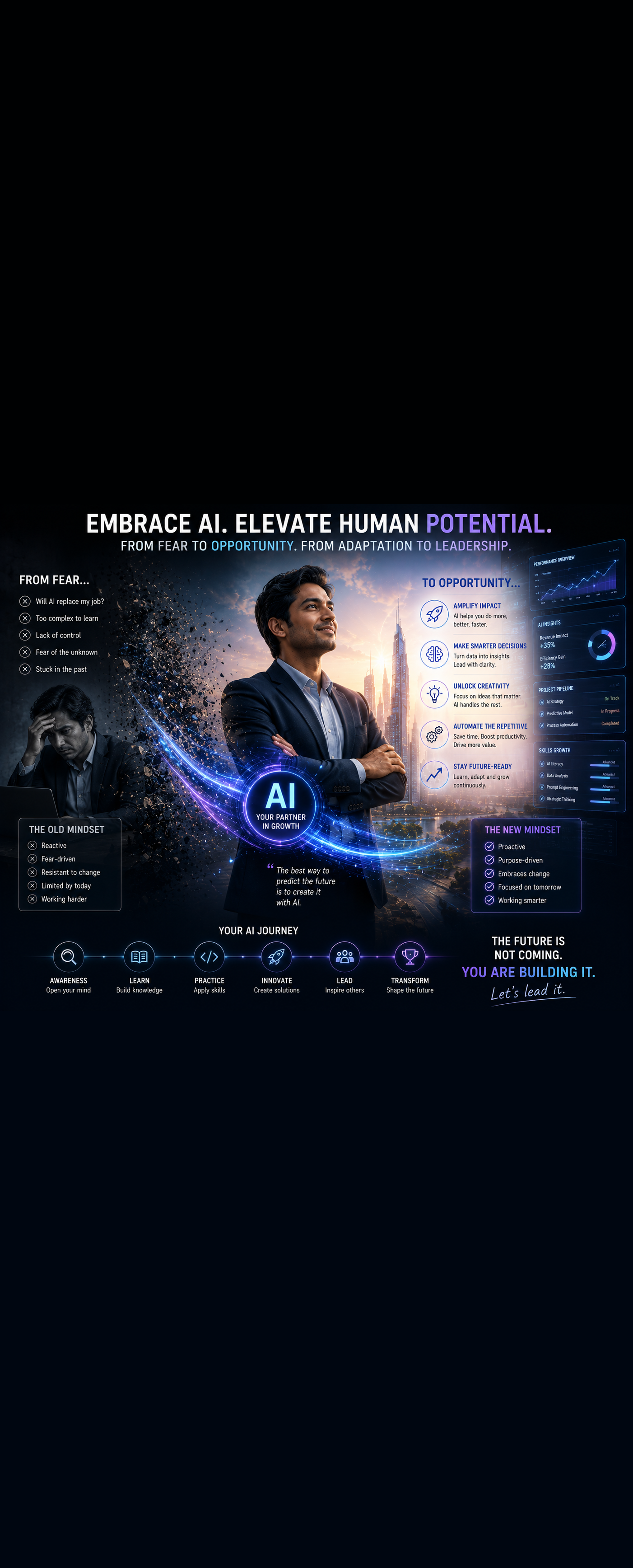
The professionals who adapt most successfully to AI are not the ones who approach it as a threat to manage. They are the ones who approach it as a capability to acquire.
This is a subtle but consequential difference in framing. When AI is a threat, your energy goes into monitoring it, debating it, and finding reasons why your particular role is safe. When AI is a capability, your energy goes into learning it, experimenting with it, and finding every way it can make you more effective.
The threat mindset is defensive and static. The capability mindset is offensive and dynamic. One keeps you in the same place while the world moves around you. The other keeps you moving faster than the world requires.
The capability mindset also changes how you present yourself to employers, clients, and collaborators. The professional who talks about AI with curiosity and confidence is perceived differently than the one who deflects AI-related questions with "I prefer to do things the human way." In most professional contexts in 2026, the latter response is not a statement of principle. It is a red flag about adaptability.
Three Starting Points That Actually Work
If you have read this far and the question has shifted from "should I adapt" to "where do I start," here are three practical entry points that work for professionals across different roles and comfort levels.
Start With the Task That Costs You the Most Time
Every professional has a task category that consumes significant time relative to the value it produces. For many, it is email. For others, it is report writing, research, documentation, meeting follow-up, or content creation.
Identify your highest time-cost, lowest-enjoyment task and spend one focused week learning how to use Claude, ChatGPT, or a relevant specialized tool to handle it faster. Do not try to transform your entire workflow at once. Change one thing, see the results, and build momentum from there.
Find One Person Who Is Already Doing It Well
Learning AI tools from documentation and tutorials is significantly slower than learning from someone who has already figured out what works. Find a colleague, a contact in your professional network, or a creator in your field who is openly sharing how they use AI in their work.
Study their approach. Ask questions. Steal ruthlessly from what works and adapt it to your specific context. The learning curve for AI tools compresses dramatically when you are building on someone else's experimentation rather than starting from scratch.
Make Your Progress Visible
One of the most effective accelerants of AI skill development is making your learning visible to your professional community. Writing about what you are learning, sharing examples of what AI-assisted work looks like in your field, and discussing the implications of AI for your profession publicly does two things simultaneously.
It forces a depth of engagement with the material that passive consumption never achieves. And it positions you, in real time, as someone building AI fluency rather than someone waiting to see how things develop. That positioning has career value that compounds alongside the skill itself.
You Are Not Behind. You Are Early.
Here is the perspective that the most psychologically healthy and practically effective AI adopters share: for all the noise about AI being everywhere, the genuine, deep integration of AI into professional workflows is still in its early stages across most industries.
The professionals who feel like they are already behind are often comparing themselves to the most visible early adopters, the ones writing newsletters, building in public, and talking loudly about their AI-powered workflows. That group is real but small. The much larger group of professionals in most fields has barely scratched the surface of what is possible.
You are not late. You are early enough that serious effort over the next six to twelve months can put you in the top tier of AI-fluent professionals in your field before that tier becomes crowded.
The window is not closing tomorrow. But it is not staying open indefinitely either. The professionals taking it seriously right now will have structural advantages over those who start a year from now that will take years to close.
The Question That Cuts Through Everything
If you leave this article with one thing, let it be this question. Not as a source of anxiety, but as a source of clarity and direction.
One year from now, do you want to be the professional who spent this year watching how AI would affect your field, or the professional who spent this year building the AI fluency that is going to define the next decade of your career?
The answer is obvious. The action is available. The only thing standing between where you are and where you want to be is the decision to begin.
Make it today.
Want more insights like this? Subscribe to the AI Success Forum newsletter.