AI Agents vs Text-to-SQL: Why Agentic AI Is Replacing Simple SQL Generation in 2026
If you have used one of those "chat with your database" tools in the last couple of years, you already know the pattern. Type a question in plain English. Get a SQL query back. Run it. Hope it is right.
That pattern is quietly dying.
In short: Text-to-SQL used to mean one AI guess, one query, no checks. In 2026, it means an AI agent that studies your schema, drafts a query, checks its own work, and only then runs it. The shift is why SQL skills are becoming more valuable, not less, and this piece breaks down exactly why.
The tools that actually work in production right now, Snowflake Cortex Analyst, Databricks Genie, WrenAI, Vanna 2.0, and a growing list of enterprise-built copilots, do not translate a question into SQL and call it a day. They work through a database the way a decent analyst would. They look at the schema, figure out how the tables actually relate to each other, draft a query, check it against the rules of the business, run it, and only then explain what came back.
This is the biggest change in the data and AI world right now, and almost nobody outside the field has noticed it. It matters whether you are a CDO writing a governance policy or a BI analyst quietly wondering if a chatbot is coming for your job.
The old way vs. the new way
For about two years, text to SQL followed a single, brittle path.
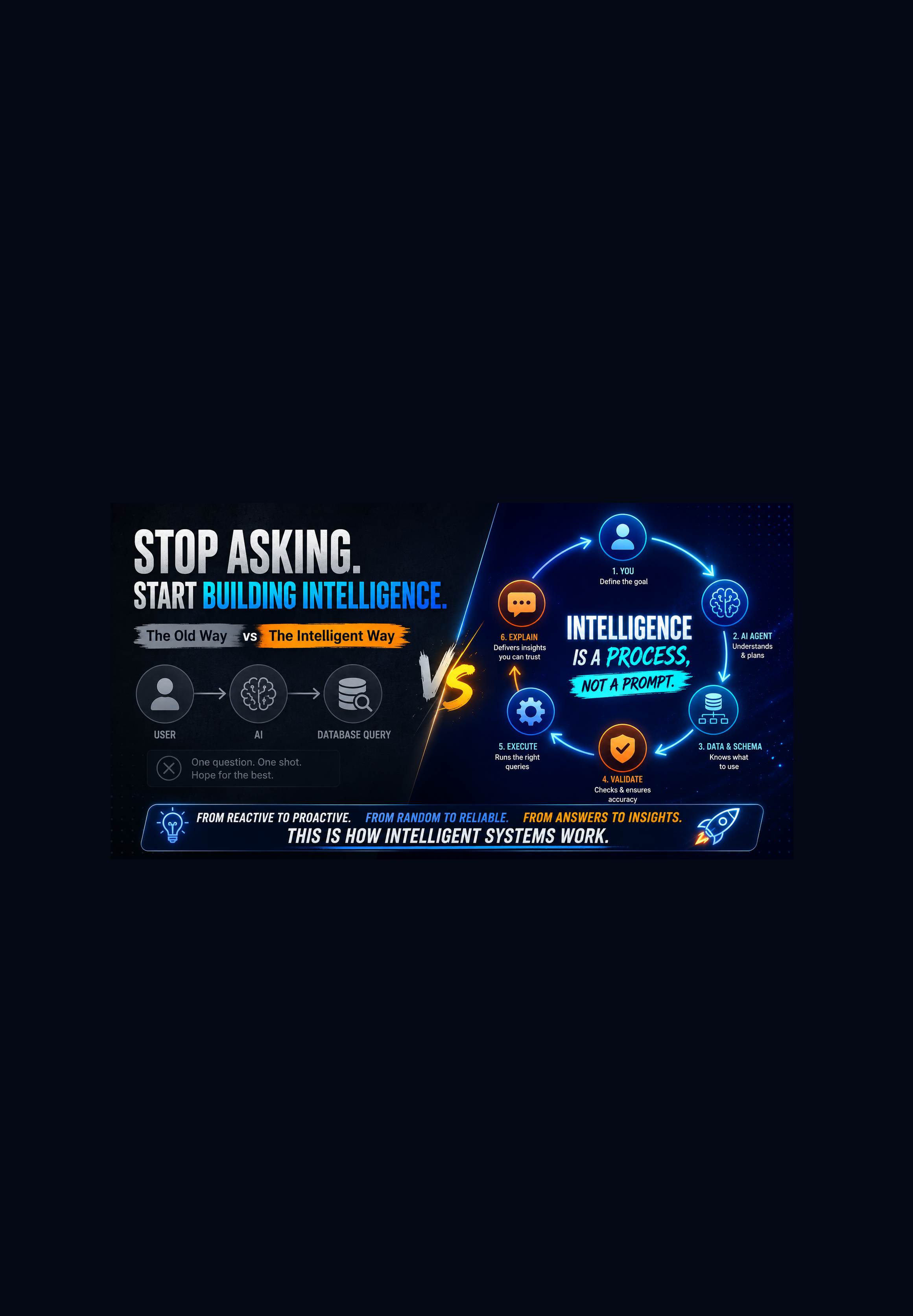
| Step | Old way (2022 to 2024) | New way (2025 to 2026) |
|---|---|---|
| 1 | User asks a question | User asks a question |
| 2 | LLM guesses a SQL query in one pass | Agent studies the schema and how tables relate |
| 3 | Query runs, no checks | Agent drafts a query |
| 4 | You hope it is right | Agent validates its own draft |
| 5 | (no equivalent step) | Agent executes the validated query |
| 6 | (no equivalent step) | Agent explains the result in plain language |
One guess versus six steps. That difference is the entire story of this article.
The old approach worked fine on small, tidy databases with a dozen tables. It fell apart the moment it hit a real company.
Why the old approach could not survive contact with a real company
Single-shot text to SQL was built and benchmarked on academic datasets with a handful of tables each. Enterprises do not look like that. A single company's database might have hundreds of tables, columns named by three different teams over fifteen years, denormalized views stacked on top of older denormalized views, and business rules that exist nowhere except in the head of one analyst who has been there since 2016.
The industry's own benchmark tells the story better than I can.
Spider 2.0, the benchmark that tests these systems against roughly 200 large, messy, real-world databases, scored the best single-shot model at 5.68% in late 2024. By April 2026, the best agentic approach had climbed past 72%.
That is not a small improvement from a better model. It is what happens when you stop asking one LLM to guess and start asking a system to reason.
The underlying problem these agents are actually solving has a name: schema linking. It means mapping a vague human question, "how much did we make last year," to the correct tables, columns, joins, and functions that will actually answer it. That kind of mapping needs context that lives outside the schema entirely. It is exactly the sort of judgment call large language models turn out to be decent at, and the kind older rule-based systems never managed.
What is actually happening inside one of these agents
Most of the serious architectures split the job into distinct roles rather than one enormous prompt. Six roles show up again and again across the industry.
1. The planner Figures out what the person is actually asking before anyone writes a line of SQL. In frameworks like MAC-SQL, this is a dedicated component called the Decomposer, and it exists specifically because "understand the question" and "write the query" are different problems.
2. The schema explorer Instead of stuffing a 300-table schema into a prompt and hoping for the best, this agent pulls in only the tables and relationships that matter, often through semantic search or a governed context layer that stores approved business definitions rather than raw column names.
3. The generator Drafts the actual SQL, usually handled by the more capable reasoning model in the stack.
4. The validator, or refiner Checks the draft against the schema, dry-runs the query plan, and catches mistakes before anything executes. A distinct agent whose entire job is to find what the generator got wrong.
5. The executor Runs the validated query, typically with row-level security and permission checks built in so it cannot see or return data it should not.
6. The explainer Takes the raw rows that come back and turns them into a sentence a human can use, and increasingly a chart or a small dashboard.
Some production systems tack on more specialists still: a PII redaction agent for anything touching healthcare or finance data, a visualization planner, an audit logger for compliance teams. The exact headcount of agents does not matter. What matters is that generating a query is now a workflow, not a function call.
Why this actually improves accuracy
A few different vendors have arrived at the same conclusion from different directions. Snowflake's Cortex Analyst reportedly hits north of 90% SQL accuracy on real workloads, and the reason is not a smarter model. It is a semantic layer that spells out, in plain terms, what "Daily Active Users" means for that company, instead of leaving the model to guess from a column called dau_flag.
The broader framework the industry uses to talk about this is a kind of maturity ladder:
- Technical metadata
- Semantic understanding
- Business context
- Cross-system rules
- Tribal knowledge nobody wrote down
The vendors doing well at enterprise scale are the ones investing at the top of that ladder, not the ones hoping a bigger model fixes a schema nobody documented.
Latency is the other real constraint. A pipeline with several agents making sequential LLM calls can easily tack on ten to twenty seconds, which is unusable for an interactive dashboard. The fix most teams have landed on is semantic caching: store the embedding of a past question, and when a new one means roughly the same thing, even if it is worded completely differently, serve the cached answer in about fifty milliseconds instead of running the whole pipeline again.
The business case, in plain numbers
Industry estimates put the time savings from agentic SQL automation at more than 140,000 hours a year across large enterprises, mostly by removing the bottleneck where every data question has to go through someone who happens to know SQL.
In practice, these systems tend to split the work into the same handful of stages: figure out intent, identify the right tables, generate the query, optimize it, validate it. Each stage belongs to one narrow agent, which is exactly what makes the whole thing auditable in a way a single black-box model call never was.
This is not just a vendor pitch, either. Salesforce built an internal tool nicknamed Horizon Agent so employees could ask data questions inside Slack, in plain English, and get back the query, the answer, and the context around it, without ever opening a separate BI tool. That is the pattern worth watching: ask where you already work, not where the dashboard happens to live.
Why SQL is becoming more valuable, not less
Here is the part most people get backwards. Agentic AI has not made SQL knowledge worth less. It has made understanding data worth more, while making the act of typing SQL syntax worth close to nothing.
Somebody still has to build and maintain the semantic layer. Cortex Analyst style accuracy does not happen by accident. It takes a person who understands both the schema and the actual business to decide what terms mean and keep those definitions current as the business changes.
Agents still need a human standing over them for governance. Every serious deployment is wrapping audit logs, role-based access, and PII redaction around the agent, and somebody with real SQL and governance experience has to design and watch that layer.
Ambiguity still needs judgment. When a schema is genuinely messy, conflicting definitions across departments, tables nobody has cleaned up since a merger, an agent can flag that it is unsure. It cannot make the final call on which definition is correct. A person who understands both the data and the business still has to.
The job numbers back this up too. The U.S. Bureau of Labor Statistics projects data scientist roles to grow roughly 35% from 2024 to 2034, well above the average for any occupation, and that growth is built on SQL fluency, not despite it. Close to a quarter of online data job postings in the US still list SQL as a requirement, now paired with AI tooling rather than replaced by it. Candidates who show up with both AI skills and solid SQL training report about 15% higher employment rates within six months of graduating than peers without the database background. Current BI job listings are asking for people who can use AI-assisted tools, Claude, MCP-based workflows, alongside Snowflake SQL and semantic modeling. The two skill sets are merging. Neither one is winning at the other's expense.
What this means depending on your role
| Your role | What changes | What still matters |
|---|---|---|
| New to SQL | You will rarely hand-write a basic select or join | Knowing what a query should logically do |
| BI analyst | The agent drafts dashboards and first-pass queries | Translating business needs, catching wrong answers |
| Data engineer | Schema design becomes the real bottleneck | You are drawing the map the agents navigate |
| Team lead or founder | You can ask data questions directly in Slack | You still need someone who catches a costly wrong answer |
Action items: what to actually do next
If you are evaluating this shift for your own team or career, here is where to start.
If you run a data team or a company:
- Build the semantic layer before you build the AI layer. Define business terms explicitly instead of hoping the model infers them.
- Treat governance as its own agent, not an afterthought. Row-level security, PII redaction, and audit logging belong in the pipeline from day one.
- Budget time for change management, not just the technology. Self-service data access changes who touches it and how. That takes training, not just a new login.
- Start with one well-designed, contained subject area. A clean, localized schema is a good early candidate. A database that grew organically for a decade needs semantic modeling work first.
- Measure latency as seriously as accuracy. Semantic caching and sensible model routing are what make this usable in a live dashboard instead of only in an overnight report.
If you are an individual contributor or job seeker:
- Keep sharpening core SQL. It is still the foundation everything else sits on.
- Learn how a semantic layer actually gets built. This is the highest-leverage skill in this entire shift.
- Practice reviewing AI-generated queries, not just writing your own. Catching a wrong join is becoming more valuable than writing a correct one from scratch.
- Get comfortable with at least one agentic tool in this space, Cortex Analyst, Genie, or WrenAI, so you understand how it thinks and where it tends to fail.
A few honest answers
Is text to SQL dead? No, it evolved. The step where language becomes SQL still happens. It is just one stage in a longer pipeline now, not the whole job.
Will AI agents replace SQL developers and BI analysts? Not any time soon. Demand for SQL-literate roles is still growing, and job postings increasingly want AI-agent fluency in addition to SQL and semantic modeling, not instead of it.
What should I actually learn to stay relevant? Schema design, semantic modeling, and how to evaluate what an AI SQL agent produces. All three sit on top of core SQL, not apart from it.
Which tools are leading this shift right now? Snowflake Cortex Analyst, Databricks Genie, Microsoft Fabric, the open-source WrenAI, and Vanna 2.0 are the names that keep coming up, each trading off vertical integration against openness in its own way.
The takeaway: SQL is not dying. Typing it by hand is. If you understand schemas, business logic, and how to catch an AI agent when it is confidently wrong, you are more valuable in this shift, not less.