AI Affiliate Marketing: The Complete Beginner's Guide

AI Affiliate Marketing: The Complete Beginner's Guide
Affiliate marketing has been a legitimate income stream for over two decades. But the arrival of AI tools, platforms, and services has created one of the most exciting affiliate opportunities in the history of the industry.
AI products are selling fast. Businesses and professionals across every sector are actively searching for tools to help them work smarter, move faster, and compete in an AI-driven market. The market is large, the products are genuinely useful, and the commission structures are often recurring, meaning you earn every month a customer stays subscribed.
If you have been looking for a practical way to build income online without creating your own product, AI affiliate marketing deserves your serious attention. This guide covers everything you need to know to start from scratch and build a real income stream.
What Is AI Affiliate Marketing
Affiliate marketing is the practice of earning a commission by recommending products or services to an audience. When someone clicks your unique affiliate link and makes a purchase or signs up for a subscription, you earn a percentage of the sale. No product creation. No customer service. No inventory.
AI affiliate marketing applies this model specifically to AI tools, platforms, software, and services. This includes tools like writing assistants, image generators, coding tools, business automation platforms, AI-powered marketing software, and online courses teaching AI skills.
What makes AI affiliate marketing particularly attractive right now is the combination of high demand, strong conversion rates, and recurring commission structures. Many AI tools operate on monthly or annual subscriptions. When you refer a customer who stays for 12 months, you earn a commission every single month of that subscription, not just on the initial sale.
Why AI Affiliate Marketing Is a Strong Opportunity in 2026
The AI software market is projected to reach hundreds of billions of dollars in the coming years. Every week, new tools launch. Existing tools expand their features. Businesses that were skeptical two years ago are now actively budgeting for AI subscriptions.
This creates a sustained and growing pool of buyers who are actively researching which tools to choose. They are reading blog posts, watching YouTube videos, scrolling Reddit threads, and following creators who can give them an honest, informed perspective on which tools are worth the subscription.
That is exactly where an affiliate marketer can add genuine value and earn consistent commissions in the process.
The timing matters too. Affiliate programs for AI tools are still relatively undercompeted compared to traditional affiliate niches like finance or fitness. Publishers who build authority in the AI tools space now are establishing positions that will become increasingly valuable as the market continues to grow.
How AI Affiliate Commissions Work
Before you start promoting anything, understand the commission structures you will encounter.
Percentage of sale: The most common structure. You earn a fixed percentage of the purchase price. Rates vary widely, from 10 percent for some enterprise tools to 40 or 50 percent for software platforms and online courses.
Recurring commissions: Many SaaS-based AI tools pay you a percentage every month for as long as your referred customer remains a subscriber. A single referral to a $99 per month tool at 30 percent commission earns you roughly $30 per month indefinitely. Ten active referrals generates $300 per month from one program alone.
Flat fee per referral: Some programs pay a fixed dollar amount per signup or free trial conversion rather than a percentage. These are common for enterprise tools where the deal size varies.
Tiered commissions: Some programs increase your commission rate as your referral volume grows. Early in your affiliate journey, you may earn 20 percent. After 50 referrals per month, that rate might increase to 30 or 35 percent.
Understanding these structures helps you prioritize which programs to promote based on your audience size and content strategy.
Top AI Affiliate Programs Worth Joining
The number of AI affiliate programs has grown significantly. Here are categories and examples of programs that offer strong commission structures and genuine product quality.
AI Writing and Content Tools
Writing tools are among the most accessible affiliate categories because the target audience is broad. Bloggers, marketers, business owners, students, and professionals of all kinds are actively looking for writing assistance.
Jasper offers one of the best-known affiliate programs in the AI writing space with recurring commissions and strong brand recognition. Writesonic and Copy.ai also run active affiliate programs with competitive rates.
The key to converting in this category is demonstrating real results. Tutorials, before-and-after content examples, and honest reviews of what each tool does well and where it falls short are the content formats that consistently drive conversions.
AI Productivity and Business Tools
Tools that help businesses automate workflows and increase productivity carry strong purchase intent from business owners and professionals with buying authority.
Zapier, which increasingly integrates AI capabilities throughout its automation platform, has a well-established affiliate program. Notion AI, Otter.ai, and various project management tools with AI features are all worth researching for affiliate opportunities.
AI Image and Creative Tools
The demand for AI image generation tools among designers, marketers, content creators, and e-commerce sellers is strong and growing.
Midjourney, while not currently running a traditional affiliate program, has spawned an entire ecosystem of courses and tools built around it. Platforms like Adobe Firefly, Canva Pro with its AI features, and various image generation tools offer affiliate opportunities worth exploring.
AI Courses and Education Platforms
Course affiliate programs frequently offer the highest commission rates in the entire industry, often between 30 and 50 percent of the course price. For premium AI courses priced at $200 to $2,000, a single referral can generate $60 to $1,000 in commission.
Coursera, Udemy, and Maven all run affiliate programs covering AI and machine learning courses. Individual course creators on platforms like Teachable and Kajabi frequently run their own affiliate programs with even higher commission rates.
AI SEO and Marketing Tools
Marketing professionals are a high-value audience because they understand ROI, have budget authority, and are actively looking for tools that deliver measurable results.
Semrush, Surfer SEO, and Clearscope all have affiliate programs and are increasingly positioning their AI features as core differentiators. These tools carry higher price points and strong recurring commission potential.
How to Find and Join AI Affiliate Programs
Finding programs is simpler than most beginners expect.
Direct search: Go to the website of any AI tool you use or want to promote. Scroll to the footer and look for an "Affiliates," "Partners," or "Referral Program" link. Many programs are listed directly on the company website.
Affiliate networks: Platforms like Impact, ShareASale, PartnerStack, and CJ Affiliate host hundreds of AI and software affiliate programs in one place. You can browse, apply, and manage multiple programs through a single dashboard. PartnerStack in particular has become the go-to network for SaaS affiliate programs.
Google search: Search for "[tool name] affiliate program" or "best AI tool affiliate programs 2026" to find curated lists and direct program pages.
When evaluating a program, check the commission rate, cookie duration (how long after a click you can earn a commission), payment terms, and whether the program offers recurring or one-time commissions.
Building Your AI Affiliate Marketing Platform
The most important decision you will make as a beginner is where and how you will reach an audience. You need a platform, a consistent place where you publish content and build trust with people who want information about AI tools.
Option One: A Blog or Niche Website
A blog is the most durable long-term platform for affiliate marketing. Content you publish today can generate search traffic and commissions for years. The trade-off is that it takes three to six months before most blogs see meaningful organic search traffic.
Choose a specific niche within AI tools rather than trying to cover everything. A blog focused on AI tools for freelancers, AI tools for small business owners, or AI tools for content creators will build authority faster than a general AI blog and will attract a more targeted audience with stronger purchase intent.
Use AI tools like Claude or ChatGPT to help you research, outline, and draft your content, then edit everything with your own voice, real experience, and genuine opinions. Search engines and readers alike respond to authenticity.
Option Two: YouTube Channel
YouTube is the second largest search engine in the world and a highly effective platform for AI tool reviews and tutorials. Video demonstrations of AI tools are particularly compelling because viewers can see the tool in action before committing to a purchase.
Tutorial videos, tool comparisons, and honest review content consistently perform well in the AI tools niche. Include your affiliate links in the video description with a clear disclosure and a direct call to action.
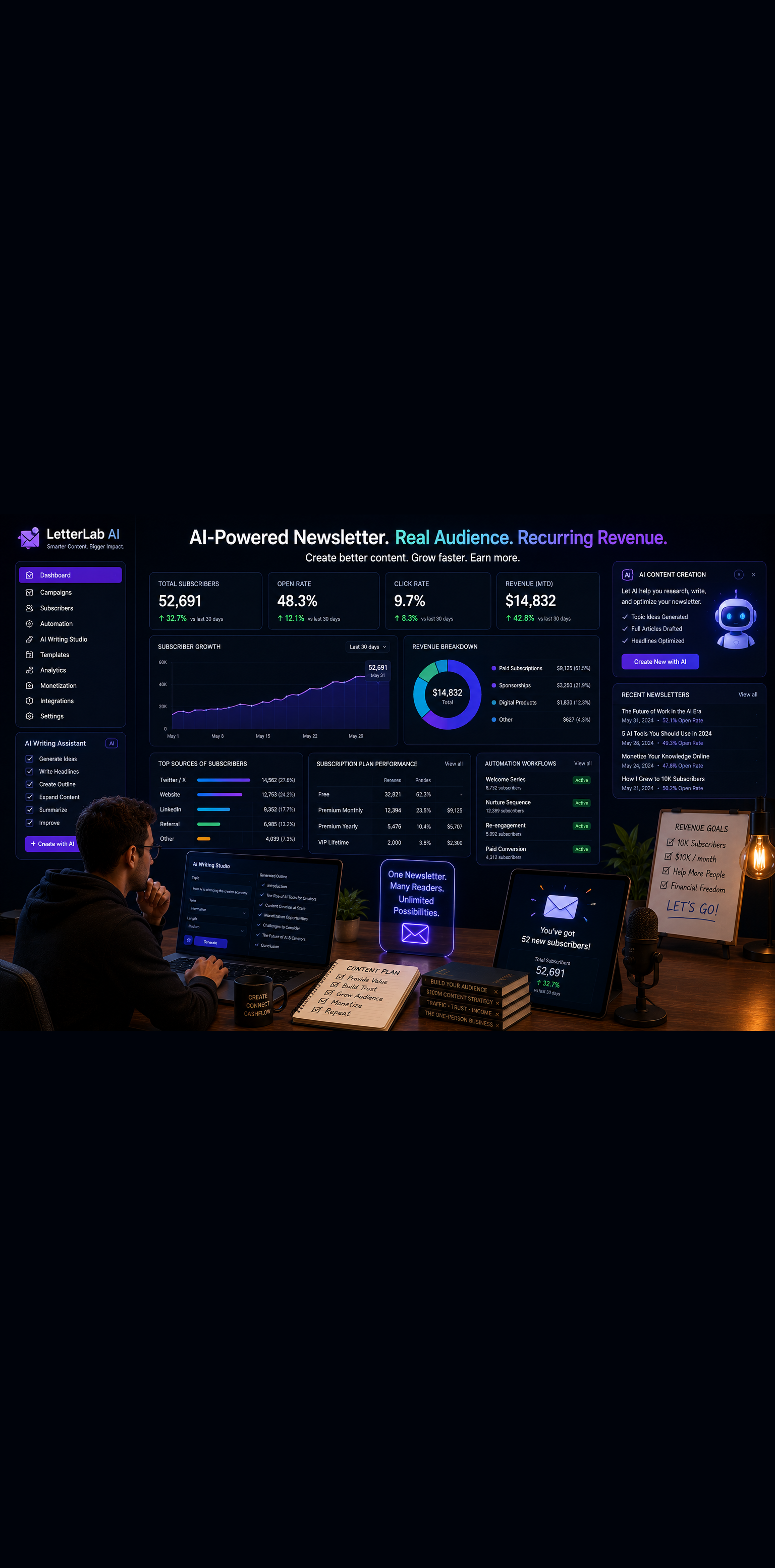
Option Three: Newsletter
An email newsletter is the highest-trust distribution channel available to a content creator. Subscribers have explicitly opted in to hear from you, which means your recommendations carry more weight than content discovered through search.
Build your newsletter around a specific theme, such as a weekly roundup of the best AI tools for a specific audience, or a practical guide to using AI in a specific profession. Include affiliate recommendations naturally within genuinely useful content rather than making every issue a promotional pitch.
Option Four: Social Media
LinkedIn is particularly effective for reaching business professionals interested in AI productivity tools. Twitter and X, YouTube Shorts, and TikTok each have active communities consuming AI content. Social media alone is harder to convert from because you have less space to build the context and trust that drives affiliate purchases, but it works well as a distribution channel that drives traffic to a blog, newsletter, or YouTube channel.
Creating Content That Converts
The biggest mistake beginners make in affiliate marketing is creating content that is obviously promotional rather than genuinely helpful. Readers and viewers are sophisticated. They can tell the difference between someone who actually uses a tool and someone who is just trying to earn a commission from it.
The content formats that consistently drive affiliate conversions in the AI tools space are:
Honest tool reviews: Cover what the tool does well, what it does poorly, who it is best for, and who should look elsewhere. A review that acknowledges limitations is far more credible and converts better than one that reads like a sales page.
Tool comparisons: "Tool A vs Tool B: Which Is Right for You?" is one of the most consistently high-converting content formats in affiliate marketing. People who are deciding between two specific tools are close to purchasing and are actively looking for a final push in one direction.
Tutorial content: Step-by-step guides showing how to use a tool to accomplish a specific task demonstrate real value and give readers a reason to click your affiliate link rather than going directly to the tool's website.
Use case roundups: "Best AI Tools for [Specific Audience or Task]" articles attract readers with clear purchase intent and allow you to include multiple affiliate links within a single piece of content.
Personal experience content: Stories about how you use specific AI tools in your own work, with real results and specific examples, are among the most trusted and shared content formats in any niche.
Disclosure, Trust, and Legal Requirements
Affiliate disclosure is not optional. In most jurisdictions including the United States, the UK, and the EU, you are legally required to disclose when content contains affiliate links. The FTC in the US is explicit that disclosures must be clear, conspicuous, and placed where readers will see them before encountering the affiliate link.
Beyond the legal requirement, disclosure is simply the right approach for building a sustainable audience. Readers who feel deceived by undisclosed affiliate relationships do not come back. Readers who see a clear, upfront disclosure and still find your content genuinely useful become your most loyal and valuable audience.
A simple disclosure at the top of any content containing affiliate links is sufficient. Something like: "This article contains affiliate links. If you purchase through these links, I may earn a commission at no extra cost to you."
Realistic Income Expectations for AI Affiliate Marketers
Affiliate marketing income is highly variable and depends on your audience size, niche, content quality, and consistency over time. Here is an honest picture of what the journey typically looks like.
Months one to three: Foundational work. Building your platform, publishing content, applying to affiliate programs. Income is typically zero to minimal. This phase is about planting seeds, not harvesting.
Months four to six: Early traction. If you have published consistently and focused on a specific niche, you should start seeing your first commissions. Income in this range is typically $50 to $500 per month.
Months seven to twelve: Building momentum. With a library of content ranking in search or growing subscriber/viewer counts, monthly commissions typically reach $500 to $2,000 for focused and consistent publishers.
Year two and beyond: Compounding returns. Content published in year one continues generating traffic and commissions. New content builds on established authority. Monthly income of $2,000 to $10,000 is realistic for publishers who have built genuine authority in a defined niche. Top AI affiliate marketers earn significantly more.
The key variable is consistency. The affiliate marketers who quit after three months of minimal income never see the compounding returns that reward the ones who persist through the slow early phase.
Final Thoughts
AI affiliate marketing combines one of the most proven online income models with one of the fastest-growing product categories in the world. The tools are real, the demand is genuine, and the commission structures reward publishers who build authentic, helpful content over time.
You do not need a massive audience to start. You need a specific niche, a platform, a handful of quality affiliate programs, and the commitment to publish consistently helpful content for the people you are trying to reach.
The professionals earning meaningful affiliate income from AI products started exactly where you are now. They picked a niche, built a platform, and kept going when results were slow.
Start this weekend. Pick your platform. Join two or three affiliate programs. Publish your first piece of content.
Your first commission is closer than you think.
Want more insights like this? Subscribe to the AI Success Forum newsletter.