Why Most People Will Be Left Behind by AI (And How Not to Be One of Them)
Why Most People Will Be Left Behind by AI (And How Not to Be One of Them)
There is a conversation happening right now in boardrooms, hiring committees, and performance reviews that most people are not aware of. It is not about whether AI will change the workplace. That question has already been settled. The conversation is about which people are adapting and which ones are not — and what to do about the ones who are falling behind.
This is not a distant future problem. The gap between AI-fluent professionals and those still working the way they did three years ago is already visible, already measurable, and already influencing who gets promoted, who gets hired, and whose work is considered indispensable.
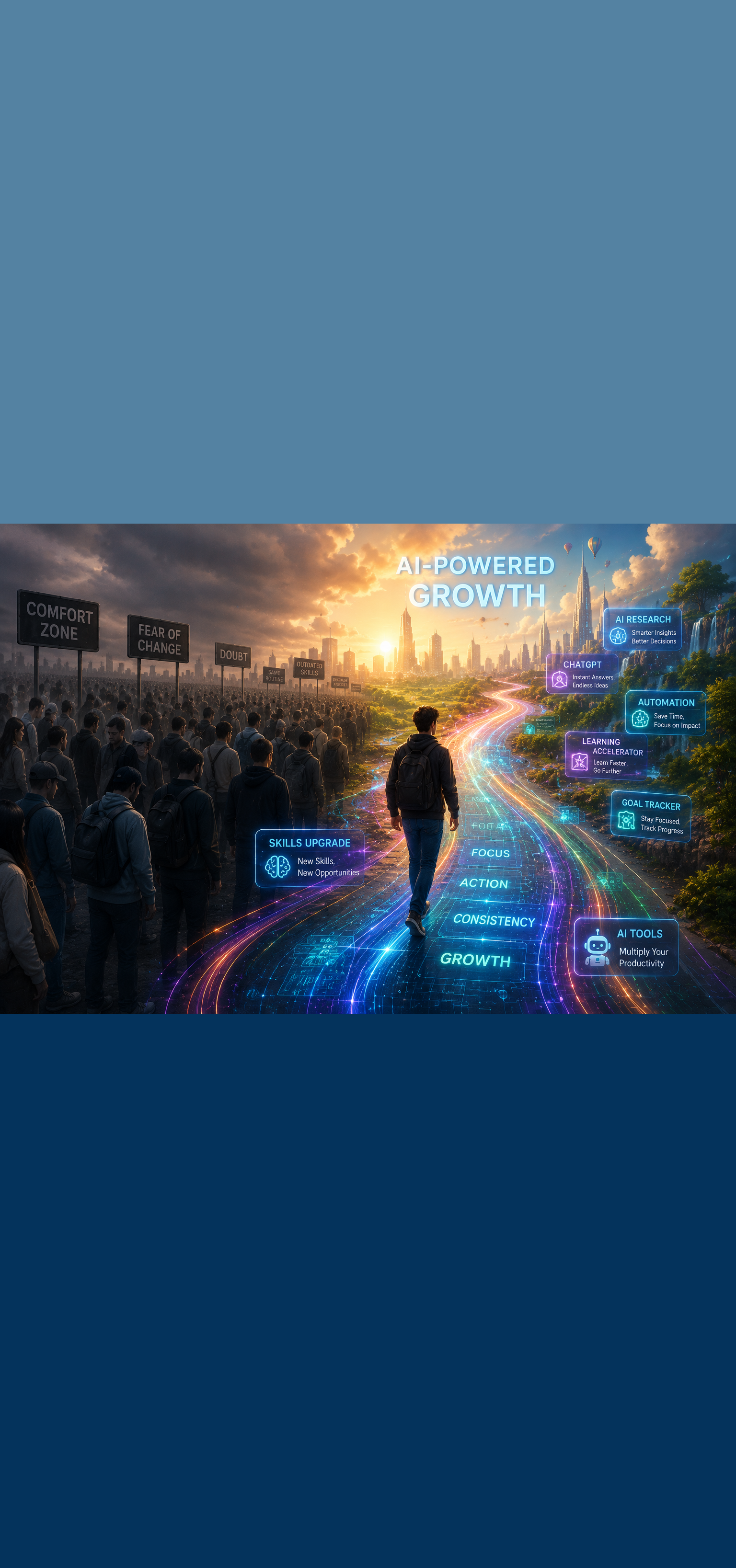
The uncomfortable truth is that most people will be left behind by AI. Not because the technology is inaccessible or the learning curve is too steep, but because the habits, mindset, and daily choices required to stay competitive are ones that most people are not making right now. This guide is for the people who intend to be on the right side of that divide.
The Gap Is Already Opening
In every major technological transition, the gap between early adopters and late adopters follows a predictable curve. At first the difference is minor and easy to dismiss. Then it becomes noticeable. Then it becomes structural — embedded in career trajectories, income levels, and professional reputations in ways that are very difficult to reverse.
We are in the noticeable phase right now. The professionals who integrated AI into their daily workflows 18 months ago are producing measurably more output, higher quality work, and faster results than those who have not. They are building reputations as sharp, fast, and high-value operators. They are getting the interesting projects, the promotions, and the client referrals.
The professionals who are still using the same tools and the same workflows they used in 2023 are not experiencing catastrophic failure. They are experiencing something subtler and more insidious: gradual irrelevance. Their output is normal. Their pace is normal. Their ideas are normal. In a world where AI-fluent colleagues are producing exceptional at normal pace, normal is a problem.
Why Most People Are Not Adapting
Understanding why most people fall behind is essential for making sure you are not among them. The reasons are more psychological than technical.
The Comfort of Competence
One of the most powerful forces holding professionals back from AI adoption is the discomfort of being a beginner again. If you are good at your job — skilled, experienced, respected — learning AI tools means temporarily feeling incompetent, making mistakes in front of colleagues, and asking questions that feel basic.
Most experienced professionals quietly avoid this discomfort by finding reasons their current approach is fine. They are not resistant to AI, they tell themselves. They just have not found the right tool yet, or they are waiting until the technology matures, or their work is too specialized for AI to help with.
These rationalizations are almost never accurate. They are the voice of a brain that has learned to protect its current competence by avoiding the vulnerability of learning.
The Illusion of Future Time
Another pattern is the perpetual deferral. Professionals who genuinely intend to engage with AI tell themselves they will start when work slows down, when the current project finishes, when they have a proper block of time to learn properly.
That time never comes. Work does not slow down. The current project always transitions into another one. And the professionals who were going to start seriously engaging with AI six months ago are in exactly the same position today — except the gap between them and their AI-fluent peers has grown six months wider.
The only time that exists for building new habits is now, imperfect as now always is.
Surface-Level Engagement
Many professionals have technically started using AI but in ways that produce minimal impact. They use ChatGPT occasionally to fix a sentence or generate a quick list. They try one tool, get a mediocre result from a vague prompt, and conclude that AI is overhyped.
This surface-level engagement is worse than no engagement in one specific way: it produces the false conviction that you have already tried AI and it is not that useful. It immunizes against the deeper, more deliberate engagement that actually transforms how you work.
Real AI fluency comes from daily use, deliberate practice, and iterative refinement of how you prompt and apply tools — not from occasional experiments that confirm your prior skepticism.
The Four Divides Creating the AI Gap
The professionals being left behind by AI are falling behind on four specific dimensions. Understanding each one helps you identify where your own gaps are and what to address first.
The Skills Divide
AI fluency is becoming a professional skill in the same way spreadsheet literacy became a professional skill in the 1990s. Professionals who could not use Excel were not fired immediately, but they were quietly sidelined from the work that required it. Over time, inability to use the fundamental tools of your field is not a minor gap — it is a disqualifying one.
The skills divide in AI is not about technical expertise. It is about practical fluency — knowing which tools handle which tasks, how to prompt them effectively for your specific work, and how to integrate them into your daily workflow. This is learnable by anyone willing to invest deliberate effort.
The Productivity Divide
The output gap between AI-fluent and non-AI-fluent professionals is already significant and growing. A professional who uses AI effectively for research, writing, analysis, and communication is producing the equivalent of 1.5 to 2x their pre-AI output. A professional who does not is producing the same as they always did.
In individual contributor roles, this gap affects how much value you deliver relative to your cost. In leadership roles, it affects how your team performs relative to AI-augmented competitors. Either way, the productivity divide has direct implications for career trajectory and professional survival.
The Learning Divide
AI is not a stable technology that you learn once and master permanently. It is a rapidly evolving field where new capabilities, new tools, and new applications emerge continuously. Professionals who have developed the habit of continuous learning about AI are compounding their advantage month over month. Those who are not engaged are falling further behind with every new development.
The learning divide is ultimately a habit divide. It separates professionals who have made staying current with AI a non-negotiable professional responsibility from those who treat it as optional.
The Mindset Divide
The deepest divide is attitudinal. Some professionals approach AI with genuine curiosity, experiment freely, accept the learning curve, and look for opportunities to integrate new capabilities into their work. Others approach it with skepticism, see it as a threat to their professional identity, resist changing workflows that have served them, and interpret every AI limitation as confirmation that the technology is not as useful as claimed.
The mindset divide predicts the other three. Professionals with a growth and integration mindset toward AI are closing skill gaps, growing the productivity advantage, and staying current continuously. Those with a protective or avoidant mindset are falling behind on all three dimensions simultaneously.
What Staying Relevant in the AI Era Actually Requires
Staying competitive is not about becoming an AI expert. It is about developing five specific qualities that define the professionals who will thrive regardless of how AI continues to evolve.
Daily Practice Over Occasional Experimentation
The single most important difference between professionals who achieve genuine AI fluency and those who do not is daily use. Not weekly. Not occasionally when it seems relevant. Daily.
When you use AI tools every day, you develop intuitions about what they are good at and where they fall short. You develop prompting instincts through repetition. You start seeing AI assistance opportunities in your work that you would never notice as an occasional user. You build the kind of practical fluency that only comes from consistent, accumulated practice.
Commit to using AI for at least one meaningful work task every day for the next 90 days. Not to experiment with what AI can do in the abstract — to actually use it for real work you need to produce. That commitment, maintained consistently, will transform your fluency faster than any course or tutorial.
Deep Tool Knowledge Over Shallow Tool Breadth
The professionals extracting the most productivity value from AI are not the ones using the most tools. They are the ones who have gone genuinely deep with a small number of well-chosen tools.
Deep tool knowledge means understanding not just what a tool does but how to get exceptional outputs from it. It means knowing the prompting patterns that produce consistently strong results for your specific work. It means understanding the tool's limitations and knowing when a different approach will serve you better.
Pick two or three core tools relevant to your most important work. Invest in understanding them deeply rather than skimming across a large surface area of mediocre familiarity.
Judgment That Complements AI Capability
One of the most durable competitive advantages in an AI-abundant world is the judgment to evaluate, direct, and apply AI outputs effectively. AI can produce a marketing strategy, a financial analysis, a product design, or a legal brief. It takes human judgment to assess whether that output is correct, whether it serves the actual goal, and where it needs to be refined or redirected.
Professionals who develop strong AI-direction skills — the ability to brief AI effectively, evaluate its outputs critically, and iteratively improve them through skillful follow-up — become highly valuable in any organization deploying AI. They are the people who make AI systems actually work rather than just having access to them.
Human Skills That AI Cannot Replicate
The professionals most resilient to AI disruption are those who combine AI fluency with the distinctly human capabilities AI cannot replicate: genuine relationship building, ethical judgment in ambiguous situations, creative vision grounded in lived experience, and the kind of contextual understanding that comes from years of navigating specific environments.
These are not skills you develop by focusing on them abstractly. They develop through the quality of your human interactions, the deliberateness of your ethical reasoning, and the depth of your industry and organizational knowledge. AI handling more of the execution layer of your work should free more time for developing these human capabilities — not less.
Continuous Learning as a Professional Non-Negotiable
The AI landscape in six months will be meaningfully different from today. The most valuable tools and techniques will evolve. New capabilities will emerge that create both new opportunities and new disruptions.
The professionals who stay competitive through this continuous evolution are those who have made learning a non-negotiable professional responsibility rather than an optional activity for slow periods. This means allocating regular time to staying current — reading, experimenting, engaging with communities of practitioners, and consistently updating your understanding of what is possible.
Thirty minutes per week invested in deliberate AI learning compounds into an enormous knowledge advantage over 12 months. The professionals not making this investment are not just falling behind today. They are falling further behind every week.
The Warning Signs You Are Falling Behind
Honest self-assessment is uncomfortable but essential. These are the indicators that you may be on the wrong side of the AI divide.
You have not changed your core work processes in the past 12 months. If your research approach, your writing process, your communication habits, and your project management methods look essentially the same as they did a year ago, you are not integrating AI in any meaningful way.
You dismiss AI limitations as evidence that AI is not useful. Every professional tool has limitations. The professionals who dismiss AI based on its limitations would have dismissed spreadsheets because they could not handle every calculation, or email because it could not replace every meeting. Limitations are not reasons to disengage — they are parameters to understand.
You feel mildly superior about not depending on AI. Some professionals have constructed a self-concept around the idea that they do not need AI because their skills and judgment are what matter. This is not intellectual independence — it is rationalized avoidance. Judgment and AI fluency are not in competition. They are complementary.
You are using AI only for tasks you find tedious. Using AI to format documents or generate boilerplate is better than nothing, but it captures a tiny fraction of the available productivity gain. If AI is only helping you with work you find annoying, you are missing the deeper integration that transforms output quality on work that actually matters.
You have not invested any deliberate time in learning AI skills in the past month. Not experimenting — learning. Reading about new capabilities, watching demonstrations, practicing new techniques, engaging with communities of practitioners.
The Action Plan: Getting on the Right Side of the Divide
If this article has identified genuine gaps in your AI engagement, here is a specific action plan for closing them.
This Week
Pick one significant work task you do regularly — a type of report, a category of client communication, a research process, a presentation format — and commit to using AI assistance for it every time you do it for the next month.
This is not an experiment. It is a commitment to building a specific habit through repetition. Choose something that matters enough to be motivating but routine enough that you will encounter it multiple times over the coming weeks.
This Month
Invest one hour in deliberate skill development. Not general reading about AI — specific skill practice in a tool relevant to your work. Find a tutorial for an AI capability you have not yet developed, work through it, and apply what you learn to a real work task within 48 hours.
Repeat this monthly. Over 12 months, that is 12 hours of deliberate AI skill development — more than enough to build genuine fluency if applied intentionally.
This Quarter
Audit your professional workflow comprehensively. Identify every category of work you do regularly and ask honestly: is there AI assistance available that could improve the quality or speed of this work? For every category where the answer is yes, identify the specific tool or approach and integrate it within the quarter.
This audit often reveals that professionals have been manually executing workflows that AI handles significantly better — and that the only thing that prevented integration was the absence of a systematic review.
Ongoing
Join at least one community of practitioners actively engaged with AI in your professional domain. This might be a LinkedIn group, a Discord community, a newsletter, or a local professional group. Consistent exposure to how others in your field are using AI keeps your knowledge current, surfaces tools and techniques you would not discover independently, and creates the social environment of continuous learning that makes staying current feel normal rather than effortful.
The Honest Reckoning
Here is the truth that most AI articles do not say directly: the professionals who are going to be significantly left behind by AI are not, for the most part, people who cannot learn these skills. They are people who will choose not to — through inertia, through rationalization, through the genuine discomfort of beginner status, or through an underestimation of how quickly the gap is widening.
The opportunity is real and accessible. The tools are available and affordable. The learning curve is steep enough to require effort but shallow enough that consistent daily practice produces fluency within months, not years.
What separates the professionals who will look back on this period as the foundation of their best career chapter from those who will look back with regret is not talent, resources, or luck. It is the decision, made now, to engage seriously and consistently.
That decision is entirely yours.
Conclusion: The Future Belongs to Those Who Start Today
Every major technological shift in history has produced winners and losers among the professionals who lived through it. The winners were not always the most talented or the most experienced. They were the ones who recognized the shift early enough, engaged with it seriously enough, and built the habits and skills that positioned them for the world that was emerging rather than the world that was fading.
You are reading this in the window when that choice is still genuinely open. The gap is significant but not insurmountable. The skills are learnable. The habits are buildable. The mindset is changeable.
Start today. Not tomorrow. Not after the current project. Not when things slow down. Today, with the tools available, with the time you have, with the imperfect circumstances that are the only circumstances any of us ever actually operate within.
The professionals who will look back on 2026 as the year everything changed for the better in their careers are the ones who started today.
Be one of them.
Want more insights like this? Subscribe to the AI Success Forum newsletter.