Perplexity vs Google Search: The Future of Search
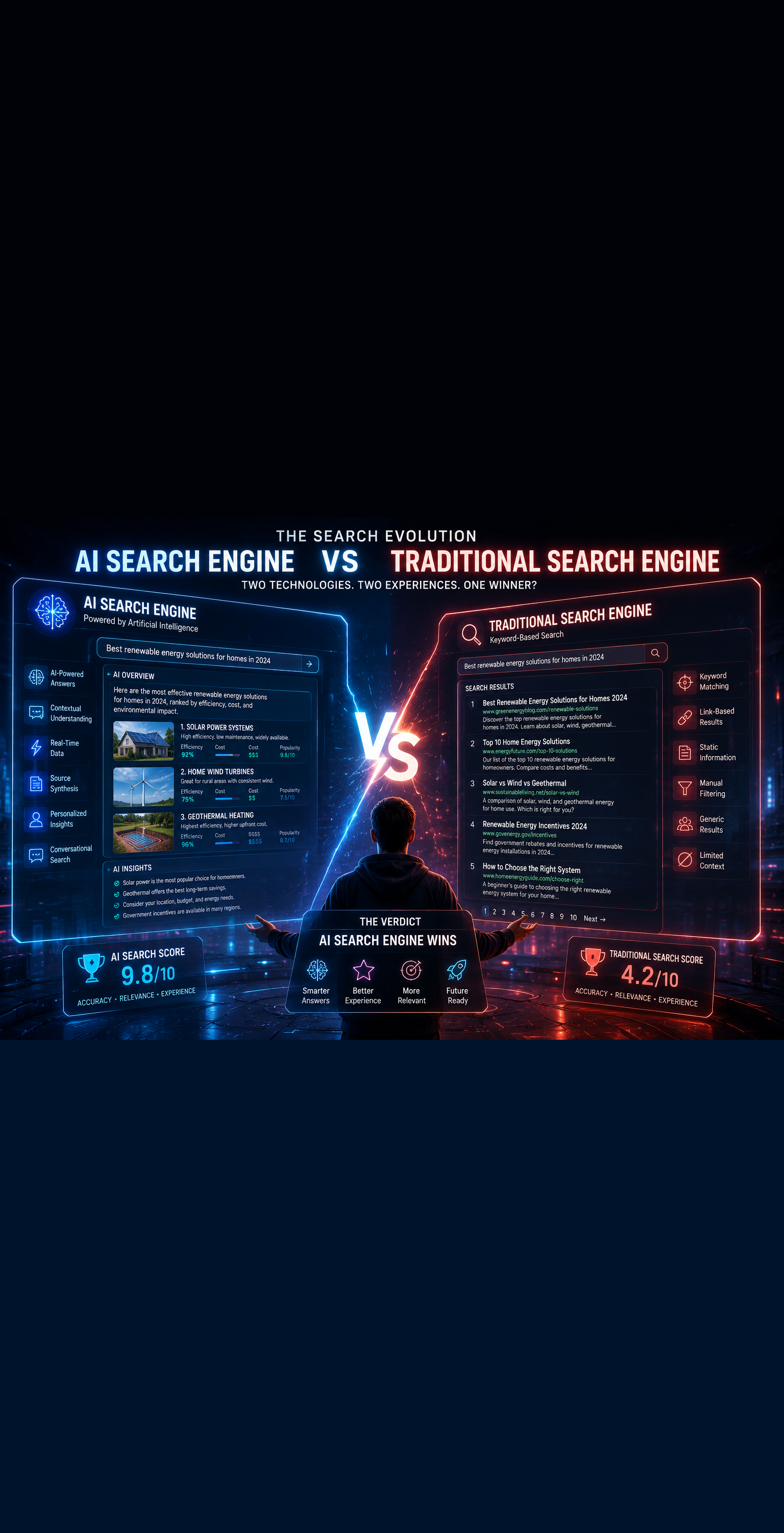
The way people search for information is changing faster than at any point since Google became a verb. For over two decades, Google Search has been the undisputed gateway to the internet. But Perplexity AI has arrived with a fundamentally different approach to answering questions, and the comparison between the two reveals something important about where search is heading.
This is not just a feature comparison. It is a look at two different philosophies about what search should actually do for the person asking the question. Understanding the difference between Perplexity vs Google Search will help you decide which tool deserves more of your time, and what the future of information discovery actually looks like.
How Google Search Works Today
Google Search has spent over two decades building the most sophisticated link index ever created. Its core function is matching search queries to the most relevant web pages and presenting them in ranked order.
In recent years Google has added AI-powered features including featured snippets, knowledge panels, and most recently AI Overviews, which generate a summarized answer at the top of the results page before the traditional blue links appear.
Google still processes over 8.5 billion searches per day. Its index is unmatched in size, its local search capabilities are unrivaled, and its integration with Maps, Shopping, Images, and News gives it a breadth that no competitor has fully replicated.
But the traditional search experience has also accumulated significant friction. Ads occupy the top positions on commercial queries. SEO-optimized content farms compete aggressively for rankings. Finding a genuinely useful, direct answer to a complex question often requires opening multiple tabs, reading past promotional content, and synthesizing information yourself.
That friction is exactly the gap Perplexity is targeting.
How Perplexity AI Works
Perplexity AI is built on a different premise entirely. Instead of returning a list of links and letting you find the answer yourself, Perplexity reads the sources for you, synthesizes the information, and delivers a direct, cited answer in conversational language.
Type a question into Perplexity and you get a structured response with inline citations showing exactly which sources each claim came from. Below the answer you will find the source links if you want to read further, along with suggested follow-up questions that help you go deeper on the topic.
Perplexity uses a combination of large language models and real-time web search to generate answers that are both current and traceable. Unlike asking a question to a standard AI chatbot, you can verify every claim Perplexity makes because the sources are right there alongside the answer.
The experience feels less like searching and more like asking a well-read research assistant who has already read everything and is ready to explain it clearly.
Perplexity vs Google Search: A Direct Comparison
Speed of Getting a Useful Answer
This is where the difference is most immediately noticeable.
With Google, getting a useful answer to a complex question typically involves clicking through to two or three pages, scanning past ads and navigation menus, and reading enough of each article to extract the relevant information. For simple factual queries, Google's featured snippets work well. For anything nuanced, the process takes time.
With Perplexity, the answer to a complex question arrives in seconds as a synthesized, readable response. You do not need to open any links unless you want to verify a specific claim or explore a source in depth.
For research-heavy users, professionals, and content creators who spend significant time gathering information, this speed difference is not trivial. It compounds across dozens of searches per day into a meaningful productivity advantage.
Winner: Perplexity for complex research queries. Google for quick navigational searches where you already know where you want to go.
Source Quality and Transparency
Google's ranking algorithm is designed to surface high-quality, authoritative sources. In practice, however, commercial intent has a significant influence on what appears at the top of many search results. High-budget SEO campaigns and advertising spend can push lower-quality content above genuinely more useful pages.
Perplexity cites its sources inline with every claim, which creates a transparency that Google's results do not offer. You can see exactly where each piece of information came from and make your own judgment about the credibility of that source.
The limitation is that Perplexity's source selection is not always perfect. It occasionally draws from sources that are not the most authoritative available on a given topic, and the synthesis process can sometimes smooth over important nuances that a careful reading of the original source would reveal.
Winner: Draw. Google has a deeper index and generally strong authority signals. Perplexity offers greater transparency through inline citations. Neither is infallible.
Handling Complex and Multi-Part Questions
This is Perplexity's strongest competitive advantage.
Google is built for keyword matching. Ask it a complex, multi-part question and it either returns results for the most prominent keyword cluster in your query or attempts an AI Overview that sometimes misses the nuance of what you actually asked.
Perplexity is built for natural language understanding. You can ask it layered, conversational questions and follow up with additional context the way you would with a human expert. The conversation thread builds context over multiple exchanges, allowing you to drill down into a topic progressively.
For researchers, analysts, students, and professionals who regularly need to understand complex topics quickly, this conversational depth is a genuine capability advantage.
Winner: Perplexity by a significant margin for complex, multi-part questions.
Local Search and Practical Daily Use
Google Search remains dominant for the types of searches that make up the majority of everyday use. Finding a nearby restaurant, checking business hours, comparing product prices, reading local news, booking a service, or navigating to a location are all areas where Google's deep integrations give it an insurmountable practical advantage.
Google Maps, Google Shopping, Google Flights, and the broader ecosystem of integrated services make it the most useful tool for action-oriented searches where you need to do something, not just learn something.
Perplexity is not designed for these use cases and does not attempt to replicate them.
Winner: Google for local, commercial, and action-oriented searches without question.
Advertising and User Experience
Google's business model is built on advertising revenue. On commercial search queries, the first several results are often paid placements. Even outside of explicit ads, the SEO industry has shaped a significant portion of the top-ranking content around what ranks rather than what is most genuinely useful.
Perplexity Pro is a subscription model. The platform does not insert advertising into its answers, which means the responses you receive are not influenced by which companies have paid for visibility.
This distinction matters more than it might initially seem. When you use Google to research a product category, compare services, or evaluate options, the results you see have been shaped by marketing budgets. Perplexity's answers are shaped by source quality and relevance instead.
Winner: Perplexity for unbiased information retrieval. The subscription model aligns incentives with the user rather than with advertisers.
Real-Time Information and Current Events
Google has indexed the web for decades and its crawling infrastructure updates continuously. For breaking news, live sports scores, stock prices, and real-time event tracking, Google's freshness and breadth remain unmatched.
Perplexity also searches the web in real time and handles current events reasonably well. Its Pro Search mode specifically prioritizes recent sources. But for genuinely time-sensitive queries where information changes by the minute, Google's infrastructure and news integration deliver more comprehensive real-time coverage.
Winner: Google for real-time and breaking news queries.
Privacy
Google collects extensive data on search behavior, location, browsing history, and user identity across its ecosystem. That data powers the personalization and advertising systems that fund its operations.
Perplexity collects less data by comparison and offers a more privacy-conscious search experience, though it is not entirely anonymous. Users who prioritize data privacy will find Perplexity the more comfortable option of the two.
Winner: Perplexity for users who prioritize search privacy.
Who Should Use Perplexity
Perplexity is the better primary search tool for people who spend significant time on research-intensive tasks.
- Content creators and bloggers who need to gather and verify information quickly across multiple topics
- Business owners and entrepreneurs making decisions that require understanding complex markets, regulations, or competitive landscapes
- Students and academics conducting literature reviews or background research
- Professionals in law, finance, medicine, and consulting who regularly need synthesized answers with traceable sources
- Anyone tired of sifting through SEO-optimized content to find a genuinely useful answer
If your daily searches involve learning, research, analysis, or understanding complex topics, Perplexity will save you meaningful time and deliver better results than Google for those specific use cases.
Who Should Keep Google as Their Primary Search Tool
Google remains the superior choice for a specific and very common set of needs.
- Finding local businesses, restaurants, and services
- Shopping, price comparison, and product research
- Navigation and maps
- Breaking news and real-time information
- Navigational searches where you already know the destination
- Image and video search
- Any query where taking immediate action is the goal
For most people, the practical answer is to use both tools for different purposes rather than choosing one exclusively.
The Bigger Picture: What This Shift Means
The rise of Perplexity and AI-powered search represents a fundamental shift in what users expect from a search experience. The traditional model of returning ten blue links and letting the user do the synthesis was built for a world where that was the best technology available.
That is no longer the case. Users increasingly expect direct answers, not directories of links. They want synthesis, not indexing. They want conversation, not keyword matching.
Google recognizes this shift, which is why AI Overviews exist and why the company has invested heavily in Gemini integration across its search products. The question is whether a company whose revenue depends on users clicking through to ad-supported pages can fully commit to a model where the answer is the destination.
Perplexity has no such conflict. Its incentive is to give you the best answer as directly as possible. That alignment between user need and business model is a structural advantage that will continue to drive adoption among users who discover it.
The Future of Search Is Conversational
The trajectory is clear. Search is moving from keyword-based link retrieval toward conversational, AI-synthesized answers with traceable sources. Perplexity is leading that transition today. Google is following as fast as its business model allows.
For users, the practical takeaway is straightforward. Add Perplexity to your daily toolkit for research and complex queries. Keep Google for local, commercial, and action-oriented searches where its ecosystem delivers genuine value.
The future of search is not one tool replacing another. It is a smarter, more intentional use of the right tool for the right type of question. The people who adapt that habit now will spend less time searching and more time knowing.
Want more insights like this? Subscribe to the AI Success Forum newsletter.